
Generative AI is a type of Artificial intelligence that creates new content. It can generate text, images, audio, video, and code. It uses learned patterns to produce useful results from your instructions.
Imagine creating an article or image with just one simple prompt. That’s the power of Generative AI. It can turn your ideas into content within seconds and save you valuable time.
Generative AI is now used in many industries and everyday tasks. Businesses use it for content, coding, research, and customer support. Its capabilities continue to grow as AI models become more advanced.
What Is Generative AI?
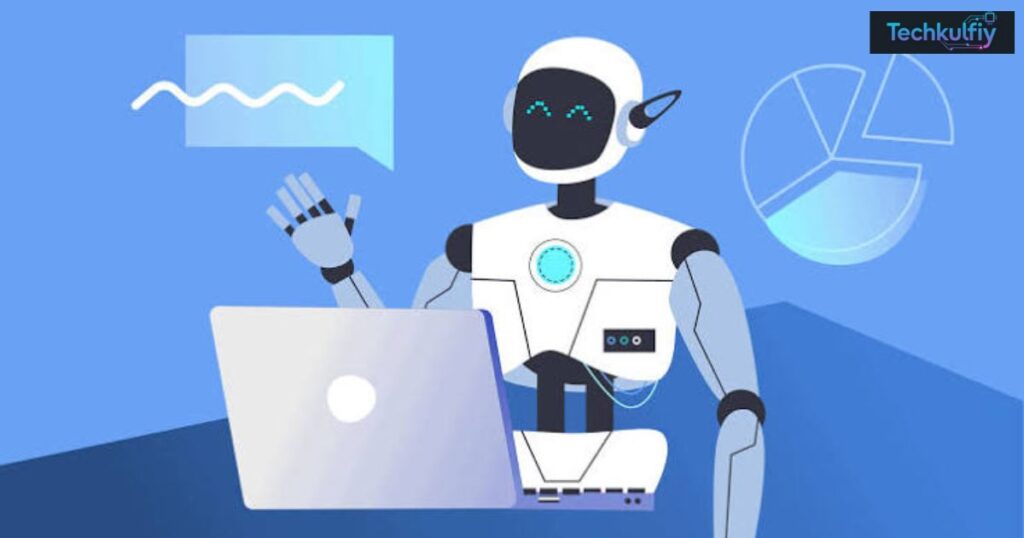
Generative AI is artificial intelligence that can create new content based on user prompts, instructions, or other inputs. That content can include writing, images, audio, video, music, software code, and structured information.
A simple way to understand it is to imagine a highly advanced digital assistant that has learned from enormous amounts of information. When you give it a request, the system uses what it learned to produce a new response. It does not simply retrieve one stored answer and paste it into your screen. Instead, the underlying model generates an output based on learned statistical patterns.
For example, you could enter a request such as, “Write a friendly email explaining a delayed delivery to a customer.” A language-based generative model can interpret that natural language requests and produce an appropriate email. Similarly, you could ask an image model to create a picture of a futuristic American city at sunset.
This process depends heavily on training data. During training, a model processes huge collections of information and learns relationships between different elements. Depending on the system, that information can include text, images, audio, video, code, or combinations of these formats.
Modern generative systems are often built using Foundation models. A foundation model is trained on broad datasets and can later be adapted for different tasks. Large language models are one important category of foundation model. They are particularly powerful for language-related tasks such as writing, summarization, translation, question answering, and Text generation.
Generative AI also relies on Natural language processing and Natural language understanding when working with language. These technologies help AI systems process human language, identify context, and respond to instructions.
The word “generative” matters because the system produces something new. You might ask it to create original content, transform existing information, or generate new content based on your requirements.
However, “new” does not mean the system thinks exactly like a human. Generative AI does not possess human consciousness. Its output comes from learned representations, probabilities, algorithms, and model architecture.
That distinction is important. A fluent answer can sound authoritative while still containing an error. You should therefore treat generative AI as a powerful tool rather than an infallible source of truth.
How Does Generative AI Work?
Generative AI works through a combination of data, algorithms, model architecture, computing power, training, and inference. Although the technical details can become extremely complex, the basic concept is easier to understand.
Imagine teaching a computer how language works by exposing it to an enormous library of text. The system analyzes relationships between words, phrases, sentences, concepts, and contexts. Over time, it develops an internal mathematical representation of those relationships.
The model does not need to memorize every sentence as a human would memorize a book. Instead, it learns statistical structures that help it predict what information should come next or what content best fits a particular request.
A typical generative AI development process involves training first. During training, the model processes large datasets. These datasets can contain structured information, unstructured data, images, documents, conversations, code, audio, and other material. Much of the information used in machine learning can also be unlabeled data, meaning humans have not manually assigned a category to every individual item.
The model gradually adjusts its internal parameters as it learns. With modern Neural networks, billions or even more parameters can influence how the system responds to an input.
After initial training, developers may perform Fine-tuning. Fine-tuning adapts a general-purpose model to a narrower purpose. For example, a broad language model could be adapted for customer support, programming, legal document analysis, or another specialized environment.
Some systems also use Reinforcement learning techniques to improve behavior. RLHF, or reinforcement learning from human feedback, is one approach that uses human preferences to help make model responses more useful, relevant, and aligned with desired behavior.
The final stage is generation. You provide a prompt, and the model processes that input before producing a generated output. The process can happen remarkably quickly because modern AI infrastructure is designed to perform enormous numbers of mathematical operations.
Prompt quality also matters. Prompt engineering refers to designing instructions that help an AI system understand what you want. A vague request may produce a generic response, while a detailed request can provide stronger context, constraints, examples, and desired formatting.
Consider the difference between these two requests.
| Basic prompt | More useful prompt |
|---|---|
| Write about laptops. | Write a 1,500-word beginner-friendly guide comparing business laptops for U.S. college students. |
| Create an image of a house. | Create a realistic image of a modern two-story American suburban home during golden hour. |
| Explain marketing. | Explain digital marketing to a small-business owner using simple examples. |
Better prompts do not magically make an AI system correct. They simply give the model clearer information about the desired task.
Types of Generative AI Models
Generative AI is not one single technology. Different Generative models use different architectures and mathematical techniques to produce content.
Some models specialize in language, some are highly effective for visual generation, and others work across multiple formats. Understanding the major model types helps explain why different AI applications behave differently.
Generative Adversarial Networks and GANs
Generative adversarial networks are commonly known as GANs. They use two competing neural networks called a generator and a discriminator.
The generator attempts to create realistic content. The discriminator evaluates whether that content looks real or generated. Through repeated training, the generator becomes better at producing realistic outputs.
GANs became especially important for realistic image generation and synthetic media. They can also support data augmentation and other applications where realistic artificial examples are useful.
One interesting feature of GANs is the competition between their two components. You can think of the generator as a skilled counterfeiter and the discriminator as an increasingly experienced detective. Each side improves because the other side becomes harder to fool.
Variational Autoencoders and VAEs
Variational autoencoders, or VAEs, use an encoder and decoder structure. The encoder compresses information into a compact representation, while the decoder uses that representation to reconstruct or generate new content.
VAEs are useful for understanding the underlying structure of data. They can generate variations of existing patterns and have applications in areas such as image processing, anomaly detection, and synthetic data generation.
Their approach differs from GANs because VAEs focus on learning a structured latent representation of information rather than creating a competitive generator-discriminator process.
Transformer Models
Transformer models changed the development of modern AI. They use an attention mechanism that allows a model to consider relationships between different parts of an input.
This architecture became particularly important for language models. Instead of treating every word as an isolated object, transformers can analyze relationships across a sequence.
That ability helps systems handle context, making them useful for Natural language processing, translation, summarization, question answering, and AI code generation.
Many modern Large language models rely on transformer-based architectures or related techniques. Their influence extends beyond text because transformer principles can also be applied to images, audio, video, and multimodal systems.
Diffusion Models
Diffusion models became especially important for modern Image generation. During training, these models learn how information changes as noise is gradually added. They then learn how to reverse that process and create meaningful content from noise.
You can imagine starting with a clear photograph and gradually covering it with static. The model learns how to perform the opposite process: beginning with noise and progressively producing an organized image.
Modern diffusion techniques can generate highly detailed visuals from text instructions. They also support image editing, variations, and other creative workflows.
Multimodal AI Models
Multimodal AI combines different forms of information. Instead of working only with text, a multimodal system may understand and generate combinations of text, images, audio, video, and other data.
This is an important direction for generative AI because real-world communication is naturally multimodal. People do not communicate exclusively through written sentences. We use photographs, speech, diagrams, video, documents, and visual context.
What Can Generative AI Create?
Generative AI can produce an increasingly wide range of digital content. Its capabilities depend on the model, training process, available tools, and the complexity of the task.
Text Generation and AI-Written Content
Text generation is one of the most visible applications of generative AI. Language models can produce emails, reports, summaries, product descriptions, articles, scripts, explanations, study materials, and many other forms of writing.
AI-generated text can also help transform information. For example, you can provide a long technical document and ask the system to explain its main ideas in simple English.
This makes generative AI useful for people who need to process large amounts of information quickly. However, important facts should still be verified because generated text can contain incorrect statements.
Image Generation
Image generation allows users to create visual content from written instructions. A prompt can describe a person, object, environment, artistic style, lighting condition, or composition.
Businesses can use generated visuals for prototypes, advertising concepts, presentations, social media campaigns, and creative exploration.
The technology is particularly useful during early-stage ideation. Instead of spending hours creating a rough concept manually, you can generate several visual directions and decide which idea deserves further development.
Video Generation
Video generation extends similar concepts into moving images. Modern systems can produce AI-generated videos from prompts or transform existing visual material.
Potential uses include advertising concepts, educational content, product demonstrations, entertainment, animation, and virtual presentations.
Video generation remains technically challenging because the system must maintain consistency across many frames. A character’s appearance, lighting, movement, and environment need to remain coherent throughout a sequence.
Audio and Music Generation
Generative AI can also produce Audio generation, speech, sound effects, and Music generation. These systems can create voices, background sounds, musical compositions, and other forms of generated audio.
This can help creators produce prototypes faster. It can also support accessibility tools, voice interfaces, entertainment, and educational applications.
AI Code Generation
Software development is another major area. AI code generation can produce software code from natural-language instructions.
A developer might describe a function and ask an AI system to generate a starting implementation. The system can also explain code, identify potential errors, create documentation, or suggest improvements.
AI does not eliminate the need for programming expertise. Developers still need to test generated code, understand security implications, review architecture, and verify that the implementation actually works.
Applications and Use Cases of Generative AI
The real value of generative AI appears when it solves a specific problem. Creating impressive content is interesting, but businesses gain more value when AI reduces repetitive work, improves customer experiences, or helps employees make better decisions.
Generative AI in Business and Marketing
Companies can use AI content generation for marketing campaigns, email drafts, product descriptions, social media concepts, market research summaries, and customer communications.
For example, an American online retailer could use generative AI to create initial descriptions for thousands of products. Human editors could then review the content, correct important details, and ensure the writing matches the company’s brand.
This approach combines automated content creation with human judgment instead of treating AI as a completely autonomous writer.
Generative AI in Software Development
Software teams can use generative systems for coding assistance, documentation, debugging, testing, and code explanation.
A developer working on a large application might ask an AI system to explain an unfamiliar function before modifying it. Another developer might use AI to create test cases for a new feature.
The greatest advantage often comes from reducing repetitive tasks. Developers can spend less time on mechanical work and more time thinking about architecture, security, user experience, and business requirements.
Generative AI in Healthcare
Healthcare organizations can explore generative AI for administrative tasks, documentation, research assistance, patient communication, and information summarization.
However, healthcare is a high-stakes environment. AI-generated information should not automatically replace professional judgment. Medical decisions require appropriate clinical expertise, validation, privacy protections, and regulatory consideration.
Generative AI in Education
Students and teachers can use generative AI to explain difficult subjects, create practice questions, summarize material, and adapt explanations to different learning levels.
The challenge is academic integrity. If students use AI to complete assignments without understanding the material, the technology can undermine learning.
Used responsibly, however, generative AI can act more like a personal study assistant. It can explain a difficult concept three different ways until one finally makes sense.
Generative AI in Finance
Financial institutions can use generative systems for document analysis, customer service, research assistance, internal knowledge retrieval, and communication.
Because financial information can be sensitive, organizations must carefully control data access. AI systems should not receive confidential information without appropriate security and governance.
Generative AI in Customer Service
AI assistants can answer common questions, summarize customer conversations, draft responses, and help service representatives find information.
A useful system does not necessarily try to answer every question independently. Instead, it can recognize when a human representative should take over.
Generative AI in Creative Industries
Designers, writers, filmmakers, musicians, advertisers, and other creators can use AI to explore ideas quickly.
The strongest creative workflow often involves collaboration. Humans provide direction, taste, context, and judgment. AI helps generate possibilities.
Benefits of Generative AI
Generative AI offers several important benefits when organizations use it carefully.
One major advantage is speed. Tasks that previously required substantial manual effort can often begin with a single prompt. A marketing team can generate several campaign concepts before lunch. A developer can create a rough code implementation within minutes. A researcher can summarize a long document before deciding whether to study it in detail.
Another benefit is productivity. Generative AI can handle repetitive tasks while people focus on work that requires judgment, creativity, communication, and specialized knowledge.
The technology can also support personalization. Businesses can use AI to create personalized content for different customers, markets, or situations. Instead of sending exactly the same message to everyone, companies can adapt content to different audiences.
Generative AI can also support decision-making by summarizing information and helping people explore possible options. It should not automatically make high-stakes decisions without appropriate controls, but it can help people understand complex information more efficiently.
| Benefit | How Generative AI Helps |
|---|---|
| Productivity | Automates repetitive content and information tasks |
| Creativity | Generates ideas, drafts, concepts, and variations |
| Personalization | Produces content for different users and audiences |
| Speed | Creates first drafts and prototypes quickly |
| Accessibility | Simplifies complex information and supports natural interaction |
| Software development | Assists with coding, documentation, and testing |
| Customer service | Handles routine questions and summarizes conversations |
A particularly valuable benefit is experimentation. Before generative AI, testing ten creative concepts could require significant time and resources. Now, teams can explore many ideas quickly and invest human effort into the strongest ones.
Generative AI vs Traditional AI
Generative AI and traditional AI both belong to the broader field of artificial intelligence, but they often solve different problems.
Traditional AI frequently focuses on classification, prediction, detection, recommendation, or decision support. For example, a fraud detection system may determine whether a transaction appears suspicious.
Generative AI focuses on producing new content. A generative system might write an explanation of why a transaction appears unusual, create a report, or summarize relevant information.
The difference becomes clearer when you compare their typical outputs.
| Feature | Traditional AI | Generative AI |
|---|---|---|
| Main purpose | Predict, classify, detect, or recommend | Create new content |
| Common output | Score, category, prediction, decision support | Text, image, audio, video, or code |
| Typical interaction | Structured inputs | Prompts and natural language |
| Example | Fraud detection | Generated financial summary |
| Creativity | Usually limited | Designed for content creation |
| Main strength | Analysis and prediction | Content generation and transformation |
The two approaches are not competitors in every situation. In many real-world systems, they work together.
A company could use traditional machine learning to detect unusual customer behavior and generative AI to produce a plain-language explanation for an employee.
This distinction is useful because generative AI is not automatically the best solution. If you need to predict whether a customer will cancel a subscription, a specialized predictive model may be more appropriate than a general-purpose language model.
Generative AI, LLMs, RAG and AI Agents
The terms generative AI, LLMs, RAG, and AI agents are often used together, but they describe different concepts.
Large language models are a type of AI model designed primarily to work with language. They can generate text, summarize information, translate content, answer questions, and assist with programming.
An LLM can therefore be generative AI, but generative AI is broader than LLMs. Image, video, music, and multimodal systems can also be generative AI without being traditional language models.
Generative AI and Large Language Models
LLMs learn statistical relationships in language and use those relationships to process and generate text.
Their capabilities come from large-scale training, model architecture, context handling, and subsequent tuning. Modern LLMs can support writing, reasoning assistance, coding, summarization, research, and conversational interfaces.
Still, an LLM’s fluency should not be confused with guaranteed factual accuracy.
What Is Retrieval Augmented Generation?
Retrieval augmented generation is commonly shortened to RAG. It combines information retrieval with generative AI.
Instead of asking a model to rely only on what it learned during training, a RAG system can retrieve relevant information from an external knowledge source and provide that information to the model before generation.
Imagine a company has thousands of internal documents. An employee asks a question about a company policy. A RAG system can search the organization’s approved documents, retrieve relevant passages, and then use a generative model to produce a readable answer.
This can make AI systems more useful for company-specific knowledge because the model has access to information outside its original training process.
What Are AI Agents?
AI agents are systems designed to perform tasks using models, tools, instructions, and sometimes multiple steps.
A chatbot may answer your question. An agentic system can potentially interpret a goal, decide what actions are required, use available tools, and continue through a workflow.
For example, a business agent could receive a request to prepare a sales report, retrieve information from approved systems, analyze the data, create a summary, and present the result.
Agentic AI and Generative AI
Agentic AI builds on generative models but focuses more strongly on action and task execution.
Generative AI can produce the language used to communicate or reason through a task. An agent can connect that capability to external tools and workflows.
The distinction matters because an AI that generates an answer and an AI that takes action on your behalf carry different risks. The second system requires stronger controls around permissions, authentication, privacy, and error handling.
Challenges, Risks and Limitations of Generative AI
Generative AI is powerful, but it has serious limitations. Understanding these weaknesses is just as important as understanding its benefits.
AI Hallucinations and Inaccurate Information
One of the most widely discussed problems is hallucination. A generative model can produce an answer that sounds convincing but contains incorrect information.
This happens because language models are designed to generate probable sequences of content. They are not automatically connected to an absolute database of truth.
For important information, you should verify facts using reliable sources. This matters especially in healthcare, finance, law, cybersecurity, academic research, and other high-stakes fields.
Bias in AI-Generated Content
AI models can reproduce or amplify biases found in their training data. If the underlying information contains social, cultural, or historical biases, those patterns may influence generated outputs.
Developers therefore need testing, evaluation, diverse datasets, monitoring, and responsible deployment practices.
Privacy and Data Security
Users should think carefully before entering sensitive information into an AI system.
Confidential business information, personal records, financial information, proprietary code, and other sensitive data may require special handling.
Organizations need clear policies that explain what information employees can provide to AI systems and which tools are approved.
Copyright and Intellectual Property
Generative AI has also created complicated questions about copyright, ownership, training data, and intellectual property.
The legal environment continues to evolve, particularly in the United States. Businesses and creators should understand the rules that apply to their specific use case instead of assuming that every AI-generated output is automatically free from legal concerns.
Deepfakes and Misinformation
Generative technology can produce highly realistic AI-generated images, voices, and AI-generated videos.
This can be useful for entertainment and creative production, but it can also make misinformation easier to create. Fake audio or video can potentially imitate people, alter events, or create misleading narratives.
The ability to generate realistic content makes digital verification increasingly important.
Cybersecurity and Malicious Use
Generative AI can be used for legitimate cybersecurity work, but the same capabilities can also be abused.
Attackers may use AI to create convincing phishing messages, automate social engineering content, or generate malicious material. Security teams therefore need to consider both the defensive and offensive possibilities of generative systems.
Job Displacement and Workforce Changes
Generative AI may automate some tasks that people currently perform. Writing, customer support, basic coding, data processing, design assistance, and administrative work may all change.
However, automation does not necessarily mean every occupation disappears. In many cases, the technology changes the tasks within a job.
The more useful question is often not, “Will AI replace this job?” but, “Which parts of this job can AI perform, and which parts still require human expertise?”
Cost, Energy and Infrastructure
Large AI models require significant computing resources. Training and serving advanced models can require powerful processors, large data centers, storage, cooling systems, and substantial electricity.
As generative AI expands, efficiency will become increasingly important. Smaller models, optimized hardware, better algorithms, and more efficient infrastructure can help reduce the cost of AI deployment.
Lack of Explainability
Some complex AI models are difficult to interpret. You may know what a system produced without being able to explain every internal calculation that led to the result.
This creates challenges in regulated and high-stakes environments. Organizations need evaluation procedures, human oversight, documentation, and appropriate risk controls.
The U.S. National Institute of Standards and Technology has developed an AI Risk Management Framework and a generative AI profile to help organizations think systematically about AI risks and trustworthy deployment.
History and Future of Generative AI
Generative AI may feel new, but the underlying ideas have developed for decades.
Early artificial intelligence research explored ways for computers to represent knowledge, recognize patterns, and produce information. As computing power and datasets expanded, researchers developed increasingly sophisticated Generative models.
Variational autoencoders emerged as an important generative technique in the early 2010s. Generative adversarial networks followed in 2014 and became especially influential in realistic image generation. Diffusion models also became an important approach for high-quality visual generation.
Then came transformer architecture. The 2017 research paper “Attention Is All You Need” introduced the transformer architecture that became foundational to modern language models.
The development of large-scale transformer models eventually enabled powerful language systems capable of generating long, context-sensitive responses. The public launch of ChatGPT in 2022 dramatically increased mainstream awareness of generative AI.
Since then, generative AI has expanded beyond chatbots. Systems can now work with multiple forms of information, leading to rapid development in Multimodal AI, AI coding assistants, image generation, video generation, voice interfaces, and AI agents.
The next stage is likely to focus less on simple content generation and more on useful task completion.
| Development | Likely Direction |
|---|---|
| Language models | More capable and specialized |
| Multimodal AI | Better understanding across text, image, audio, and video |
| AI agents | More complex task automation |
| RAG | Better access to current and private information |
| On-device AI | More AI processing directly on phones and computers |
| Enterprise AI | Greater integration with business workflows |
| AI safety | Stronger evaluation, governance, and monitoring |
| Smaller models | More efficient AI with lower computing requirements |
The future of generative AI will also depend on trust. People will expect AI systems to become more accurate, transparent, secure, and reliable.
Businesses will need to decide where AI genuinely creates value rather than adopting it simply because everyone else is doing so. A flashy AI feature may attract attention, but a quiet system that saves employees ten hours every week can create much more practical value.
For individuals, the most useful skill may become knowing how to work effectively with AI. Understanding prompts, verifying information, protecting private data, reviewing generated content, and combining AI with human judgment will matter.
Generative AI is therefore best understood as a new layer of computing rather than merely another software feature. It can transform how people create, search, communicate, analyze information, and build products.
The technology will continue evolving. Models will become more capable, interfaces will become more natural, and AI agents will increasingly connect generative models with real-world tools.
But human judgment will remain essential.
The strongest use of generative AI is not replacing human thinking. It is giving human thinking a faster, more capable partner.
Frequently Asked Questions About Generative AI
What is generative AI in simple terms?
Generative AI is a type of artificial intelligence that creates new content from instructions or other inputs. It can produce writing, images, audio, video, music, and code.
How does generative AI work?
Generative AI learns patterns from large amounts of training data. When you provide a prompt, the trained model uses those learned patterns to produce an output that fits the request.
What are examples of generative AI?
Common examples include AI writing assistants, image generators, coding assistants, voice generators, video creation systems, and conversational AI applications.
What is the difference between AI and generative AI?
Artificial intelligence is the broader field. Generative AI is a category within AI focused on creating new content rather than only analyzing, classifying, or predicting information.
What can generative AI create?
Generative AI can create text, images, video, audio, music, software code, summaries, designs, synthetic data, and other digital content.
Is ChatGPT generative AI?
Yes. ChatGPT is an example of a generative AI application that can generate text and perform a wide range of language-based tasks.
What are the main types of generative AI models?
Major approaches include transformer models, diffusion models, GANs, VAEs, and other autoregressive and generative architectures.
What are the biggest risks of generative AI?
Important risks include inaccurate information, bias, privacy problems, cybersecurity threats, misinformation, deepfakes, copyright concerns, and potential workforce disruption.
Will generative AI replace jobs?
Generative AI is likely to automate some tasks and change many jobs. However, the effect will vary by occupation, industry, and how organizations integrate the technology.
What is the future of generative AI?
The future is likely to include more capable multimodal systems, specialized models, AI agents, RAG-powered applications, on-device AI, enterprise automation, and stronger AI safety practices.
FAQs
Is ChatGPT a generative AI?
Yes. ChatGPT is a generative AI tool that creates text, answers questions, summarizes information, and helps with many tasks.
What is Generative AI?
Generative AI is a type of artificial intelligence that creates new content such as text, images, videos, audio, and code.
What are the top 5 generative AI tools?
Popular generative AI tools include ChatGPT, Google Gemini, Claude, Microsoft Copilot, and Midjourney.
How is Gen Z using AI?
Gen Z uses AI for studying, content creation, brainstorming, coding, research, and everyday productivity.
Which AI is 100% free?
Several AI tools offer free plans, but they may have usage limits. ChatGPT, Gemini, and Microsoft Copilot are examples with free access.
Meta Description
Learn what Generative AI is, how it works, its uses, benefits, models, risks, and future in this complete beginner-friendly guide.
