
Vultr Agentic AI Platform Updates are drawing attention as businesses explore AI agents that can perform tasks, use tools, and manage complex workflows. Unlike traditional chatbots, agentic AI systems can work through multiple steps to achieve a goal, making reliable cloud infrastructure increasingly important.
For US businesses, running AI agents requires more than powerful models. Companies also need secure execution environments, flexible computing resources, user access controls, and reliable ways to monitor automated activity. Vultr is expanding its cloud infrastructure and management capabilities to support these enterprise AI requirements.
This guide explains the latest Vultr Agentic AI Platform Updates, including infrastructure improvements, AI agent security, CPU and GPU clusters, open-source integrations, and practical business applications. It also covers important limitations and what companies should consider before adopting agentic AI.
What Are Vultr Agentic AI Platform Updates?

Vultr Agentic AI Platform Updates refer to improvements across Vultr’s cloud infrastructure and AI-related services that help businesses build, deploy, and operate agentic AI applications. These improvements focus on computing resources, security, identity management, workload provisioning, and connections between AI agents and the systems they use.
Traditional AI applications usually respond to a question, generate content, or perform a narrowly defined operation. Agentic AI systems can take a broader approach. They may break a task into smaller steps, retrieve information, call tools, interact with software, and evaluate results before continuing.
For example, a business AI agent might review a support request, retrieve information from a knowledge base, prepare a response, and send the result to a human employee for approval. Every step depends on software, data, computing resources, and appropriate permissions.
Vultr is developing infrastructure to support these workloads through services such as Vultr Cloud Compute, Vultr Cloud GPU, Vultr Kubernetes Engine, and other cloud management capabilities.
In October 2026, Vultr announced several platform enhancements intended to improve enterprise AI infrastructure, including changes related to application access, audit logging, cluster provisioning, and agent execution environments. Vultr also announced its participation as a Gold member of the Agentic AI Foundation, supporting open and interoperable technologies for agentic systems.
These Vultr Agentic AI Platform Updates reflect an important change in how businesses think about AI. Instead of focusing only on model performance, organizations increasingly need infrastructure that can run AI agents securely and efficiently in real-world environments.
Why Agentic AI Needs Better Cloud Infrastructure
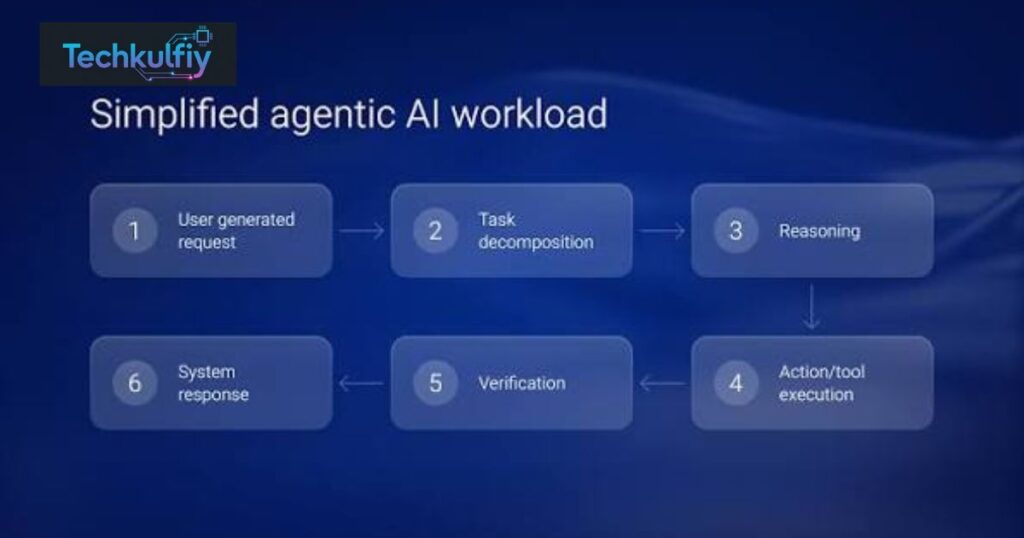
Agentic AI introduces requirements that go beyond generating text or processing a single request. An agent may need to reason through a task, access company information, call an external API, execute code, and communicate with another service.
Each action creates an infrastructure requirement.
A language model may need GPU resources for inference. The application surrounding it may require CPU capacity for orchestration, databases for information storage, networking for communication, and monitoring tools for tracking performance.
This is why agentic AI infrastructure often combines different types of computing resources instead of relying exclusively on GPUs.
Consider an AI development assistant. It might analyze a coding request using a language model, create a temporary environment for testing, execute commands, inspect the output, and revise its solution. The model handles reasoning, but the surrounding infrastructure supports execution, isolation, storage, and communication.
The Vultr Agentic AI Platform Updates aim to address several parts of this broader infrastructure challenge.
For enterprises, the goal is to move beyond experimental demonstrations and build systems that can operate under normal business conditions. That means controlling costs, handling failures, protecting sensitive data, and maintaining reliable access to computing resources.
A well-designed platform can help teams manage these requirements, but it cannot guarantee that an AI agent will always make the correct decision. Application design, model behavior, permissions, and human oversight remain essential.
New Enterprise Security and Identity Management Features
Security is a major concern when AI agents can access company systems or perform actions automatically. A traditional chatbot may only return text, while an agent could potentially retrieve confidential records, modify files, or interact with business services.
The Vultr Agentic AI Platform Updates announced in October 2026 include improvements to identity and access management.
One important addition is support for OAuth-based authentication for third-party applications. OAuth uses authorization mechanisms that can reduce the need to distribute long-lived credentials directly to applications. Administrators can manage registered applications and control their access through permission policies.
Vultr also announced support for SCIM, which helps organizations manage user identities through their enterprise identity provider. This can simplify user provisioning and access management when employees join, change roles, or leave an organization.
Another addition is Vultr Audit Logs, which provide visibility into user and agent activity. These logs can help administrators investigate account activity, API requests, resource changes, and security-related events.
For a company running multiple AI agents, this visibility can be valuable. If an agent interacts with infrastructure or an application unexpectedly, audit records may help investigators understand what happened and which account or integration was involved.
However, security features must be configured correctly. Organizations still need to apply least-privilege permissions, protect credentials, monitor suspicious activity, and establish procedures for responding to incidents.
The important lesson from these Vultr Agentic AI Platform Updates is that enterprise AI needs identity controls and accountability alongside computing power.
Vultr Clusters and Flexible Computing Resources
Agentic AI workloads can require different computing resources at different stages. A model may need GPU acceleration, while task planning, API calls, data processing, and sandbox execution may rely more heavily on CPUs.
Vultr Clusters provides self-service cluster infrastructure intended to help enterprises provision computing resources for their workloads. The company’s October 2026 announcements also described improvements to the cluster management experience.
A simpler provisioning process can help infrastructure teams adjust capacity when workloads change. Instead of waiting for a manual setup process, teams can use supported self-service workflows to create or modify infrastructure more efficiently.
The Vultr Agentic AI Platform Updates also highlight the importance of balancing performance and cost. AI infrastructure can become expensive when high-value resources remain idle while teams wait for configuration or deployment tasks to finish.
CPU and GPU resources serve different purposes. CPUs can handle orchestration, application logic, databases, and tool execution. GPUs can accelerate model inference and other parallel computing workloads.
A business might use GPU infrastructure to run a language model while deploying supporting services on CPU instances. Separating these roles can help the company allocate resources according to actual demand.
However, the best configuration depends on model size, request volume, concurrency, latency requirements, and the behavior of the application. Companies should benchmark their workloads rather than assuming that every agent requires a large GPU cluster.
Vultr VX1 and Secure AI Agent Execution
AI agents can become more powerful when they are allowed to execute code, use tools, and interact with software. Those capabilities also introduce risks.
An agent may generate an incorrect command, process untrusted input, or attempt an action that exceeds its intended purpose. If its execution environment has broad access to the host system, a mistake can become a security problem.
Vultr VX1 Cloud Compute is positioned as part of the company’s infrastructure approach for enterprise AI workloads. Vultr has highlighted its support for modern CPU-based computing and isolated execution environments for agentic applications.
One relevant capability is nested virtualization, which can support the creation of isolated microvirtual machines when configured with the appropriate software. These environments can be useful for running code or testing generated solutions with stronger separation from the host system.
For example, a coding agent could generate a script and execute it inside a temporary environment. The system can then inspect the output without granting the agent unrestricted access to the underlying infrastructure.
The Vultr Agentic AI Platform Updates involving agent execution are relevant because secure automation requires more than model-level safeguards. Runtime controls can help limit what an agent can access or affect.
Nevertheless, a sandbox is not a complete security solution by itself. Organizations should also restrict network access, manage credentials carefully, limit execution privileges, monitor resource consumption, and destroy temporary environments when they are no longer needed.
Teams should verify the exact virtualization options, configuration requirements, and isolation guarantees available for their selected Vultr instance type before designing a production deployment.
Cloud Storage and Faster Infrastructure Provisioning
Deploying AI workloads repeatedly can involve preparing operating system images, installing dependencies, configuring software, and validating the environment.
When an organization needs multiple similar instances, repeating these steps manually can slow down deployment and introduce inconsistencies.
Vultr has announced support for booting certain instances from block storage volumes. Its enterprise AI infrastructure updates also describe plans for faster volume cloning capabilities to support rapid instance creation and replication.
The practical benefit is straightforward: a team may be able to prepare a validated environment and reuse it when additional capacity is needed, subject to the supported service and feature availability.
For example, a company might maintain a tested base image for an AI agent’s execution environment. When demand increases, the company could provision additional instances from a prepared image rather than repeating the full setup process.
These Vultr Agentic AI Platform Updates can be relevant to organizations that need to scale workloads while maintaining consistency between environments.
However, cloning a storage volume does not automatically solve every deployment problem. Applications may still need unique credentials, network configuration, environment variables, software updates, and access policies.
Organizations should also consider data protection. A cloned volume may contain sensitive files or credentials if the base image has not been prepared carefully.
A good deployment process should separate reusable software configuration from sensitive information and should include validation before new instances receive production traffic.
Open-Source Technologies and Interoperable AI Agents
AI infrastructure is becoming more complex, with applications relying on different models, tools, databases, frameworks, and cloud services. Open standards can make it easier for these components to communicate.
In October 2026, Vultr announced that it had joined the Agentic AI Foundation as a Gold member. The foundation supports open-source technologies and standards intended to improve interoperability across the agentic AI ecosystem.
Technologies associated with this ecosystem include the Model Context Protocol, commonly known as MCP, and the Agent2Agent protocol, often called A2A. These projects address different aspects of communication between AI applications, tools, and agents.
MCP can provide a standardized way for compatible AI applications to connect to tools and data sources. A2A is intended to support communication and collaboration between agents.
These protocols do not automatically make every application compatible. Developers still need to implement the appropriate interfaces, configure authentication, and define the operations an agent is permitted to perform.
The Vultr Agentic AI Platform Updates related to open infrastructure matter because organizations may not want their entire AI architecture tied to a single provider or framework.
An open and composable approach can give developers more flexibility when selecting models, infrastructure, orchestration systems, and application frameworks.
For businesses, interoperability can also make future migration easier. However, portability still depends on the use of compatible services, data formats, networking, and deployment configurations.
Vultr MCP Server and Infrastructure Visibility
Another relevant development is the Vultr MCP Server, which was documented as being available in public preview in October 2026.
The server allows compatible MCP clients and AI assistants to access information about a Vultr infrastructure account through supported read-only tools. Users can ask questions about resources, running instances, spending information, or available cluster upgrades.
This can make infrastructure information easier to explore without manually navigating every page of a cloud management interface.
For example, an administrator might ask an AI assistant which instances are running in a particular region or whether a Kubernetes cluster has an upgrade available. The assistant can retrieve information through the supported interface and present it in a more accessible format.
The current documented MCP Server is read-only. It can inspect supported account resources but cannot create, modify, or delete infrastructure or initiate actions that spend money.
This distinction is important. Reading infrastructure information is different from granting an agent permission to make changes.
The Vultr Agentic AI Platform Updates around MCP reflect the growing interest in connecting AI assistants to operational systems. However, public preview functionality can change, and developers should review the current documentation before depending on it in production.
Organizations should also ensure that only authorized users and applications can access infrastructure information, particularly when the data reveals resource usage, system architecture, or operational costs.
Potential Business Applications of Vultr Agentic AI Infrastructure
The infrastructure improvements described in the Vultr Agentic AI Platform Updates may support several types of enterprise applications. The actual results depend on the workload, software design, and configuration.
AI-Powered Software Development
Development teams can use AI agents to review code, generate tests, investigate errors, and automate repetitive programming tasks.
These workflows may require model inference, CPU-based execution environments, repositories, testing tools, and secure sandboxes. Cloud infrastructure can help teams provide these resources without relying on a single developer’s computer.
Human review remains important before generated code is merged into production systems.
Customer Support Automation
An AI agent can retrieve approved support documentation, categorize requests, draft answers, and route complicated cases to human employees.
Reliable infrastructure helps keep the supporting services available as demand changes. Access controls are also important because support systems may contain customer information.
Organizations should measure resolution quality, escalation rates, response times, and customer satisfaction instead of assuming that automation automatically improves service.
Internal Knowledge Assistants
Businesses may build AI assistants that search company policies, technical documents, and approved internal resources.
Such systems can help employees find information more quickly, but they must respect existing document permissions. An agent should not gain access to confidential records simply because it can search them.
Infrastructure, identity controls, and monitoring should be designed around the sensitivity of the underlying data.
IT Operations and Cloud Management
AI assistants can help administrators understand infrastructure status, summarize alerts, and investigate configuration questions.
Read-only access can be a useful starting point because it allows the assistant to provide information without immediately changing production resources.
If an organization later permits automated actions, it should introduce explicit authorization, restricted permissions, approval requirements, and audit logging.
Data Processing and Research
AI agents may help process documents, organize information, call approved APIs, and coordinate multiple steps in a research workflow.
These tasks can involve a mix of CPU processing, storage, networking, and model inference. A flexible infrastructure environment can help teams adjust resources to the workload.
The business value should be measured through accuracy, processing time, operating cost, and the amount of human review still required.
Cost Efficiency and AI Infrastructure Planning
Cloud AI expenses can grow quickly when applications use expensive resources inefficiently. GPU capacity may be needed for model inference, while CPU resources support orchestration, data handling, and application execution.
The Vultr Agentic AI Platform Updates emphasize flexible provisioning and a broader range of infrastructure options for enterprise AI workloads.
Companies should calculate costs based on their own requirements. Important factors include the number of model requests, average response length, expected concurrency, compute utilization, storage, networking, and the number of supporting services.
A workload that receives occasional requests may not need the same infrastructure as a customer-facing agent serving thousands of users.
Businesses should also distinguish between fixed and variable costs. Some resources may remain active continuously, while others can be scaled according to demand. Whether a particular service can be provisioned or removed automatically depends on the supported configuration.
Cost monitoring should include both infrastructure expenses and engineering time. A cheaper compute instance may not provide the best overall value if it increases response latency or requires significant maintenance.
Organizations should establish spending alerts, measure resource utilization, and test different configurations before committing to a large deployment.
Benefits and Limitations of the Latest Updates
The Vultr Agentic AI Platform Updates offer several potential advantages for organizations developing production AI applications.
Improved identity management can help administrators control access to cloud resources. Audit logs can provide visibility into activity. Flexible cluster provisioning may reduce manual setup work, while isolated execution environments can support safer testing of generated code.
Open protocols may also help developers connect AI agents to compatible tools and services without relying entirely on proprietary interfaces.
However, these capabilities have limitations. A platform does not automatically prevent an agent from making mistakes, leaking information through an authorized channel, or producing inaccurate results.
Some features may also have specific prerequisites, limited availability, or additional costs. Organizations must confirm which services are available in their chosen region and account configuration.
| Area | Potential benefit | Limitation to consider |
|---|---|---|
| Identity management | More controlled application access | Requires correct permission policies |
| Audit logging | Better visibility into activity | Logs need monitoring and retention planning |
| CPU and GPU clusters | Flexible resource allocation | Costs depend on workload and utilization |
| Isolated execution | Safer environment for running code | Isolation still requires careful configuration |
| Storage-based provisioning | Reuse of prepared environments | Sensitive data must be removed from base images |
| Open protocols | Greater interoperability | Applications must implement compatible interfaces |
| MCP infrastructure access | Easier access to supported information | Public preview is read-only and may change |
| AI automation | Potential reduction in repetitive work | Human oversight remains necessary for consequential tasks |
A successful implementation depends on matching the available features to the actual business problem.
How to Evaluate Vultr for an Agentic AI Project
Before adopting the Vultr Agentic AI Platform Updates for a production project, organizations should define their requirements and test the platform against measurable criteria.
First, identify the intended use case. A coding assistant, customer support agent, and internal research tool have different infrastructure and security needs.
Second, estimate the workload. Determine which model will be used, how many requests are expected, whether GPU acceleration is required, and how much storage and network capacity the application needs.
Third, design the permission model. List the data sources, APIs, and services the agent must access. Give it only the permissions needed to perform its assigned tasks.
Fourth, test execution safety. If the agent runs code or performs automated operations, evaluate sandboxing, network restrictions, resource limits, and procedures for terminating a problematic task.
Fifth, measure performance. Track response time, success rates, failure recovery, resource utilization, and cost per completed task.
Finally, review the current product documentation, feature availability, support terms, and pricing before deployment. Features announced for future availability should not be treated as fully available until their release is confirmed.
A small, controlled pilot can reveal problems before the organization commits to a larger deployment. It also provides evidence for deciding whether automation delivers meaningful business value.
Frequently Asked Questions
What are Vultr Agentic AI Platform Updates?
They are improvements to Vultr’s cloud infrastructure and management capabilities intended to support enterprise AI and agentic workloads. Announced changes include identity management, audit logging, cluster provisioning, and execution infrastructure.
What is agentic AI?
Agentic AI describes AI systems that can work through multiple steps, use tools, retrieve information, and perform actions to accomplish a goal. Their autonomy depends on the model, application design, available tools, and permissions.
Does Vultr offer infrastructure for AI agents?
Vultr provides cloud computing, GPU infrastructure, Kubernetes, storage, and related services that developers can use to build AI applications. The appropriate configuration depends on the workload.
What is the Vultr MCP Server?
It is a service that allows compatible MCP clients and AI assistants to access supported information about Vultr infrastructure. Its documented public-preview version is read-only.
How do Vultr’s audit logs help enterprises?
Audit logs can help administrators review supported user and agent activity, including account interactions and API requests. Their value depends on appropriate configuration, retention, and monitoring.
Can Vultr AI agents execute code securely?
Developers can design agent execution environments using supported infrastructure and isolation technologies. Security depends on the complete configuration, including permissions, networking, and resource limits.
Does agentic AI require GPUs?
Not every part of an agentic workflow requires a GPU. GPUs are useful for many model inference tasks, while CPUs can support orchestration, data processing, and tool execution.
Is Vultr suitable for small businesses?
It may be suitable for businesses that need cloud infrastructure for AI applications. They should compare service requirements, expected usage, support needs, and costs before choosing a configuration.
Can businesses use open-source AI tools with Vultr?
Vultr supports infrastructure and services that developers can use with compatible AI tools and frameworks. Exact compatibility depends on the chosen software, hardware, and deployment requirements.
Do the latest Vultr updates guarantee better AI performance?
No. Infrastructure improvements can help with deployment, security, and resource management, but actual AI performance depends on the model, application, workload, and configuration.
Conclusion
The latest Vultr Agentic AI Platform Updates show how cloud infrastructure providers are adapting to AI systems that do more than answer questions. As AI agents begin interacting with tools, databases, APIs, and execution environments, businesses need stronger infrastructure and clearer operational controls.
Vultr’s work on identity management, audit logging, flexible clusters, storage-based provisioning, and agent execution environments addresses several practical needs associated with enterprise AI. Its participation in the Agentic AI Foundation also reflects the importance of open protocols and interoperability across the AI ecosystem.
These developments may be useful for companies building software development assistants, internal knowledge tools, customer support workflows, and cloud management applications. However, the right infrastructure depends on the workload, the sensitivity of the data, and the degree of autonomy granted to each agent.
Organizations should begin with a clearly defined use case, use restricted permissions, test security controls, and measure performance and cost. They should also confirm the current availability of announced features before designing a production architecture around them.
Ultimately, agentic AI success depends on more than a powerful model or a cloud provider. It requires a well-designed application, reliable infrastructure, responsible automation, and ongoing monitoring. Vultr provides infrastructure options that businesses can evaluate for these needs, but each deployment should be validated against its own technical and operational requirements.
