
The S&P 500 (Mini) has become a popular product among traders and investors in America. It gives an alternative way to gain exposure to the stock market within the US. Many people will research this market when looking into futures and opportunities available.
The S&P 500 (Mini) is generally referred to as the E-mini S&P 500. This product tracks the S&P 500 index, so traders can speculate on the market without having to invest in hundreds of individual stocks.
Traders should look to understand more about the values, trading times, leverage, and risks involved with this product. Here is an easy to understand breakdown.
What Is The S&P 500 (Mini)?
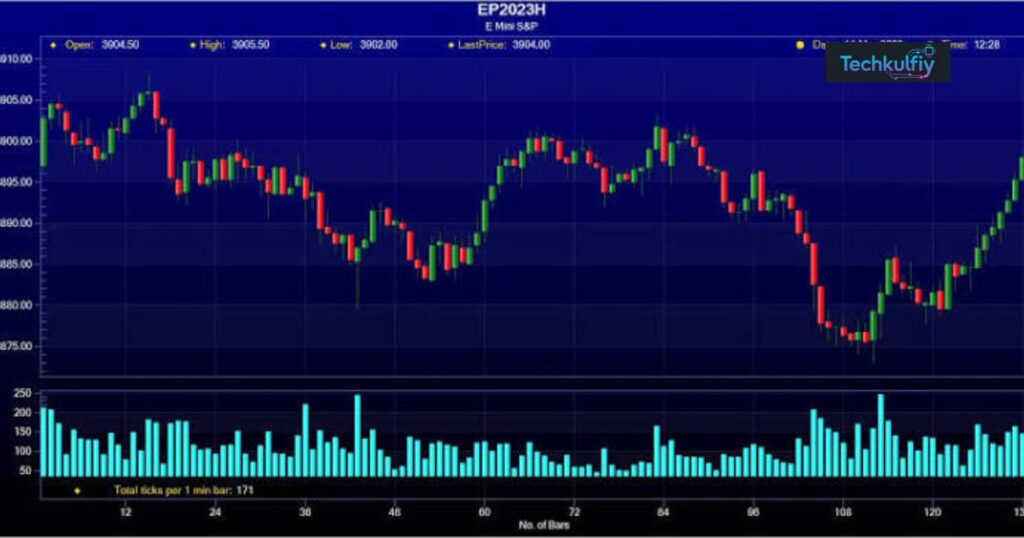
The S&P 500 (Mini) is generally known as the E-mini S&P 500 futures contract. It has the symbol ES and is available to trade on the Chicago Mercantile Exchange (CME).
The product tracks the S&P 500 Index which tracks around 500 of the biggest publicly traded companies in America. These are from a variety of important industries.
The performance of this product is influenced by technology, healthcare, financial services and consumer companies. This helps investors get a feel for how the broader stock market is performing.
Although the name suggests you’re investing in all 500 companies, this is not the case. You’re simply trading the futures contract which tracks the index.
The E-mini futures was created to give less exposure than the traditional S&P 500. It became popular with individual traders and institutions.
Now traders use these contracts for many reasons. Some will trade them to speculate on short-term price movements. Others will use them to hedge their investments.
The S&P 500 (Mini) differs from the Micro E-mini. They both track the same index but have different contract sizes.
This will help newcomers to understand what to trade.
How Does The S&P 500 (Mini) Work?
The S&P 500 (Mini) works by trading futures. Traders can speculate on how the market will perform.
If the trader believes the price will go up they can buy the contract. This is commonly known as going long.
If they believe the price will fall they can sell the contract. This is known as going short.
So if the price of the E-mini futures is 6,000 points and the trader believes the market will rise they would buy the contract (going long). The price then rises to 6,010.
The contract has gone up by 10 points in the index. As each point is worth $50, the potential gain equals $500.
This doesn’t include any commission or trading costs. If the market had fallen by 10 points the trader would lose $500.
This shows how this product reacts to price movements. Even small price movements can have a tangible impact on your finances.
The product has a standard multiplier. Traders should understand this before they start trading.
As this isn’t a stock investment there are expiry dates for trading. Each contract has a specific expiry month.
Traders will usually close their positions or roll them over to another month.
S&P 500 (Mini) Contract Details
It’s important to understand the contract details before trading. Here are some key features of the E-mini S&P 500.
Feature E-mini S&P 500 Symbol ES Exchange CME Multiplier $50 × indexMinimum tick0.25 index pointsTick value$12.50 Settlement Cash Expiry Quarterly Underlying Index S&P 500
The multiplier will dictate how much exposure you’ll have. Every point in the index costs $50 for one standard contract.
The minimum movement in price is known as a tick. This is 0.25 points in the index.
Each tick is worth $12.50. This means there are 4 ticks in one full point.
This will help traders know how much profit/loss they can make and how large of a position to open.
The E-mini generally has quarterly expiries. This means March, June, September and December.
You want to be careful when trading and ensure you know when the expiry dates are. Your broker will have information on how to roll the contracts.
S&P 500, E-mini And Micro E-mini Differences
New traders can get confused between these 3 products. They all track the same underlying market but have different purposes.
The S&P 500 Index tracks the performance of large companies in America. This is a stock index.
The E-mini S&P 500 is a futures contract which tracks the index. It has the symbol ES and has a $50 multiplier.
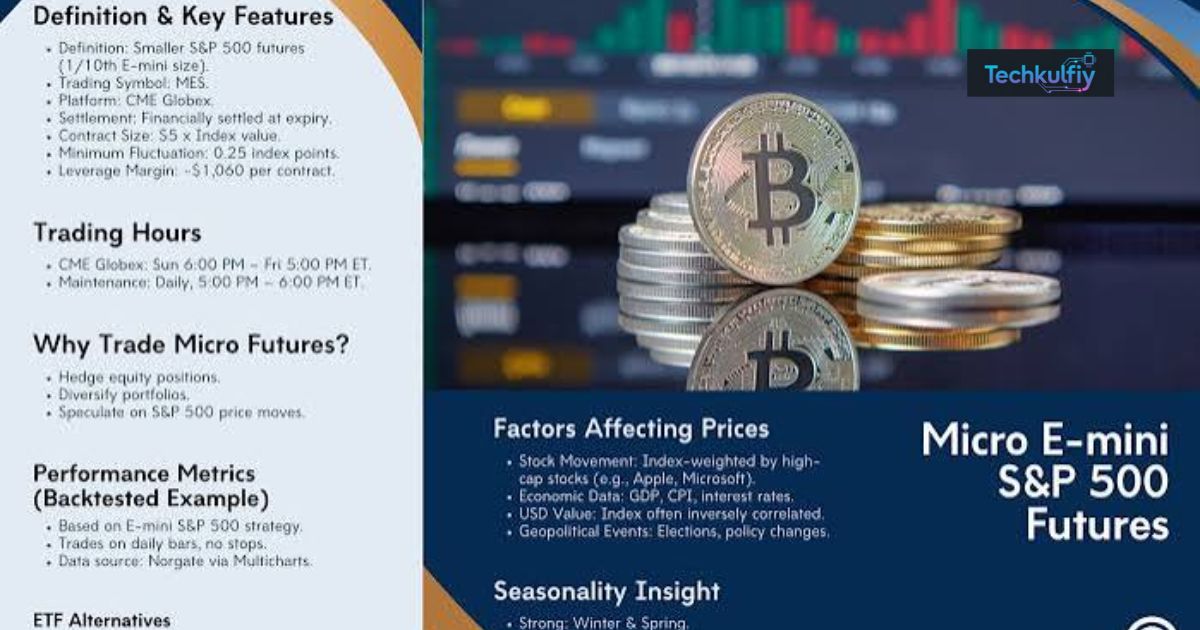
The Micro E-mini S&P 500 has less exposure. It has the symbol MES and has a $5 multiplier.
Here is a simple table showing the differences.
Feature S&P 500 Index E-mini Micro E-mini Product Stock Index Futures Futures Symbol SPX ES MES Multiplier N/A $50 $5 Tick Value N/A $12.50 $1.25 Exposure Index S&P 500 S&P 500
The Micro-Emini is 1/10th the size of the standard E-mini. This means traders can open smaller sized positions.
However, this still carries risk as both products use leverage and market volatility.
Why Is The S&P 500 (Mini) Popular Among Traders In The US?
This product is popular as it gives traders exposure to the overall stock market in America.
Rather than buying individual stock, traders can use one standard contract. This makes it easier to track how the overall market is going.
Here are some reasons why this product is popular.
Exposure To Major American Companies
The contract tracks the S&P 500 index. This contains companies from various sectors of the economy.
This helps investors track how the overall market is performing.
High Market Activity
This product is popular with individual traders and institutions. This means there is a well-established market.
There will be high liquidity which can make it easier to enter and exit positions. Although this can vary depending on abnormal market conditions.
Longer Trading Hours
This product can be traded outside of regular US stock market hours. This allows traders to react to developments internationally.
Traders can track economic announcements outside of the normal market hours.
Flexible Trading Opportunities
Traders can go long or short. You can also use these contracts to hedge your existing exposure.
Easy Access
There are multiple brokerage firms offering access to futures markets. This will vary depending on account requirements and trading costs.
This makes this product interesting to many different market participants. However it doesn’t guarantee you will make a profit.
What Influences The S&P 500 (Mini) Market?
There are many factors which can cause the S&P 500 (Mini) to move. Understanding them can help traders track price movements.
Federal Reserve Interest Rates
The Federal Reserve will impact financial conditions throughout the USA. Interest rates will influence borrowing and investment.
Higher interest rates can put pressure on company valuations. Whereas lower rates could boost the stock market.
However this will depend on expectations. Traders often react to unexpected decisions.
Inflation Reports In The US
Inflation can impact consumers and businesses. Investors will closely watch the Consumer Price Index (CPI).
Higher inflation can cause worries about interest rates. Whereas lower inflation could improve expectations for the future.
Sometimes these reports can cause large price movements in futures.
Employment Reports
The employment market in the US is an important indicator. Traders will track job creation, unemployment and wage growth.
Strong employment can boost consumer spending. However could cause worries about inflation.
Low employment can cause worries about slower growth.
Corporate Earnings
The S&P 500 contains companies from a variety of industries. This can cause the index to move depending on their earnings.
Good results can boost investor confidence. Whereas poor results can cause selling pressure.
Treasury Bond Yields
US Treasury bond yields can be an important factor when making investment decisions. Higher yields can make bonds more attractive than stocks.
However this can increase borrowing costs for companies. This could affect stock valuations.
Geopolitical Developments
International conflicts and political uncertainty can affect investor sentiment. Unexpected developments can cause increased volatility.
Traders will also track energy prices, trade policies and global supply chains.
Trading Times In The US For The S&P 500 (Mini)
It’s important to know what times this product is available to trade.
E-mini futures are traded electronically on the CME Globex platform. The regular trading times run from Sunday evening until Friday afternoon.
Typically the trading times in Eastern Time are:
Sunday – 6pm.
Monday to Thursday – With a daily maintenance period.
Friday – 5pm.
Daily Maintenance – Usually 5-6pm.
Trading times may vary on holidays. Always ensure you check the calendar.
The regular stock market in the US runs from 9.30am to 4pm.
Many futures traders will pay close attention to this time. Often there will be increased activity and important price movements.
However E-mini contracts can also be traded outside of these times.
This can give traders flexibility to react to international developments. However can cause risk if there is unexpected news.
How To Trade The S&P 500 (Mini)
Before trading you want to ensure you have the right preparation. New traders should understand the contract before risking real money.
Here are the basics.
Understand Futures
Before trading you want to understand how the E-mini futures work. Understand the multipliers, tick values and expiry dates.
Also understand how margin works when trading futures.
Choose A Futures Broker
You will need to have an eligible brokerage account to trade futures. Different brokers will offer different platforms.
Compare the commission, data costs, margin requirements and customer service. Ensure the broker is regulated.
Learn How To Read Price Charts
Price charts can help traders see how the market is moving. Many people will use candlestick charts to help understand price movements.
They will also look at volume and trends. This helps organise your trading.
However technical indicators can’t guarantee future prices.
Create A Trading Strategy
Your trading strategy should include rules for when to enter/exit and how much you’re willing to risk.
Don’t get tempted to change your strategy for every little movement. Sticking to your strategy can help reduce emotional decisions.
Use A Demo Account
Many trading platforms offer demo accounts. This can help new traders get used to trading.
Learn how to place orders and manage your positions. However this won’t guarantee you success in live trading.
Manage Your Risks
Before opening a position work out how much you could lose. Consider using appropriate stop loss orders.
However you can’t guarantee the price you will get when using stop loss orders. Fast market conditions can cause slippage.
Best Strategies To Trade The S&P 500 (Mini)
Different traders will use different strategies when trading futures. This depends on their experience and financial aims.
No strategy can guarantee profits. All strategies involve some uncertainty.
Trend Trading
Trend trading looks at the overall direction of the market. Traders look for opportunities where the price is consistently moving in one direction.
If the price is trending upwards this can help with long positions. Whereas downwards trending can create opportunities for short positions.
Some traders use moving averages to determine trends. They will also look at price structure and volume.
Support/Resistance
Support and resistance are common technical terms.
Support is an area where buying pressure may occur. Whereas resistance is an area where selling pressure may occur.
Traders will look at these levels for potential breakouts. However prices can break through these levels unexpectedly.
Breakout Trading
Breakout traders will look at prices breaking out of set ranges.
For example the S&P 500 (Mini) may be trading in a tight range. If the price breaks above resistance this could cause buying pressure.
Some traders will wait for volume confirmation. Others will look for a re-test of the breakout level.
False breakouts can be a big risk. Just because the price moves doesn’t mean there will be a sustained trend.
Moving Average Strategy
Moving averages can help traders understand recent price direction. They can help reduce short-term price volatility.
Some traders will look at short and long term averages. When they cross this can show a change in market momentum.
However moving averages use past prices and can’t guarantee future price movements.
News Trading
Some traders will track important economic news. Such as inflation and Federal Reserve decisions.
This can cause fast price movements in futures. However unexpected volatility can cause increased losses.
New traders should understand the risks involved.
Understanding Leverage and Margin
Leverage is an important aspect of futures trading. It allows you to control larger positions with little capital.
This capital is known as margin.
For example, if the price of the E-mini futures was 6,000 points, the notional value would be $300,000.
We can work this out using the below calculation.
$50 contract multiplier. It does not mean traders must deposit $300,000
The margin will usually be much lower but you can still be exposed to the whole movement of the contract.
If the price of the E-mini moves 20 points against you, you would make a loss of $1,000.
This doesn’t take into account any commission or other charges. As you can see, it’s important to be cautious when trading with leverage.
There are two important terms in relation to margins.
Initial Margin – This is the amount of margin you’ll need to open a position.
Maintenance Margin – This is the lowest level of margin you need to keep your position open.
If the equity in your account drops below the maintenance margin you may have to add more funds. Brokers may also force you to close your position depending on their risk policies.
Margins can vary depending on the market conditions and can also depend on the broker you’re using.
It’s important to never assume a contract is cheap to trade due to low margins. Always calculate how much you could be exposed to.
S&P 500 (Mini) vs S&P 500 ETFs
Some investors prefer to trade futures whereas others invest in ETFs. Both give you exposure to the wider US stock market.
ETFs will give you exposure to an ETF which tracks the S&P 500. You can buy shares in an ETF through your normal brokerage account.
The E-mini gives you exposure by being a futures contract.
FeatureE-mini S&P 500S&P 500 ETFTypeFutures ContractExchange Traded FundOwnershipNot owns sharesOwns shares in ETFTrading HoursExtended hoursNormal hoursExpiryQuarterlyNo expiryLeverageBulit-inLeverage depends on productRisksLeverage and futures risksMarket and fund risks
If you want to gain exposure to the market for the long-term then ETFs may suit you better. If you’re an experienced trader wanting to gain flexible exposure to the index, futures might suit.
Ultimately both products aren’t necessarily better than each other. It depends on your financial goals and risk tolerance.
What are the Risks of Trading the S&P 500 (Mini)?
Whilst the S&P 500 (Mini) can give you access to an important financial market there are some big financial risks to consider.
High Leverage
As mentioned above, leverage can increase your exposure to the market. This means small price movements can cause big profits/losses.
Too much leverage can cause you to lose money quickly.
Volatility
Prices can often change significantly when there is economic news. This can cause sudden price movements.
This can make it difficult to trade.
Emotional Trading
When trading you may make emotional decisions. This could mean you close your winning positions too early.
Alternatively, you may hold onto losing positions for too long. Having a clear trading plan can help you avoid this.
Overtrading
Some beginners will open too many positions. They may also continue trading when they start to lose.
This can increase your trading costs and put unnecessary pressure on you financially.
Margin Calls
You may be asked to add more margin to your account. This can happen when your account value begins to fall. Brokers may also force you to close your positions.
Unplanned Economic Events
Political events and economic reports can impact market expectations which can cause price movements before you can adapt your positions.
Never risk any money that you need for essential expenditure. Futures trading should never be seen as a guaranteed income source.
Should I Trade the S&P 500 (Mini) as a Beginner?
The S&P 500 (Mini) can be attractive to beginners as it tracks a well-known index of US stocks.
However, simply knowing what the S&P 500 is doesn’t mean futures trading will be straightforward.
The standard E-mini contract carries a large amount of financial exposure. Even small price movements are important due to the $50 multiplier.
To begin with it’s important to understand what futures are. Understanding leverage, margin, expiry and order execution.
The Micro E-mini has a smaller contract size. It has a multiplier of $5 rather than $50.
This can allow you to trade smaller positions. However, there is still financial risk involved.
As a beginner you should:
Understand the basics of futures trading.
Understand the difference between ES and MES.
Know about margin requirements.
Use a demo account to practice.
Understand technical analysis.
Have clear financial risk management.
Don’t borrow money to trade.
Don’t expect guaranteed returns.
Always ensure you learn before you take any financial risks.
How Economic News Impacts the S&P 500 (Mini)
Economic news plays an important role in futures trading. Traders will look at various reports to understand how the economy is doing in the US.
The Consumer Price Index helps to understand price changes in consumer prices. This can impact inflation expectations.
Employment reports help to understand how many jobs are being created and unemployment levels. This helps investors understand how the labour market is performing.
Announcements from the Federal Reserve are highly watched. Interest rate changes can impact stock market valuations.
Company earnings can also impact the S&P 500 (Mini). If large companies perform well this can boost investor confidence.
However, if company earnings are poor this can cause selling pressure. This is particularly important as large companies can impact the overall index.
Sometimes positive news won’t cause prices to rise. Markets can sometimes do the opposite as expectations were already priced in.
Traders should look at the economic data and what investors are expecting.
Where Can US Traders See S&P 500 (Mini) Prices?
There are many platforms available to view information on the S&P 500 (Mini).
The CME Group will have information on the official contract specs and exchange. Futures brokers will also provide charts and trading platforms.
Financial websites will provide market updates and economic news. Some platforms will offer technical indicators and price alerts.
When choosing a platform to use, you should look at:
Live data on futures markets.
Accurate contract specs.
Good charting tools.
Transparency on commissions.
Clear margin requirements.
Reliable order execution.
Proper regulation.
Some platforms will have delayed data so ensure you’re getting live data.
Futures prices can differ to the cash index. This is because financing costs, dividend expectations and market expectations all play a part.
What Should I Consider Before Opening a Position?
Being prepared can help you make more organised decisions. However, there will always be some uncertainty in financial markets.
Before opening a position in the S&P 500 (Mini), consider the following:
Overall market direction – Is the market going up, down or sideways?
Economic Calendar – There may be important announcements which can cause increased volatility.
Key support and resistance levels – This can help organise your trading decisions.
Financial exposure – Ensure you know how much you’re exposed to. Know what each point and tick is worth.
Exit strategy – Know how much you’re willing to lose.
Futures contract month – Know what month you’re trading and what the expiry and rollover requirements are.
This can help you avoid any unnecessary surprises.
A good trading decision doesn’t require you to predict everything. It’s important to understand the risks you may face.
FAQs
- What is the S&P 500 (Mini)?
The S&P 500 (Mini) is commonly referring to the E-mini S&P 500 futures contract. It allows traders to track the movements of the S&P 500 without buying all the 500 stocks.
- What is the ticker?
The standard E-mini S&P 500 has the ticker ES. The Micro E-mini has the ticker MES.
- How much is one E-mini contract worth?
The notional value is calculated by multiplying the futures index price by $50. At 6,000 points, the notional value would be $300,000.
- What is the difference between ES and MES?
ES is the standard E-mini contract.
MES is the Micro E-mini contract.
ES has a multiplier of $50 multiplier. MES has a $5.
- Can beginners trade the S&P 500 (Mini)?
Beginners can get access to futures markets through an eligible broker. However, it is important to understand leverage and margin before trading.
- What are the trading hours?
E-mini futures are generally traded between Sunday evening and Friday afternoon. There is a daily maintenance period. The times will also vary on holidays.
- Is it risky to trade S&P 500 (Mini)?
Yes. Futures carry leverage, volatility and margin call risks. You can lose significant amounts of money if the price goes against you.
- What impacts the price of the S&P 500 (Mini)?
Decisions from the Federal Reserve, inflation, employment reports, company earnings and treasury yields can all impact prices.
- Does the E-mini contract expire?
Yes. The E-mini futures generally have a quarterly expiry. This is March, June, September and December.
- Is the E-mini better than an S&P 500 ETF?
Neither option is necessarily better. ETFs may be better for long-term investors whereas futures may be better for experienced active traders.
Conclusion
The S&P 500 (Mini) can offer an alternative way to get involved in the US stock market. The E-mini futures contract will track movements related to 500 large US companies.
Traders appreciate the high liquidity, extended hours and flexible trading opportunities. However, futures trading does carry leverage and financial risk.
It’s important to understand the contract specs, margin requirements and market movements. Also keep up-to-date with economic reports and overall market conditions.
As a beginner it’s important to educate yourself. Using a demo account can help you build practical knowledge.
The S&P 500 (Mini) can be a useful tool for informed market participants. However, it’s important to make disciplined decisions and manage your risk properly.

Noor ul Ain is a tech enthusiast and the founder of Techkulfiy. She loves exploring Artificial Intelligence (AI) and future tech, breaking down complex trends into simple, engaging updates for her readers.