


NASDAQ is a major electronic stock exchange in the United States.
It lists many companies from technology and other major industries.
It also tracks indexes such as the Nasdaq Composite and Nasdaq-100.
Want to understand how major U.S. companies move the market?
NASDAQ gives you a closer look at stocks, indexes, and market trends.
Its daily changes can reveal shifts in technology and growth stocks.
The NASDAQ is an important part of the U.S. stock market.
It provides market data and supports trading in many listed companies.
Investors often watch it to understand broader market performance.
What Is NASDAQ?
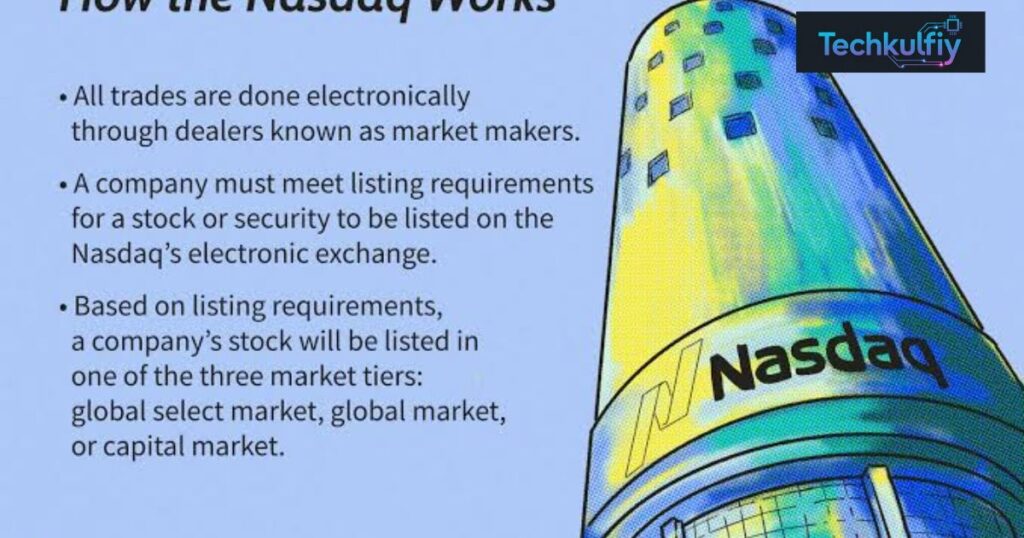
Nasdaq originally stood for the National Association of Securities Dealers Automated Quotations. Today, Nasdaq refers to a major electronic stock exchange operator and the market ecosystem connected with it. Unlike a traditional physical trading floor, electronic systems allow orders to be matched and processed digitally.
The Nasdaq stock exchange is home to thousands of listed companies from different industries. Technology is strongly represented, but the exchange is not limited to technology. Healthcare, consumer businesses, industrial companies, communications businesses, and other sectors also trade on Nasdaq.
The term NASDAQ can become confusing because people use it in several different ways. Sometimes they mean the exchange itself. Sometimes they mean the Nasdaq Composite, while other times they mean the Nasdaq-100. These are different things.
The exchange is where securities can be listed and traded. An index, on the other hand, measures the performance of a selected group of securities. This distinction is important when reading financial news.
The Nasdaq Composite is a broad market index that tracks a large number of securities listed on Nasdaq. The Nasdaq-100 is a narrower index that focuses on 100 of the largest non-financial companies listed on the exchange.
| NASDAQ Term | What It Means |
|---|---|
| Nasdaq stock exchange | An electronic exchange where securities are traded |
| Nasdaq Composite | A broad index covering many Nasdaq-listed securities |
| Nasdaq-100 | An index tracking 100 major non-financial Nasdaq companies |
| NDX | The ticker symbol commonly used for the Nasdaq-100 Index |
| QQQ | An ETF designed to track the Nasdaq-100 |
| Nasdaq market data | Information about prices, trading activity, and market performance |
The Nasdaq market has become especially important because many influential businesses are listed there. Its role extends beyond daily trading. It provides important financial infrastructure for companies, investors, brokers, and other participants in the global financial system.
A simple way to understand it is this: Nasdaq is the marketplace, while an index is a measurement of selected stocks within that marketplace.
How Does the NASDAQ Stock Market Work?
The NASDAQ operates through electronic trading systems. Instead of investors physically meeting on a trading floor, buy and sell orders are handled electronically through a network of market participants and trading systems.
When you place an order through a brokerage account, your broker sends the order into the market. Depending on the order type and market conditions, the transaction can be matched with a suitable seller or buyer.
Prices constantly change because buyers and sellers are continuously interacting. If demand for a stock increases while available supply remains limited, its price may rise. If more investors want to sell than buy at current prices, the price can fall.
This process helps create the real-time market data investors see on trading platforms. Prices, trading volume, bid and ask prices, and other information can change within seconds.
The market also includes professional participants such as market makers. Their role can help provide liquidity by being willing to buy or sell securities under defined market conditions. Liquidity matters because investors generally want to enter or exit positions without causing unusually large price movements.
Nasdaq trading is also influenced by company announcements, earnings reports, economic statistics, interest-rate decisions, and international events. A major earnings surprise from a large company can affect not only that company but also broader Nasdaq sectors and indexes.
For example, suppose a major semiconductor company reports much stronger revenue than analysts expected. Investors may interpret the results as evidence of strong demand for chips. Other semiconductor and technology stocks could also move because expectations about the wider industry may change.
The market therefore acts like a constantly updating information system. Every new piece of information can change expectations, and changing expectations can influence prices.
For U.S. investors, regular Nasdaq market hours generally cover the main U.S. trading session from 9:30 a.m. to 4:00 p.m. Eastern Time. Nasdaq also supports trading activity outside regular market hours through pre-market and after-hours sessions, although liquidity and trading conditions can differ from the regular session.
The important point is that the Nasdaq stock market does not simply respond to what happened yesterday. It responds to what investors believe could happen next.
Nasdaq Composite vs. Nasdaq-100
The Nasdaq Composite and Nasdaq-100 are two of the most discussed Nasdaq index benchmarks, but they serve different purposes.
The Nasdaq Composite provides broad exposure to securities listed on Nasdaq. It includes companies from many industries and therefore gives investors a wider view of the exchange.
The Nasdaq-100, identified by the ticker NDX, is more concentrated. It tracks 100 of the largest non-financial companies listed on Nasdaq. Because many of these businesses operate in technology and other growth-oriented industries, the index has a strong connection with technology stocks, innovation, and growth stocks.
The two indexes can perform differently because they contain different securities and have different compositions. A strong rally in large technology companies may have a particularly noticeable effect on Nasdaq-100 performance.
The Nasdaq-100 uses a modified market-capitalization weighting approach. This means larger companies generally have more influence than smaller companies, although methodology rules are designed to prevent excessive concentration.
The index is regularly reviewed and rebalanced according to its methodology. Its annual reconstitution can also change which companies are included.
| Feature | Nasdaq Composite | Nasdaq-100 |
|---|---|---|
| Main purpose | Broad view of Nasdaq-listed securities | Tracks 100 major non-financial Nasdaq companies |
| Coverage | Much broader | More concentrated |
| Financial companies | Can be included | Excluded |
| Common ticker | IXIC | NDX |
| Technology exposure | Significant | Particularly significant |
| Company size | Includes a broad range | Focuses on large companies |
| Investor use | Broad Nasdaq market analysis | Large-cap growth and innovation exposure |
The difference becomes easier to understand with a simple example. Imagine the Nasdaq Composite as a large basket containing many different products sold in a supermarket. The Nasdaq-100 is more like a carefully selected basket containing 100 major products from that supermarket.
Neither index tells the entire story of the market. Each answers a different question.
The Composite can help you understand the broader Nasdaq-listed market, while the Nasdaq-100 can help you follow major non-financial companies that often have strong exposure to innovation and growth.
What Companies Are Listed on NASDAQ?
The Nasdaq exchange hosts thousands of Nasdaq companies. These businesses vary greatly in size, industry, business model, and stage of development.
Many well-known companies associated with technology and innovation trade on Nasdaq. Major examples have included Apple, Microsoft, Amazon, Alphabet, Nvidia, Meta Platforms, Broadcom, and other large businesses. The exact composition of indexes can change over time, so an individual company’s presence in a particular index should always be checked against the latest official methodology and constituent data.
The exchange also includes companies involved in biotechnology, healthcare, software, semiconductors, communications, retail, consumer services, industrial activities, and other areas.
This variety is important because the Nasdaq is not simply a collection of computer companies. Its listed companies represent a wide range of businesses.
At the same time, the Nasdaq-100 has a different selection process from the broader exchange. A company can be listed on Nasdaq without being included in the Nasdaq-100.
Company size is one important consideration. Market capitalization, liquidity, listing requirements, and index methodology all help determine whether a company qualifies for particular indexes.
The following table shows examples of major companies that investors often associate with Nasdaq. Their inclusion in a specific index can change, so these examples should be treated as illustrations rather than a permanent constituent list.
| Company | Common Industry Association | Why Investors Watch It |
|---|---|---|
| Apple | Consumer technology | Large global business and major market influence |
| Microsoft | Software and cloud | Enterprise software and cloud exposure |
| Nvidia | Semiconductors | AI and advanced computing exposure |
| Amazon | Consumer and cloud | E-commerce and cloud computing |
| Alphabet | Internet and technology | Search, advertising, cloud, and AI |
| Meta Platforms | Communications technology | Social platforms and digital advertising |
Large companies can have a meaningful effect on Nasdaq performance because market-cap-weighted indexes give greater influence to companies with larger market values.
That does not mean smaller Nasdaq companies are unimportant. Smaller businesses can sometimes experience much larger percentage price movements. However, their effect on a broad market-cap-weighted index is generally smaller.
This is one reason investors should distinguish between an individual Nasdaq stock and the Nasdaq index itself.
NASDAQ Sectors and Industry Breakdown
The Nasdaq sectors cover much more than technology. However, the exchange and its major indexes are widely associated with innovation, software, semiconductors, digital services, and other growth-oriented businesses.
The Nasdaq technology sector includes businesses connected with software, hardware, semiconductors, information technology, and related services. These companies can be highly sensitive to changes in economic expectations and investor demand for growth.
The Nasdaq healthcare sector includes companies involved in biotechnology, pharmaceuticals, medical devices, healthcare services, and related activities. Healthcare stocks can respond to clinical developments, regulatory decisions, drug approvals, and changes in healthcare spending.
The Nasdaq industrials segment includes businesses involved in manufacturing, transportation, equipment, aerospace, and other industrial activities.
The Nasdaq consumer staples area includes businesses that sell products people generally continue buying even when economic conditions become weaker. Food, household products, and everyday necessities can fall into this broad category.
By contrast, Nasdaq consumer discretionary businesses tend to depend more heavily on consumer spending patterns. Retail, travel, entertainment, and other non-essential purchases can be more sensitive to changes in household income and confidence.
Other areas include Nasdaq telecommunications, Nasdaq utilities, and Nasdaq basic materials. Each sector reacts differently to interest rates, economic growth, commodity prices, consumer behavior, and other factors.
| Sector | Examples of Business Activities | Common Market Sensitivities |
|---|---|---|
| Technology | Software, hardware, semiconductors | Interest rates, innovation, earnings |
| Healthcare | Biotechnology, medical products, services | Regulation, research, approvals |
| Consumer discretionary | Retail, travel, entertainment | Consumer spending |
| Consumer staples | Food, household products | Defensive demand, inflation |
| Industrials | Manufacturing, equipment, transportation | Economic growth and business spending |
| Telecommunications | Communication services | Subscriber growth, advertising, competition |
| Utilities | Electricity and essential services | Interest rates, regulation |
| Basic materials | Chemicals, metals, materials | Commodity prices and global demand |
A sector breakdown can help investors understand why an index is moving. If semiconductor stocks fall sharply, for example, a technology-heavy index may experience pressure even when some other sectors remain stable.
This is also why looking only at the headline index number can hide important details. Two days with the same Nasdaq percentage change can have completely different reasons behind them.
The modern Nasdaq market is strongly connected with innovation and growth and innovation, especially in areas such as artificial intelligence, cloud computing, cybersecurity, semiconductors, software, and digital services.
However, sector concentration also creates risk. If one group becomes highly valued and later experiences a broad decline, a concentrated index can feel that pressure more strongly.
How Is NASDAQ Performance Measured?
Investors measure Nasdaq performance in several ways. The simplest method is to look at the percentage change in an index over a specific period.
For example, if an index rises from 20,000 to 20,400, its point increase is 400. Its percentage increase is 2%.
Percentage changes are often more useful than points because they make different market periods easier to compare.
Index performance can also be measured over different time periods. Investors may examine one-day, one-month, one-year, five-year, or longer-term returns.
The method used to construct an index also matters. Market-capitalization weighting means larger companies generally have greater influence. Therefore, the price movement of a very large company can have a greater effect on an index than the movement of a smaller company.
The Nasdaq-100 is designed around a modified market-capitalization methodology. This structure gives significant weight to large companies while applying index-specific rules to manage concentration.
Investors should also understand the difference between price return and total return. A price index measures changes in the prices of its components. A total-return calculation can also account for reinvested dividends.
Volatility is another important measure. An index may produce a positive return over a long period while experiencing several large declines along the way.
Consider a simple example. An index rises 15% during one year, falls 10% the next year, and then rises again. Looking only at the final number can hide how difficult the journey was for investors who experienced those declines.
This is why market performance should be viewed over an appropriate time horizon rather than through a single daily move.
Another important point is that an index is not the same as every stock within it. A Nasdaq index can rise while many individual stocks fall. The opposite can also happen.
Investors therefore use index performance as one measure of the broader equity market, not as a perfect representation of every company.
Factors That Affect NASDAQ Prices
Many forces can affect Nasdaq performance. Some are company-specific, while others influence the entire stock market.
Interest rates are among the most important factors. When interest rates rise, future corporate cash flows can become less attractive to investors because higher rates change the value placed on future earnings. Growth-oriented companies can be particularly sensitive to changing rate expectations.
Federal Reserve policy therefore receives significant attention. Investors watch interest-rate decisions, policy statements, inflation data, employment figures, and other economic information for clues about future monetary policy.
Inflation also matters. Persistent inflation can influence consumer spending, business costs, interest rates, and corporate profit expectations.
Company earnings are another major driver. Revenue growth, profit margins, earnings guidance, and management expectations can move individual stocks and, when the companies are large enough, influence an index.
Technology trends can also affect the Nasdaq. Developments in artificial intelligence, cloud computing, semiconductors, cybersecurity, and automation can change investor expectations about future business growth.
The connection between global markets and the Nasdaq has also become increasingly important. Large U.S. companies often generate significant revenue outside the United States, so international economic conditions can affect their results.
Currency movements can influence multinational companies as well. Changes in the value of the U.S. dollar can affect the dollar value of revenue earned in foreign markets.
Geopolitical events can create another source of uncertainty. Trade restrictions, conflicts, supply-chain disruptions, energy prices, and international policy changes can affect companies and investors.
Investor sentiment matters too. Markets do not move only because of current business results. They also move because investors change their expectations about the future.
| Factor | Possible Effect on NASDAQ |
|---|---|
| Interest rates | Can change valuations and demand for growth stocks |
| Inflation | Can affect costs, consumer demand, and monetary policy |
| Federal Reserve policy | Can influence borrowing costs and investor expectations |
| Corporate earnings | Can change expectations about company value |
| AI and technology trends | Can influence growth expectations |
| Treasury yields | Can affect the relative appeal of equities |
| Global economic growth | Can influence multinational revenue |
| Currency movements | Can affect overseas earnings |
| Geopolitical events | Can increase uncertainty and volatility |
| Investor sentiment | Can accelerate buying or selling activity |
A Simple Case Study
Imagine a large semiconductor company announces that demand for AI chips is much stronger than expected. Its revenue forecast increases, and investors become more optimistic about future growth.
The company’s stock may rise. Other semiconductor businesses may also gain because investors expect stronger industry demand. If the company has a large weighting in the Nasdaq-100, its move can contribute to the index’s daily performance.
Now imagine that interest-rate expectations change at the same time. Investors may become more cautious about high-growth companies because higher rates can affect valuations.
The final market reaction could therefore depend on several forces happening at once.
This example shows why the Nasdaq cannot be explained by one factor alone.
NASDAQ vs. S&P 500 and Dow Jones
The Nasdaq, S&P 500, and Dow Jones are three major names in discussions about the U.S. stock market. However, they are constructed differently and represent different groups of companies.
The Nasdaq Composite covers a broad group of securities listed on the Nasdaq exchange. The Nasdaq-100 focuses on 100 major non-financial companies listed on Nasdaq.
The S&P 500 tracks approximately 500 leading large-cap U.S. companies and uses a market-capitalization-weighted methodology. The Dow Jones Industrial Average, commonly called the Dow, tracks 30 large U.S. companies and uses a price-weighted methodology.
These differences can produce different market performance on the same day.
For example, if large technology companies perform strongly, the Nasdaq-100 may respond differently from the Dow because their sector exposure and construction are different.
The Dow’s price-weighted structure means a stock’s share price affects its influence in the index. That differs from the market-capitalization approach used by the S&P 500 and Nasdaq-100.
| Index | General Coverage | Weighting Approach | Common Use |
|---|---|---|---|
| Nasdaq Composite | Broad Nasdaq-listed securities | Market-cap based methodology | Broad Nasdaq market view |
| Nasdaq-100 | 100 major non-financial Nasdaq companies | Modified market-cap based | Large growth and innovation exposure |
| S&P 500 | About 500 major U.S. companies | Market-cap based | Broad large-cap U.S. market benchmark |
| Dow Jones | 30 major U.S. companies | Price weighted | Traditional large-company market indicator |
The comparison is useful because no single index represents the entire U.S. market perfectly.
The Nasdaq is often closely watched for its exposure to leading businesses, technology, innovation, and growth. The S&P 500 provides broader large-cap exposure across many sectors. The Dow represents a much smaller group of companies and follows a different weighting system.
These distinctions matter when you compare returns. A period that benefits technology and growth companies may produce a different result from a period that benefits defensive or value-oriented businesses.
How to Invest in NASDAQ
You cannot directly purchase an index such as the Nasdaq Composite or Nasdaq-100 as if it were an individual company. Instead, investors generally use financial products designed to provide exposure to an index.
Exchange-traded funds, commonly called ETFs, are one of the most widely used approaches. For example, investors often use funds designed to track the Nasdaq-100. QQQ is a well-known example of an ETF that seeks to track the performance of the Nasdaq-100.
Index funds can make index investing easier because one investment can provide exposure to many companies instead of requiring an investor to purchase every stock separately.
The main idea behind Nasdaq-100 investment exposure is diversification across the companies included in the relevant index. However, diversification does not eliminate risk.
An investor should consider the fund’s expense ratio, tracking difference, liquidity, structure, tax considerations, and portfolio concentration before investing.
Investors can also buy individual Nasdaq-listed stocks. This approach provides more control, but it creates company-specific risk. One company can experience problems even when the broader index performs well.
A diversified index fund spreads exposure across multiple businesses, although a technology-heavy index can still carry substantial sector concentration.
The choice between an individual stock and an index product therefore depends on factors such as investment goals, time horizon, diversification needs, risk tolerance, and understanding of the investment.
For long-term investors, it can be useful to distinguish between investing and short-term trading. Index investing generally focuses on gaining broad market exposure over time, while active trading attempts to benefit from shorter-term price movements.
The investment market also includes products beyond ordinary stocks and ETFs. These products can provide different forms of exposure, but their risks and structures can be more complicated.
| Investment Approach | Main Idea | Main Consideration |
|---|---|---|
| Nasdaq-100 ETF | Tracks or seeks to track Nasdaq-100 performance | Fees, tracking, concentration |
| Broad Nasdaq fund | Provides wider Nasdaq exposure | Broader but still exchange-specific |
| Individual Nasdaq stock | Direct ownership of one company | Higher company-specific risk |
| Index fund | Passive exposure to a selected index | Less control over individual holdings |
| Options | Contract-based exposure | Leverage and time-related risk |
For beginners, understanding what an investment actually owns is more important than simply choosing a product because its name contains “Nasdaq.”
A useful rule is simple: know the index, know the product, and know the risks before investing.
NASDAQ Index Options and Other Investment Products
The Nasdaq ecosystem also includes derivatives and other financial products. Index options are contracts that give traders exposure to movements in an underlying index according to specific contract terms.
The Nasdaq-100 has associated options products commonly referred to as Nasdaq-100 Index Options. The NDX symbol is commonly used for the Nasdaq-100 index itself.
Options trading involves concepts such as calls, puts, strike prices, expiration dates, premiums, volatility, and settlement. These concepts are different from simply buying shares of a company or an ETF.
A call option generally gives the holder the right, under the contract terms, to benefit from an increase in the underlying asset. A put option generally provides exposure to a decrease. Buyers and sellers of options have different risk profiles.
Understanding these products requires more than basic stock-market knowledge. This is where index options education and options trading basics become important.
For example, an investor who buys an option does not simply own the underlying index. The value of the option depends on several factors, including the underlying index level, strike price, remaining time, implied volatility, and other market conditions.
Index options trading can also involve leverage. Leverage can increase potential gains, but it can also increase losses. Time decay can reduce the value of certain options as expiration approaches.
Advanced traders may use different index options strategies for hedging, income, directional views, or volatility-related positions. These strategies can become complex quickly, so understanding the contract before entering a trade is essential.
Other Nasdaq-related investment products include ETFs, futures, mutual funds, structured products, and index-linked instruments. Each product has its own structure, costs, liquidity characteristics, and risks.
| Product | What It Provides | Main Risk Consideration |
|---|---|---|
| Nasdaq-100 ETF | Exposure to Nasdaq-100 companies | Market and concentration risk |
| Index fund | Passive index exposure | Market declines and tracking differences |
| Index options | Contract-based index exposure | Leverage, time decay, volatility |
| Futures | Contract-based exposure to an index | Leverage and rapid losses |
| Individual stocks | Ownership in a specific company | Company-specific risk |
Financial products have also become more accessible through modern trading platforms. This reflects continuing financial innovation across the investment industry.
However, easier access does not make complex products simple. An investor should understand the product’s mechanics before using it.
The broader lesson is that the Nasdaq represents much more than a daily number on a financial website. It connects companies, investors, exchanges, indexes, technology, and the wider financial markets.
The Nasdaq also provides valuable market data that helps investors follow prices, volume, index movements, and other information. Access to accurate Nasdaq market data can help investors understand what is happening, although data alone cannot predict future prices.
For someone researching investment opportunities, the Nasdaq can be an important part of the U.S. equity landscape. Its strong presence in technology, healthcare, communications, and other innovative industries makes it particularly relevant to investors studying global growth and the changing economy.
At the same time, the Nasdaq is not risk-free. Stock prices can fall quickly, valuations can change, and even successful companies can experience major declines.
“The stock market is filled with individuals who know the price of everything, but the value of nothing.” — Philip Fisher
The quote highlights an important investing principle: knowing a price is not the same as understanding an investment.
The Nasdaq can be useful as a stock market index, a trading venue, a source of market information, and a gateway to many investment products. Understanding the difference between the exchange, the indexes, individual companies, and derivatives makes the entire market easier to follow.
For U.S. investors, the Nasdaq remains an important part of the U.S. index landscape and the wider global financial system. Whether you are studying the Nasdaq Composite, researching Nasdaq-100 companies, comparing Nasdaq-100 performance, or learning about options, the key is to understand what the specific product or index actually represents.
The Nasdaq’s connection with technology, innovation, and major global companies will continue to make it an important part of financial discussions. But successful investing requires more than following a popular index. It requires understanding diversification, valuation, risk, time horizon, and the purpose of the investment.
In the end, the Nasdaq is best understood not as one single investment, but as a broad financial ecosystem that helps connect leading businesses, investors, technology, and the modern investment market.
Meta Description
Explore NASDAQ, its major indexes, listed companies, market performance, sectors, and how the Nasdaq stock market works.
