

Mistral Large 4 is a new open-weight AI model from European AI company Mistral. It combines advanced reasoning, coding, and multimodal abilities in one system.
But can Mistral Large 4 really challenge powerful Chinese AI models? Its claims about cybersecurity, reasoning, and enterprise performance have quickly made it a major AI story.
With a huge context window, Mixture-of-Experts architecture, and support for demanding AI tasks, Mistral Large 4 targets both developers and businesses. This model could also strengthen Europe’s position in the global AI race.
What Is Mistral Large 4?
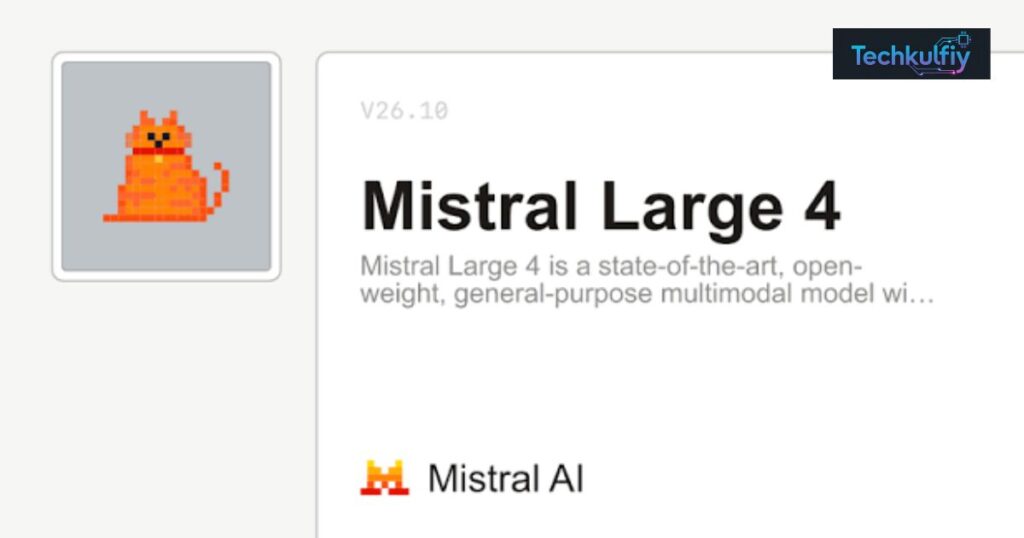
Mistral Large 4 is Mistral’s newest open-weight, general-purpose multimodal model. The company introduced its public preview on October 6, 2026, describing it as its largest and most capable model so far.
The model uses a Mixture-of-Experts (MoE) architecture. Mistral says it has around one trillion total parameters, with only a portion activated for each task. Its official documentation currently lists about 1.05 trillion total parameters and 52 billion active parameters, alongside a 1.6-billion-parameter vision encoder.
That architecture is important because a huge model does not necessarily need to use all of its parameters for every request.
Instead, a Mixture-of-Experts model can route different tasks to relevant parts of the network. This can help provide powerful capabilities while making inference more efficient than activating the entire model for every request.
Mistral is positioning the model as a serious option for companies and developers that want powerful AI infrastructure without depending entirely on closed systems.
Why Is Mistral Large 4 Important?
The arrival of Mistral Large 4 matters because the global AI industry has increasingly been dominated by companies from the United States and China.
American companies have built powerful proprietary models, while Chinese companies have made rapid progress with open and open-weight systems.
Mistral wants Europe to have another option.
The company has consistently promoted AI sovereignty, which means organizations should have more control over their models, infrastructure, data, and deployment choices.
This is particularly important for governments and businesses that don’t want sensitive information to depend entirely on an external AI provider.
Mistral says its new model was trained from scratch using 3,800 NVIDIA Grace Blackwell GPUs in its European data centers.
That makes the launch more than another model update.
It is also a statement about Europe’s ability to build and operate large-scale AI infrastructure.
What Does “Le Chonk” Mean?
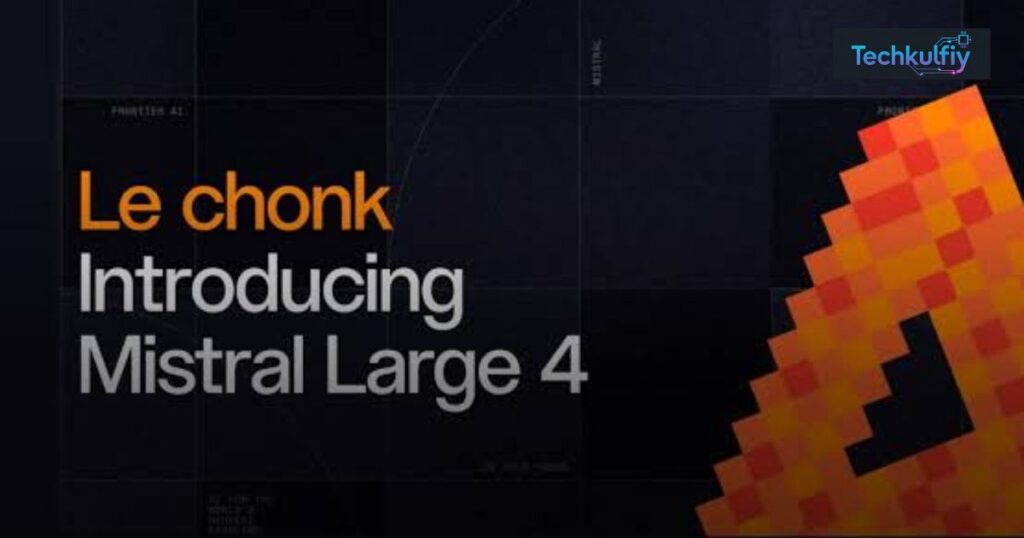
Le Chonk is the unofficial nickname for Mistral Large 4.
Mistral itself uses the playful name in its launch announcement, describing the model as “very officially” Le Chonk.
The name has attracted attention because it sounds very different from the serious naming conventions normally associated with frontier AI models.
Underneath the humorous nickname, however, the model is technically substantial.
With more than one trillion total parameters and multimodal capabilities, it represents a major step up in scale for Mistral.
The company says the model is designed for demanding workloads rather than simple chatbot conversations.
Its capabilities include coding, reasoning, multimodal AI, agentic workflows, cybersecurity, finance, and other enterprise applications.
How Powerful Is Mistral Large 4?
Mistral describes Mistral Large 4 as a frontier-level open-weight model.
The company reports strong performance across several areas, including coding, agentic workflows, and multimodal understanding. It also says the model reaches state-of-the-art performance among open models for cybersecurity, finance, and manufacturing workloads.
However, it is important to separate company claims from independent testing.
Mistral’s own benchmarks are useful for understanding what the company is targeting, but they don’t automatically prove that the model is the best overall system.
Independent analysis has found that the model’s strongest area appears to be cybersecurity, while its overall position is more complicated.
That means users shouldn’t judge the model using a single benchmark.
Different models can perform better at different tasks.
One system may be stronger at coding, another at reasoning, and another at creative writing or multimodal understanding.
The real test for Mistral Large 4 will be how it performs across independent evaluations and real-world workloads after wider access.
Mistral Large 4 and Cybersecurity
Cybersecurity is one of the most interesting areas for Mistral Large 4.
Mistral has highlighted cybersecurity AI as a major strength of the model. The company says the model performs at state-of-the-art levels among open models in cybersecurity tasks.
This matters because cybersecurity is becoming increasingly dependent on AI.
Security teams need to analyze code, identify vulnerabilities, investigate suspicious behavior, and respond to threats quickly.
An advanced AI model can potentially help security professionals examine large amounts of technical information much faster.
Mistral has also made cybersecurity testing a major part of the model’s preview period.
The company says cybersecurity leaders, vetted partners, and state authorities will work with the model in real-world settings, including environments with reduced moderation and expanded cyber capabilities.
That approach could help researchers discover weaknesses before the model becomes more widely available.
It also highlights an important challenge: powerful AI models can be useful for both defensive security and potentially harmful activities.
Responsible testing will therefore be critical.
Can Mistral Large 4 Beat Chinese AI Models?
This is the question that has generated much of the attention around the launch.
At an Abu Dhabi event, Mistral CEO Artur Mensch said the company’s new model was ahead of Chinese models in certain areas, particularly cybersecurity. He used that claim to challenge the idea that Europe cannot compete in AI.
However, the statement should be understood carefully.
Mensch did not identify a complete list of Chinese models or provide a single overall benchmark proving that Mistral Large 4 beats every Chinese competitor.
Mistral’s own announcement instead says the model is competitive with the strongest open-source models globally and significantly outperforms open-weight models developed in the US and Europe.
That is different from saying it is the world’s best AI model.
Chinese companies continue to produce extremely capable open-weight models, so the competition is far from over.
The more accurate conclusion is that Mistral has created a serious European contender that can compete in several important areas.
What Makes Mistral Large 4 Open-Weight?
One of the biggest differences between Mistral Large 4 and many leading proprietary AI models is its open-weight strategy.
With a closed AI model, users typically interact with the system through an API or hosted service. They don’t receive the model’s weights or full control over how the underlying system operates.
Open-weight AI provides more flexibility.
Once the weights are released, organizations can potentially download, customize, and deploy the model according to the applicable license and technical requirements.
Mistral says it will release the weights by the end of October. Its French-language announcement specifies October 26 as the planned date.
That could be extremely important for companies that want more control over their AI deployment.
Businesses can potentially run models closer to their own infrastructure instead of sending every request to an external provider.
For highly regulated industries, that flexibility can be a major advantage.
Why Open-Weight AI Matters for Businesses
Businesses are becoming more interested in private AI and enterprise AI.
A company may have confidential financial information, customer records, internal code, research documents, or intellectual property that it doesn’t want exposed through an uncontrolled external workflow.
An open-weight model can provide more deployment flexibility.
Organizations may be able to host the model within their own infrastructure, customize it for specific tasks, and integrate it with internal systems.
This is one reason Mistral is emphasizing AI sovereignty.
The company argues that organizations should have greater control over their data, intellectual property, infrastructure, and AI systems.
For European businesses, this message has particular importance because of privacy regulations, data governance, and concerns about dependence on foreign technology providers.
Mistral Large 4 for Coding
Coding is another major target for Mistral Large 4.
Modern AI models can help developers write functions, understand existing code, identify bugs, explain technical systems, and work through complex programming tasks.
Mistral says its new model performs strongly on coding benchmarks and supports agentic coding workflows.
Agentic coding is different from simply asking an AI to write a small piece of code.
An AI coding agent can potentially break a larger task into steps, inspect files, make changes, run tools, and iterate toward a solution.
That can make AI much more useful for software engineering.
For example, instead of asking for one function, a developer could give an AI agent a larger software task.
The system could analyze the codebase, identify relevant files, propose changes, and help implement them.
The quality of this workflow depends heavily on reasoning, tool use, reliability, and the model’s ability to understand large codebases.
That is why coding and agentic benchmarks are important for evaluating frontier models.
Mistral Large 4 for Multimodal AI
Mistral Large 4 is also natively multimodal.
This means the model isn’t limited to text. It can work with visual information through its vision capabilities.
Multimodal AI allows a model to combine different types of information rather than treating every task as a text-only problem.
For businesses, this could be useful in areas such as document analysis, visual inspection, technical diagrams, and other workflows where text and images need to be understood together.
Mistral says the model performs particularly well in visual grounding, where it can connect information in images with language-based instructions.
This could make the model more useful for enterprise AI applications.
A company may want an AI system that can understand reports, screenshots, diagrams, documents, and written instructions in one workflow.
Multimodal capabilities make that type of application more practical.
Mistral Large 4 for Enterprise Workloads
The model is not being positioned only as a general chatbot.
Mistral has specifically highlighted enterprise workloads such as cybersecurity, finance, law, and manufacturing.
This is important because enterprise customers have different requirements from everyday chatbot users.
Businesses care about reliability, security, deployment options, data control, cost, and integration with existing systems.
A model can be extremely intelligent but still be difficult to use commercially if it doesn’t meet those requirements.
Mistral is trying to address this by combining frontier performance with an open-weight approach.
The company also says the model is fluent in more than 160 languages, which could make it useful for international organizations.
Mistral Large 4 Pricing
The public preview of Mistral Large 4 is available through Mistral’s platform and API.
Mistral’s current documentation lists pricing of $1.36 per million input tokens and $4.18 per million output tokens, with discounted pricing shown during the launch period.
Pricing is important because AI companies are competing not only on intelligence but also on inference cost.
A model that provides strong performance at a reasonable price can become attractive to businesses and developers.
For companies processing millions or billions of tokens, even a small difference in cost can have a major impact.
However, API pricing is only one part of the total cost.
Organizations running an open-weight model themselves also need to consider hardware, electricity, infrastructure, maintenance, engineering, and deployment.
How Large Is Mistral Large 4?
The scale of Mistral Large 4 is one of its most impressive specifications.
Mistral describes it as a one-trillion-parameter model, while its current documentation lists approximately 1.05 trillion total parameters. The model uses a Mixture-of-Experts architecture, meaning only a portion of the network is active for a given task.
The model also includes a 1.6-billion-parameter vision encoder.
Its context window is listed at up to one million tokens in Mistral’s current documentation.
A large context window can be useful when working with long documents, large codebases, extensive research material, or multi-step agentic workflows.
It allows an AI system to consider more information at once.
For enterprise users, that can be particularly useful when tasks involve large amounts of internal data.
How Was Mistral Large 4 Trained?
Mistral says Mistral Large 4 was trained from scratch using 3,800 NVIDIA Grace Blackwell GPUs located in its own European data centers.
This is a significant infrastructure investment.
Training frontier models requires enormous amounts of computing power, data, engineering, and energy.
By operating its own European infrastructure, Mistral is also reinforcing its message around European AI sovereignty.
The company recently raised €3 billion in its Series D funding round, which Mistral says is being used to significantly expand its compute capacity.
That funding could allow the company to train larger models and improve existing systems more rapidly.
Mistral also says the reinforcement-learning process behind the preview is still continuing, meaning the model is expected to improve as training scales.
Mistral Large 4 vs Closed AI Models
The debate around open AI vs closed AI is becoming increasingly important.
Closed models can provide highly polished experiences through hosted services, while open-weight models can offer more control and customization.
Neither approach is automatically better for every user.
A consumer who simply wants an AI assistant may prefer a convenient hosted service.
A large company with strict privacy requirements may prefer to deploy an open-weight model within its own environment.
Mistral Large 4 is clearly targeting the second group while also competing in general-purpose AI.
Its open-weight strategy gives developers more control over deployment and customization.
However, users must still consider licensing, hardware requirements, security, and technical expertise before choosing an open model.
What Does Mistral Large 4 Mean for Europe?
The launch has symbolic importance for Europe.
The global AI race has often been described as a competition between the United States and China.
Mistral wants to challenge that narrative.
The company is trying to establish Europe as a serious center for frontier AI, not simply a region that regulates technology developed elsewhere.
The launch of a trillion-parameter model trained on European infrastructure strengthens that argument.
Mistral’s success could also encourage more investment in European AI research, data centers, semiconductor infrastructure, and AI startups.
If European companies can build competitive models while maintaining control over their infrastructure, governments and businesses may have more choices.
That could make the global AI market more competitive.
Is Mistral Large 4 Better Than Chinese AI Models?
There is no simple yes-or-no answer.
Mistral has made strong claims about its performance in specific areas, especially cybersecurity. Its CEO has also argued that Europe can compete with Chinese models.
But Chinese AI companies have several strong open-weight models of their own.
Different benchmarks produce different results, and model performance can vary dramatically depending on the task.
So it would be misleading to say that Mistral Large 4 has defeated China in AI.
A more accurate statement is that Mistral has produced a serious European model that competes with leading open-weight systems.
Its strongest advantages may ultimately come from the combination of performance, open weights, European infrastructure, multilingual support, and enterprise focus.
What Are the Main Benefits of Mistral Large 4?
The model offers several important advantages for developers and businesses.
Its multimodal AI capabilities allow it to work with more than text. Its reasoning capabilities are designed for complex tasks. Its coding performance makes it relevant to software developers.
Its agentic AI features can help with multi-step workflows.
Its open-weight approach gives organizations greater deployment flexibility.
Its focus on cybersecurity, finance, manufacturing, and law makes it especially interesting for enterprise applications.
The large context window can also help with long documents and complex projects.
Together, these features make the model more than a standard chatbot.
It is designed as a general-purpose foundation for developers and organizations building their own AI applications.
What Are the Limitations?
Despite the excitement, Mistral Large 4 is not perfect.
First, many of the strongest performance claims currently come from Mistral itself.
Independent testing is still important before declaring the model the best open-weight system overall.
Second, the model weights have not yet been released at the time of the public preview. Mistral says they will arrive later in October.
That means developers cannot yet fully evaluate the model’s local deployment experience.
Third, running a model of this scale can require substantial hardware and infrastructure.
Open weights don’t automatically mean inexpensive deployment.
Organizations need powerful computing resources and skilled engineers to operate large AI models efficiently.
There are also safety considerations.
Powerful models can be useful for cybersecurity defense but can also be misused. Mistral’s decision to work with cybersecurity experts and authorities during the preview shows how seriously the company is treating that issue.
Who Should Use Mistral Large 4?
Mistral Large 4 is particularly interesting for developers, businesses, AI researchers, cybersecurity professionals, and organizations that want greater control over their AI systems.
Developers can explore coding and agentic workflows.
Security teams can test AI-assisted vulnerability analysis.
Businesses can investigate private enterprise AI deployments.
Researchers can study an advanced open-weight model.
Organizations concerned about AI sovereignty can explore a European alternative to models controlled by US or Chinese companies.
For casual users, however, the value may depend on how the final public release develops.
The biggest opportunity is likely to come from developers building applications on top of the model rather than ordinary users simply chatting with it.
What Happens Next?
The next major milestone for Mistral Large 4 is the release of its model weights.
Mistral says the weights will arrive by the end of October, with its French announcement giving October 26 as the planned date. The company also plans to publish more details about the architecture, benchmarks, and post-training methodology.
That information will make it easier for researchers and developers to evaluate the model.
The company also says it expects the model to improve rapidly as training continues and more computing resources come online.
That means the version available today may not represent the final capability of the system.
Mistral has already described Mistral Large 4 as the foundation for a new generation of specialized and optimized models.
If that roadmap succeeds, this launch could become the beginning of a much larger European AI ecosystem.
Frequently Asked Questions
What is Mistral Large 4?
Mistral Large 4 is Mistral AI’s latest open-weight, multimodal frontier model. It combines reasoning, coding, agentic capabilities, and visual understanding in a Mixture-of-Experts architecture.
What is the nickname of Mistral Large 4?
The model’s unofficial nickname is Le Chonk. Mistral uses the playful name in its official launch announcement.
How many parameters does Mistral Large 4 have?
Mistral describes it as a one-trillion-parameter model, while its documentation lists approximately 1.05 trillion total parameters and about 52 billion active parameters.
Is Mistral Large 4 open source?
It is being released as an open-weight AI model. Mistral has announced that the model weights will be released later in October 2026.
Is Mistral Large 4 better than Chinese AI models?
Mistral claims it outperforms some Chinese models in specific areas, particularly cybersecurity. However, it is too early to say that it is better than all Chinese AI models across every benchmark and task.
What is Mistral Large 4 best at?
Mistral highlights cybersecurity, coding, agentic workflows, multimodal understanding, finance, law, and manufacturing as important strengths.
How much does Mistral Large 4 cost?
Mistral’s current API documentation lists $1.36 per million input tokens and $4.18 per million output tokens, with launch-period discounts shown in its documentation.
When will the Mistral Large 4 weights be released?
Mistral says the weights will be released by the end of October 2026. Its French announcement specifies October 26 as the planned release date.
Conclusion
Mistral Large 4 is one of the most significant European AI launches of 2026 because it combines enormous scale with an open-weight strategy and a strong focus on enterprise applications.
Its performance claims, particularly in cybersecurity, are ambitious, but the model still needs broader independent testing before anyone can confidently call it the world’s best open AI model.
What is already clear is that Mistral is no longer presenting Europe as a follower in the AI race. With its trillion-parameter model, European infrastructure, multimodal capabilities, and plans to release the weights, the company is making a serious attempt to compete with leading systems from both China and the United States.
Whether Mistral Large 4 ultimately beats its Chinese rivals across the board remains to be seen. But if its performance continues improving as Mistral scales training and infrastructure, Le Chonk could become an important turning point for Europe’s position in global AI.

About the Author
The author at TechKulfiy writes informative articles about technology, software, digital platforms, and IT solutions. The goal is to make complex topics easier to understand by providing clear explanations, practical insights, and helpful information. Each article aims to help readers explore technology topics and make informed decisions.