
AI Development Tutorials are step-by-step guides for building AI systems.
They explain key concepts, coding methods, data, and model development.
These tutorials help beginners understand and practice AI development.
Want to turn an idea into an intelligent application? Start learning AI.
AI Development Tutorials make complex concepts easier to understand.
With practical steps, you can build useful AI projects with confidence.
These tutorials cover Python, machine learning, data processing, and AI models.
You can also explore tools used to create and deploy AI applications.
Hands-on practice helps you develop stronger AI development skills.
What Is AI Development?
AI development is the process of creating software that can perform tasks associated with human intelligence. These tasks include understanding language, recognizing images, predicting outcomes, finding patterns, recommending products, and generating content. Traditional software usually follows rules written directly by programmers. AI systems can instead learn useful patterns from data and use those patterns to produce predictions or decisions. That difference explains why AI technology has become such a powerful part of modern software development. The broader field includes machine intelligence, machine learning, deep learning, natural language processing, computer vision, robotics, and generative AI. Together, these technologies help developers create intelligent machines that can respond to information in increasingly sophisticated ways.
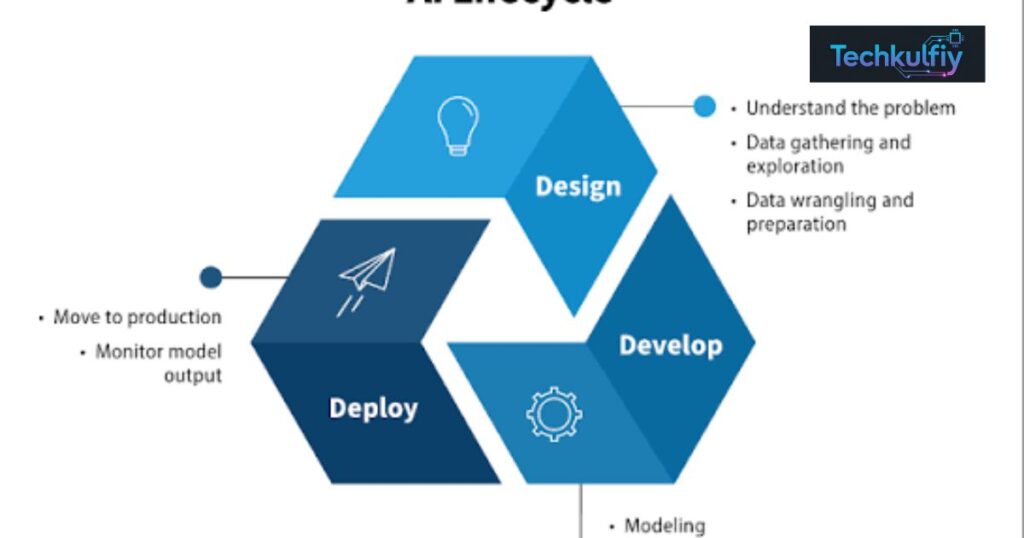
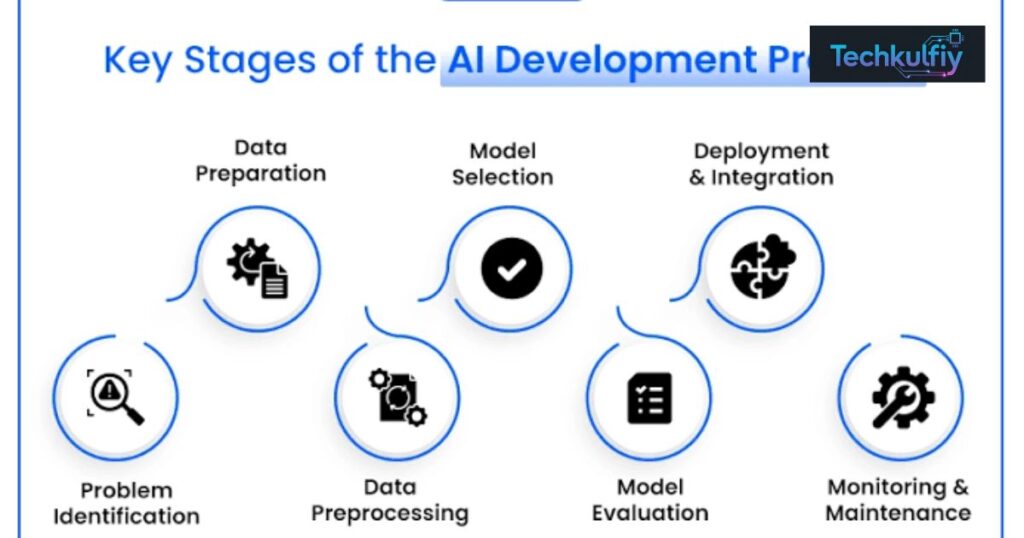
A practical AI project usually begins with a problem rather than a model. A U.S. retailer might want to predict product demand. A hospital could explore tools for medical-image analysis. A financial company may need better fraud detection. Developers first define the problem, collect suitable information, prepare the data, choose an approach, develop or integrate an AI model, evaluate its performance, and then deploy the resulting application. This lifecycle explains the features of artificial intelligence that make it different from ordinary automation: systems can identify patterns, adapt to information, support decision making, and perform tasks at a scale that would be difficult for people alone. The importance of artificial intelligence therefore comes from its ability to turn large amounts of information into useful actions rather than simply making software look “smart.”
Prerequisites for AI Development
Before jumping into advanced AI development tutorials, build a foundation that makes the harder concepts easier. You don’t need to become a mathematician before writing your first AI program. However, basic programming, statistics, and logical thinking will save you plenty of frustration later. The main prerequisites for artificial intelligence include programming fundamentals, data structures, algorithms, basic probability, statistics, and an understanding of how computers process information. For people starting from scratch, programming for AI should usually come before advanced neural networks. Python is particularly useful because it has a large ecosystem for data analysis and machine learning. Python’s official documentation describes the language as easy to learn and suitable for rapid application development. ([Python documentation][1])
Mathematics also has an important place in AI, although you can learn it progressively. Mathematics for artificial intelligence usually includes probability, statistics, linear algebra, and some calculus. Statistics helps you understand data and evaluate models. Linear algebra gives you the language needed to work with vectors and matrices. Calculus becomes more relevant when you study optimization and neural-network training. You should also understand data structures and data handling because AI applications constantly move, transform, store, and retrieve information. A beginner doesn’t need to master every concept at once. Start with programming and small datasets, then expand your mathematical knowledge as your projects become more advanced.
| Skill | Why It Matters in AI Development |
|---|---|
| Python | Builds AI applications and works with major AI libraries |
| Statistics | Helps analyze data and evaluate models |
| Linear algebra | Supports vectors, matrices, and neural networks |
| Algorithms | Helps solve computational problems efficiently |
| Data structures | Organizes and processes information |
| APIs | Connects AI models with applications |
| Git | Tracks and manages development changes |
Python for AI Development
For many beginners, Python for artificial intelligence is one of the best places to start. Python uses readable syntax and has an enormous collection of libraries for scientific computing, data analysis, machine learning, and application development. The official Python resources provide beginner material as well as detailed documentation for developers. ([Python.org][2]) In practical artificial intelligence programming, you might use NumPy for numerical operations, Pandas for structured data, Matplotlib for visualization, and scikit-learn for classical machine learning. Later, you can move into frameworks such as PyTorch or TensorFlow when your work requires neural networks and deep learning.
The real value of Python becomes clear when you build something instead of simply reading about it. Imagine a small U.S. online store that wants to predict whether a customer might cancel an order. You could load customer information with Pandas, clean the dataset, analyze patterns, train a machine learning model, evaluate its predictions, and connect the model to a web application. This is where AI tools and libraries become practical rather than theoretical. Scikit-learn’s tutorials cover machine-learning workflows such as loading datasets, learning and prediction, model selection, text processing, and evaluation. ([Scikit-learn][3]) Python also supports virtual environments and package management, which makes it easier to maintain separate development projects. ([Python documentation][1])
Data Preprocessing for AI
Data is the raw material behind many AI models, and poor data can quietly damage an otherwise promising project. Data analysis helps developers understand what a dataset actually contains before training begins. You may find missing values, duplicated records, inconsistent formats, extreme values, or irrelevant features. Preprocessing can include cleaning records, converting categories into numerical values, scaling features, removing duplicates, handling missing information, and selecting useful variables. For text-based applications, developers may also need tokenization, normalization, and other language-processing steps. For images, preprocessing might involve resizing, normalization, and augmentation. The exact process depends on the problem and the type of data.
Consider a company building an AI system to predict customer churn. Its database might contain customer age, subscription type, purchase history, support interactions, and cancellation status. If some records contain missing values or inconsistent labels, the model may learn misleading patterns. Developers therefore divide information into training, validation, and test sets and take care to prevent data leakage. Predictive analysis becomes meaningful only when a model performs well on new information rather than merely memorizing its training examples. This is also where AI pattern recognition begins to matter. The model needs useful signals that help it distinguish meaningful relationships from random noise.
| Preprocessing Stage | Main Purpose |
|---|---|
| Data collection | Gather relevant information |
| Data cleaning | Remove or correct errors |
| Missing-value handling | Prevent incomplete records from damaging training |
| Feature engineering | Create useful input variables |
| Encoding | Convert categories into usable numerical formats |
| Scaling | Put numerical features on suitable ranges |
| Data splitting | Separate training, validation, and testing |
| Quality checks | Detect leakage, bias, and unusual patterns |
AI Algorithms and Problem Solving
Not every AI problem requires a giant neural network. Classical AI algorithms remain valuable for search, planning, optimization, reasoning, and structured decision-making. Imagine a navigation application trying to find an efficient route through a city. Search algorithms can explore possible paths and compare alternatives. Local search can improve a current solution step by step. Adversarial search can help a game-playing system evaluate possible moves against an opponent. Constraint-based methods can solve scheduling problems where several conditions must be satisfied simultaneously. These techniques form an important part of artificial intelligence algorithms and help explain how machines approach problems before machine learning enters the picture.
Reasoning and planning are equally important. A software system may need to represent facts, understand relationships, evaluate possible actions, and choose a useful sequence. This is where AI problem solving becomes more than simply making predictions. Developers can combine rules, search, optimization, knowledge representation, and learned models depending on the task. For example, an airline scheduling system might use optimization to balance aircraft, crew, time, and airport constraints. A game-playing system may use search to evaluate possible moves. A modern AI agent may combine a language model with tools and structured decision processes. Understanding these AI algorithms and techniques gives developers a wider toolkit instead of forcing every problem into machine learning.
Machine Learning for AI Development
Machine learning is one of the central technologies within modern AI development. Instead of writing every rule manually, developers provide data and allow an algorithm to learn patterns that can support predictions or decisions. Supervised learning uses examples with known outcomes. A model might learn to classify emails as spam or predict customer churn. Unsupervised learning works with data that doesn’t have predefined labels and can discover groups or structures. Semi-supervised approaches combine labeled and unlabeled information, while reinforcement learning allows an agent to learn through actions, feedback, and rewards. These different types of artificial intelligence techniques serve different purposes, so choosing the right approach matters.
The development process doesn’t end when a model produces predictions. You need to evaluate how well those predictions work. Accuracy can be useful, but it isn’t always enough. For an imbalanced fraud-detection dataset, for example, a model could achieve high accuracy while missing many fraudulent transactions. Precision, recall, F1 score, confusion matrices, and other metrics can provide a clearer picture. This is why AI decision making depends on careful evaluation rather than impressive-looking numbers. Scikit-learn provides tools and tutorials for supervised learning, unsupervised learning, model selection, text classification, and evaluation. ([Scikit-learn][3]) In practice, developers often compare several approaches before selecting the model that provides the best balance of performance, cost, speed, and reliability.
| Learning Approach | Typical Use |
|---|---|
| Supervised learning | Classification and prediction |
| Unsupervised learning | Clustering and pattern discovery |
| Semi-supervised learning | Problems with limited labeled data |
| Reinforcement learning | Sequential decisions and interactive environments |
| Deep learning | Complex images, language, audio, and multimodal tasks |
Deep Learning for AI Development
Deep learning uses multi-layer neural networks to learn complex representations from data. A neural network contains interconnected computational units that adjust their parameters during training. The model makes a prediction, measures its error through a loss function, and updates its parameters using optimization methods. Repeating this process across many examples allows the network to learn useful representations. Deep learning has become particularly important for language, images, speech, video, and other high-dimensional information. It forms a major part of modern AI capabilities and powers many applications that seemed difficult only a few years ago.
Different architectures work well for different tasks. Convolutional neural networks have played an important role in computer vision, where models need to recognize visual patterns. Recurrent architectures have been used for sequential data, while transformer architectures now dominate many language and multimodal workloads. Developers also use transfer learning to adapt existing models instead of starting with random parameters every time. Frameworks such as PyTorch provide workflows for datasets, model construction, automatic differentiation, optimization, and saving trained models. ([PyTorch Docs][4]) This makes deep learning more accessible because developers can experiment in hosted environments or run projects locally without building every mathematical component from scratch.
A simple way to understand deep learning is to imagine teaching a child to recognize a dog. You don’t explain every pixel. Instead, the child gradually learns shapes, textures, ears, faces, and other visual clues from examples. Neural networks learn in a somewhat analogous computational way, although their internal processes are fundamentally different from human intelligence. The important lesson for developers is that deep learning needs suitable data, appropriate architecture, meaningful evaluation, and enough computational resources. Bigger models aren’t automatically better. Sometimes a smaller, well-trained model is the smarter engineering choice.
Generative AI and Transformer Models
Generative AI has expanded the scope of modern AI technology beyond prediction and classification. Generative systems can create text, images, code, audio, and other content from learned patterns. Large language models can summarize documents, answer questions, assist with coding, generate drafts, and power conversational applications. This has created new forms of AI content creation, AI chatbots, and virtual assistants for consumers and businesses. Generative AI can also support internal company workflows, such as searching documents, extracting information, preparing reports, and answering employee questions. The key is to treat these models as components inside a larger system rather than magical boxes that automatically solve every business problem.
Transformer models are particularly important because attention mechanisms allow models to capture relationships between tokens and process complex sequences efficiently. Modern developers can work with pretrained models, embeddings, retrieval systems, fine-tuning methods, and APIs rather than training every large model from zero. This approach can dramatically reduce the resources needed for experimentation. Hugging Face’s Transformers documentation provides tools for working with pretrained models and building modern machine-learning applications. AI frameworks and model libraries now make advanced experimentation accessible to developers who previously needed specialized research infrastructure. However, responsible development still requires attention to hallucinations, privacy, bias, security, copyright, cost, and evaluation.
| Generative AI Concept | Simple Explanation |
|---|---|
| Large language model | AI model trained to work with language |
| Transformer | Architecture based heavily on attention mechanisms |
| Token | A unit of text processed by a language model |
| Embedding | Numerical representation of information |
| Prompt | Input instructions given to a generative model |
| RAG | Combines generation with retrieved external information |
| Fine-tuning | Further training a model for a particular purpose |
| Multimodal AI | Works across multiple types of information |
Building and Deploying AI Applications
Creating an AI model is only one stage of AI development. A model inside a notebook isn’t automatically a useful product. Real applications need an interface, APIs, databases, authentication, monitoring, error handling, security, and reliable infrastructure. Developers may deploy models through cloud platforms, containers, web services, mobile applications, or dedicated inference systems. They also need to consider latency and cost because an impressive model that takes too long to respond may frustrate users. A practical artificial intelligence automation system should therefore balance intelligence with speed, reliability, and maintainability.
Imagine a U.S. healthcare company building an AI assistant for internal document search. The team might connect a language model to approved company documents through retrieval. Employees could ask questions in natural language, while the system retrieves relevant information before generating an answer. This combines natural language processing, databases, APIs, model inference, access controls, and monitoring. The same basic architecture can support AI customer service, document analysis, recommendation systems, and internal knowledge assistants. Developers should also test the system against realistic examples, monitor failures after launch, and regularly review whether the application continues to meet its intended goals.
| Development Stage | What Happens |
|---|---|
| Problem definition | Identify a specific user or business need |
| Data preparation | Collect and prepare relevant information |
| Model selection | Choose an algorithm, pretrained model, or AI service |
| Development | Build and integrate the AI component |
| Evaluation | Test quality, accuracy, safety, and reliability |
| Deployment | Release the application for real users |
| Monitoring | Track errors, performance, cost, and behavior |
| Improvement | Update data, prompts, models, or application logic |
A useful case study is a customer-support assistant. The company doesn’t necessarily need to train a language model from scratch. It can use a suitable model, connect it to approved knowledge sources, add safeguards, test representative questions, and monitor responses. That approach can be faster and cheaper than creating a massive model independently. The lesson is simple: good AI engineering is often about choosing the right components, not building everything yourself.
AI Development Applications, Tools, and Career Opportunities
The applications of artificial intelligence now stretch across almost every major industry. In AI healthcare, developers can support medical research, image analysis, administrative workflows, and patient-facing tools. AI finance can assist with fraud detection, risk analysis, customer support, and document processing. AI in manufacturing can support quality inspection and predictive maintenance. AI in agriculture can analyze crop conditions and environmental information. AI in transportation can support route planning, traffic analysis, logistics, and autonomous vehicles. The same underlying technologies can appear in very different forms depending on the industry’s needs. This variety explains why AI solutions have become attractive to businesses of all sizes.
AI also has a growing role in AI in education, where systems can support personalized learning, tutoring, content generation, and administrative tasks. AI security can help identify unusual activity and potential threats. AI applications in retail can power recommendations, demand forecasting, and customer analysis. Robotics combines AI with sensors, physical control, and environmental awareness. Meanwhile, AI research continues to expand the boundaries of what models can accomplish. These developments create artificial intelligence career opportunities across software engineering, data science, research, product development, and specialized AI roles.
| Career | Main Focus |
|---|---|
| AI machine learning engineer | Builds and integrates machine-learning systems |
| Data scientist | Analyzes data and develops predictive models |
| AI research scientist | Studies new AI methods and capabilities |
| Computer vision engineer | Builds systems that understand visual information |
| NLP engineer | Develops language-processing applications |
| AI product manager | Connects AI capabilities with product goals |
| MLOps engineer | Manages AI deployment and production workflows |
| Generative AI engineer | Builds applications using modern generative models |
The U.S. job market also increasingly values developers who can connect AI models with reliable software. Learning artificial intelligence jobs isn’t only about memorizing algorithms. Employers often look for people who can solve problems, write maintainable code, work with data, evaluate models, and understand production systems. A portfolio can demonstrate these abilities more clearly than a certificate alone. For example, a developer could build a customer-support chatbot, a document-analysis application, a computer-vision project, or a forecasting system and explain how each component works. The strongest projects show both technical ability and practical judgment.
The future of artificial intelligence will likely involve deeper integration between models, software, data, robotics, and human workflows. Developers will continue exploring AI real-world applications while dealing with important questions around reliability, privacy, security, bias, and responsible use. Understanding the risks of artificial intelligence is therefore part of becoming a capable developer rather than an optional extra. As artificial intelligence research advances, the most valuable skill may be adaptability: knowing how to learn a new model, framework, or development method without losing sight of the underlying engineering principles.
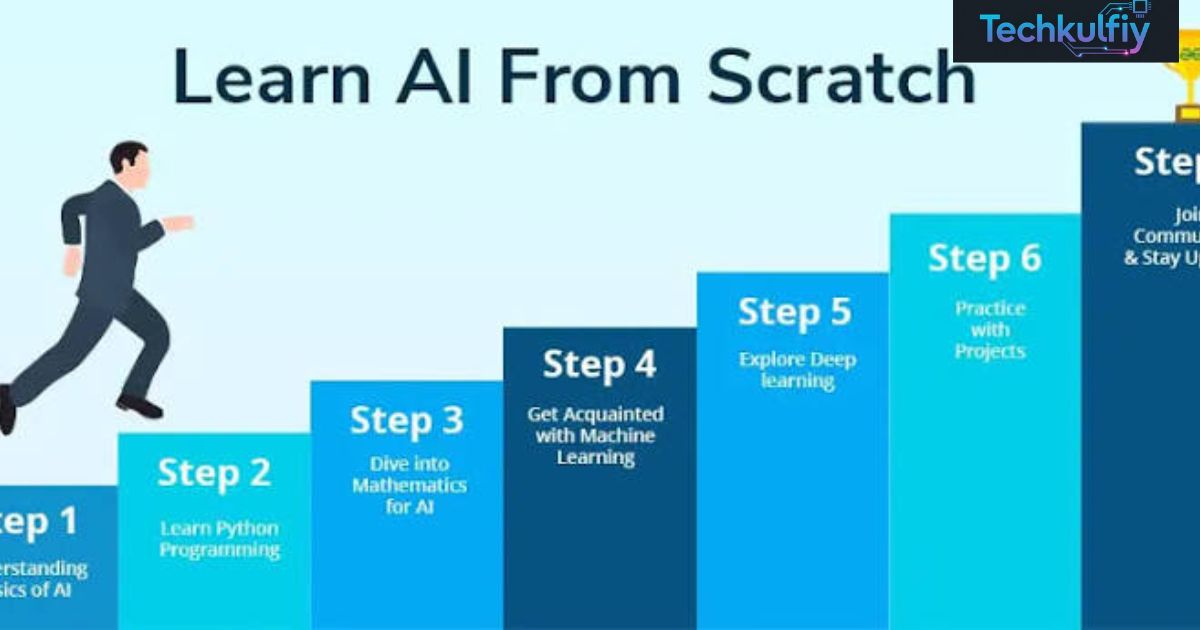
The journey through AI development tutorials doesn’t need to be overwhelming. Start with programming, learn how data behaves, understand machine learning, explore deep learning, and then move into generative AI and deployment. Build small projects as you learn instead of waiting until you feel completely ready. A simple model that solves a real problem can teach you more than hours of passive reading. Over time, those projects become a portfolio, your knowledge becomes more connected, and AI development stops looking like a maze of unfamiliar terms. It becomes what it really is: a practical way to turn data, algorithms, and software into useful intelligent systems.
FAQs
1. How do I start learning AI development as a beginner?
Start with Python, basic mathematics, data handling, and machine learning concepts. Then build small AI projects through practical tutorials.
2. What is the difference between Machine Learning, Deep Learning, and Generative AI?
Machine Learning learns patterns from data, while Deep Learning uses neural networks. Generative AI creates new content such as text, images, and code.
3. Do I need a high-end GPU to learn and build AI applications?
No, beginners can learn AI using a regular computer and cloud platforms. A powerful GPU becomes more useful for training large models.
4. What is the difference between Fine-Tuning a model and RAG?
Fine-tuning changes a model’s behavior by training it on specific data. RAG gives a model relevant external information when generating responses.
5. How long does it take to become an AI developer?
It depends on your background and learning pace. With consistent practice, you can build basic AI projects within a few months.
Meta Description
Explore AI Development Tutorials to learn AI, build smart models, master Python, and create practical AI apps step by step easily.
