

3I/ATLAS is an interstellar comet from outside our solar system.
It is the third known interstellar object observed by scientists.
Its unusual path shows that it came from another star system.
What if a comet from another star suddenly entered our cosmic neighborhood?
That is what makes 3I/ATLAS such an exciting space discovery.
Scientists are studying its journey, chemistry, and unusual behavior.
3I/ATLAS was discovered on July 1, 2025, by the ATLAS survey.
Astronomers have used powerful telescopes to study its composition.
Its observations may reveal clues about distant planetary systems.OL
What Is 3I/ATLAS?
3I/ATLAS is a comet that originated outside our solar system. Scientists classify it as an interstellar object because its speed and orbital path show that it did not form around our Sun. NASA identifies it as the third known interstellar object observed passing through our solar system. ([NASA Science][1])
The name itself is fairly simple. The number “3” refers to its position as the third known interstellar object. The letter “I” means interstellar. ATLAS refers to the survey telescope that discovered it.
The term 3I/ATLAS NASA is commonly searched because NASA has published detailed information about this unusual comet. According to NASA, its characteristics, color, direction, speed, icy nucleus, and coma are consistent with cometary behavior. ([NASA Science][1])
A comet has a solid center called a nucleus. When sunlight heats the nucleus, frozen materials release gas and dust. This creates a surrounding cloud called a coma. The same process can produce dust and gas structures that appear like a cometary tail.
This behavior is important because it provides strong evidence that 3I/ATLAS is a natural comet rather than an artificial object.
| Feature | Details |
|---|---|
| Object | 3I/ATLAS |
| Type | Interstellar comet |
| Classification | Third known interstellar object |
| Discovery date | July 1, 2025 |
| Discovering system | ATLAS |
| Origin | Outside the solar system |
| Orbital path | Hyperbolic |
| Closest Earth distance | About 270 million km |
| Closest Sun distance | About 210 million km |
In simple terms, an ordinary solar-system comet is like a traveler who belongs to the neighborhood. 3I/ATLAS is more like a traveler who came from another city, visited briefly, and continued on its way.
Discovery and History of 3I/ATLAS
The story of 3I/ATLAS began on July 1, 2025. The NASA-funded ATLAS telescope in Rio Hurtado, Chile, reported observations of the object to the Minor Planet Center. ATLAS stands for the Asteroid Terrestrial-impact Last Alert System. It is part of a sky-monitoring system designed to discover objects moving through space. ([NASA Science][2])
The first observation was only the beginning. After the discovery, scientists searched older astronomical records for earlier images of the same object. They found pre-discovery observations that extended the observational record back to June 14, 2025. This additional information helped researchers calculate its trajectory more accurately. ([NASA Science][2])
The 3I/ATLAS discovery quickly attracted worldwide attention because its movement was different from ordinary comets. Its high velocity and unusual path showed that it was traveling through the solar system rather than orbiting the Sun permanently.
The object became the focus of extensive 3I/ATLAS observations. Telescopes around the world collected information about its position, brightness, gases, dust, and changing activity. Space-based observatories added another layer of information that ground-based telescopes cannot always provide.
| Date | Development |
|---|---|
| June 14, 2025 | Earliest known pre-discovery observations |
| July 1, 2025 | Official discovery report |
| July 2025 | Follow-up observations expanded |
| October 30, 2025 | Closest approach to the Sun |
| December 2025 | Detailed JWST observations |
| 2026 | New studies examined its chemistry and origin |
The history of 3I/ATLAS also demonstrates why long-term astronomical surveys matter. A fast-moving object can initially appear as a tiny point of light. With enough observations, scientists can turn those small points into a detailed map of its journey.
3I/ATLAS Trajectory and Orbit
The 3I/ATLAS trajectory is one of the strongest reasons scientists classify the object as interstellar. Its 3I/ATLAS orbit is not a closed orbit around the Sun. Instead, the object follows a hyperbolic trajectory and will eventually leave the solar system. ([NASA Science][1])
When 3I/ATLAS was discovered, it was traveling at about 221,000 kilometers per hour. The Sun’s gravity increased its speed as it moved inward. Near perihelion, its speed reached roughly 246,000 kilometers per hour. ([NASA Science][1])
The comet reached its closest point to the Sun on October 30, 2025. It passed about 210 million kilometers from the Sun, or around 1.4 astronomical units. This placed it just outside the orbit of Mars.
The 3I/ATLAS speed is remarkable, but speed alone does not explain its interstellar status. Scientists combine velocity with the shape and direction of the orbit. Together, these measurements show that the comet was not gravitationally bound to the Sun.
| Orbital Detail | Approximate Value |
|---|---|
| Discovery speed | 221,000 km/h |
| Speed near perihelion | 246,000 km/h |
| Closest Sun distance | 210 million km |
| Closest Sun distance | 1.4 AU |
| Orbit type | Hyperbolic |
| Long-term path | Back into interstellar space |
The 3I/ATLAS Earth distance was never dangerous. NASA states that the comet came no closer than about 270 million kilometers from Earth, or 1.8 astronomical units. ([NASA Science][1])
The International Astronomical Union also reported that thousands of observations confirmed that 3I/ATLAS would not come close to Earth. ([International Astronautical Union][3])
Another interesting detail involves small changes in its motion. Comets can experience tiny trajectory changes when gases escape from their surfaces. This process is called outgassing. NASA says the observed changes in 3I/ATLAS were small and compatible with normal cometary activity. ([NASA Science][1])
Where Did 3I/ATLAS Come From?
The simple answer is that 3I/ATLAS came from outside our solar system. Its trajectory can be traced backward to interstellar space rather than to a normal orbit around the Sun.
The exact star system where it formed is not known. NASA explains that 3I/ATLAS likely formed around another star and was later ejected into interstellar space. It may have traveled for millions or even billions of years before reaching our solar system. ([NASA Science][1])
This makes the comet origin especially valuable to scientists. Most comets studied in detail belong to our own solar system. Their chemistry records the conditions that existed when our planetary neighborhood formed.
3I/ATLAS offers a different sample.
The 2026 Nature study found unusual isotopic signatures in the comet. Its water showed a very high deuterium-to-hydrogen ratio, while its carbon isotope ratios were also unusual compared with known solar-system bodies. Researchers concluded that the measurements point toward formation in a very cold environment at temperatures of about 30 kelvin or lower. ([Nature][4])
The same study suggested that its material may have been assembled as long ago as about 12 billion years ago. That is an estimate based on models of galactic chemical evolution, not a direct measurement of the comet’s age. ([Nature][4])
This possibility makes 3I/ATLAS particularly fascinating. Its material may preserve information from an ancient planetary environment that formed long before our own solar system.
“Interstellar objects provide the only directly observable samples of icy planetesimals formed around other stars.” ([Nature][4])
That idea gives scientists a powerful opportunity. Instead of studying only our own cosmic neighborhood, researchers can compare its chemistry with material from another planetary system.
Physical Characteristics of 3I/ATLAS
The 3I/ATLAS size is not known with complete precision because its solid nucleus is surrounded by gas and dust. Hubble observations from August 20, 2025, allowed astronomers to estimate the nucleus diameter at between about 440 meters and 5.6 kilometers. ([NASA Science][1])
That range is wide, but this is normal for an active comet. The solid nucleus can be difficult to separate from the surrounding coma in telescope images.
The comet nucleus is the solid center of the object. Around it sits the coma, which contains gas and dust released from the surface. As the comet moves closer to the Sun, heating can increase the amount of material escaping from the nucleus.
Researchers have also examined the comet’s color and surface-related properties. A red spectral slope has been reported in observations, which describes how the object’s reflected light changes across different wavelengths.
Other measurements have helped scientists study its brightness and rotation. A changing brightness pattern can provide clues about the spin period and the shape of the nucleus, although such measurements can be affected by the surrounding coma.
| Physical Property | What Scientists Study |
|---|---|
| Nucleus | Size and structure |
| Coma | Gas and dust surrounding the nucleus |
| Color | Surface and dust properties |
| Brightness | Activity and rotation clues |
| Dust | Release from the nucleus |
| Gas | Chemical composition |
| Spin | Rotation behavior |
The visible appearance of 3I/ATLAS should not be confused with the size of its solid body. A comet’s coma can extend far beyond the nucleus. In other words, the object can look much larger than the rocky or icy core hidden inside it.
What Is 3I/ATLAS Made Of?
The 3I/ATLAS composition is one of the most important areas of current research. Scientists can study the gases surrounding the comet by examining the light they produce.
This method is called spectroscopy. Different molecules produce specific patterns in light, almost like fingerprints. By studying those fingerprints, scientists can identify chemical compounds even when they cannot directly collect a physical sample.
The 3I/ATLAS chemistry has revealed water, carbon dioxide, carbon monoxide, and other molecules. The James Webb Space Telescope provided particularly valuable infrared measurements of the comet’s coma. ([Nature][4])
The Nature study used JWST observations from December 22 and 23, 2025. Researchers examined water, carbon dioxide, carbon monoxide, and their isotopic forms. Ground-based ALMA observations were also used to study gases including carbon monoxide and hydrogen cyanide. ([Nature][4])
| Material or Measurement | Why It Matters |
|---|---|
| Water | Reveals icy material |
| Carbon dioxide | Helps explain chemical formation |
| Carbon monoxide | Provides clues about the comet’s environment |
| Methane | Adds information about volatile material |
| Deuterium | Helps reveal formation conditions |
| Carbon isotopes | Help investigate origin and age |
The high deuterium level is particularly interesting. Nature reported a D/H ratio of about 0.98%, more than an order of magnitude higher than values found in known comets. ([Nature][4])
This unusual chemistry does not mean the comet is artificial. Instead, it provides evidence about the environment where its icy material formed.
In simple terms, chemistry works like a cosmic fingerprint. The molecules themselves tell scientists something about the temperature, radiation, and history of the environment where the comet developed.
How Active Is 3I/ATLAS?
The 3I/ATLAS activity is one of the clearest signs that it is a comet. As sunlight warms the nucleus, frozen materials can change directly from solid to gas. The escaping gas can carry dust away from the surface.
This process is known as comet outgassing.
The resulting cometary activity can create a coma around the nucleus. It can also produce dust and gas structures that change as the object moves closer to or farther from the Sun.
Scientists study this activity because it reveals what lies beneath the surface. Different ices can become active at different temperatures. A comet therefore acts like a natural chemical laboratory that changes as sunlight heats it.
The term outgassing is especially important when discussing small changes in the comet’s path. When gas escapes from one part of the nucleus, it can produce a tiny push. Over long periods, these small forces can slightly change the predicted trajectory.
NASA says observations of 3I/ATLAS showed only small non-gravitational changes that were compatible with cometary outgassing. ([NASA Science][1])
The object also experienced stronger heating as it approached the Sun. That increased activity helped astronomers collect more information about its gases and chemical composition.
This is why scientists do not judge a comet only by its appearance. Its changing activity can reveal much more about its physical structure.
How Scientists Are Studying 3I/ATLAS
The study of 3I/ATLAS involves many types of instruments. No single telescope can reveal every part of the story.
The ATLAS telescope was responsible for the initial discovery. Its full name, the Asteroid Terrestrial-impact Last Alert System, describes its role in surveying the sky for moving objects. The discovery gave researchers the opportunity to coordinate additional observations. ([NASA Science][2])
The James Webb Space Telescope then provided powerful infrared data. Its instruments can identify molecular emissions that are difficult to study from Earth.
The JWST observations published in Nature measured several gases and isotopic forms. These observations helped researchers investigate the comet’s chemical history and possible birthplace. ([Nature][4])
Other telescopes contribute different types of information. Photometric observations can measure changes in brightness. Spectroscopic observations can reveal molecules. Precise position measurements help astronomers calculate the trajectory.
These combined astronomical observations are essential because the comet is moving rapidly through space.
| Observation Type | Main Purpose |
|---|---|
| Imaging | Study appearance and dust |
| Spectroscopy | Identify molecules |
| Photometry | Measure brightness changes |
| Astrometry | Calculate position and orbit |
| Infrared observations | Study gases and thermal signatures |
| Long-term monitoring | Track changes in activity |
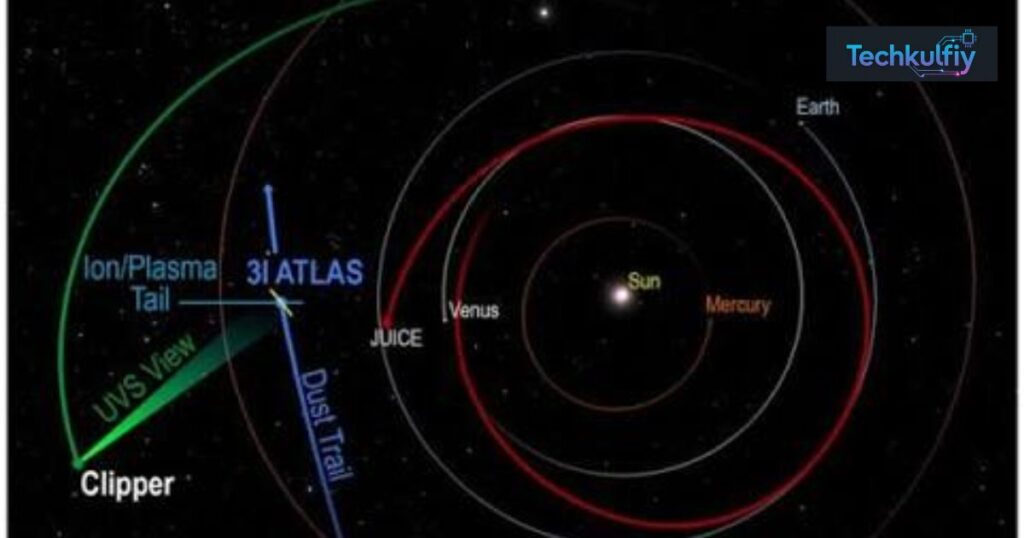
NASA has also used several spacecraft and observatories to study the object. NASA reports that the comet was observed by missions including Hubble, Webb, SPHEREx, and spacecraft operating around Mars. ([NASA Science][2])
This multi-observatory approach is important because 3I/ATLAS cannot simply be captured and brought back to Earth. Scientists must learn about it while it passes through the solar system.
Is 3I/ATLAS an Alien Spacecraft?
The question of whether 3I/ATLAS could be an alien spacecraft has received considerable attention online.
Some discussions describe the object as a possible artificial probe because it is interstellar and has unusual chemical properties. Other discussions focus on its trajectory, brightness, or reported radio signals.
However, an unusual object is not automatically an artificial object.
NASA’s observations show that 3I/ATLAS has an icy nucleus, a coma, gas production, dust, and behavior consistent with a comet. NASA therefore classifies it as an interstellar comet. ([NASA Science][1])
The International Astronomical Union has also addressed misinformation surrounding the object. In February 2026, the IAU said that more than 4,000 observations had confirmed that 3I/ATLAS would not come close to Earth. ([International Astronautical Union][3])
It is useful to separate scientific observations from speculation.
| Established Observation | Speculative Interpretation |
|---|---|
| Hyperbolic path | Artificial spacecraft |
| Icy nucleus | Engineered object |
| Coma and dust | Alien technology |
| Unusual chemistry | Artificial origin |
| Interstellar origin | Alien probe |
| Cometary outgassing | Propulsion system |
The distinction matters. A natural comet can have unusual chemistry without being engineered. A small non-gravitational acceleration can result from gas escaping its surface without requiring propulsion technology.
Likewise, reports involving radio signals need careful scientific analysis. A signal alone does not prove communication. Researchers must determine its source, repeatability, frequency behavior, physical mechanism, and whether natural explanations can account for it.
At present, the available evidence supports the classification of 3I/ATLAS as a natural interstellar comet. Claims that it is an alien spacecraft remain speculation rather than an established scientific conclusion.
Why Is 3I/ATLAS Important for Space Exploration?
The importance of 3I/ATLAS goes far beyond its unusual name.
Scientists normally study planets, asteroids, and comets that formed in our own solar system. Those objects contain valuable information about our cosmic history. But they cannot directly tell us everything about planetary systems around other stars.
An interstellar object can provide a different kind of evidence.
The 2026 Nature research describes interstellar objects as observable samples of icy planetesimals formed around other stars. The chemical and isotopic properties of 3I/ATLAS therefore provide an opportunity to compare another planetary environment with our own. ([Nature][4])
This is important for space exploration because scientists want to understand whether the processes that created our planets are common throughout the galaxy.
The unusual isotope ratios in 3I/ATLAS suggest that its material formed under conditions very different from those represented by known solar-system comets. Researchers linked the measurements to a very cold formation environment and an ancient, relatively metal-poor setting. ([Nature][4])
| Scientific Question | What 3I/ATLAS Can Teach Us |
|---|---|
| How do other planetary systems form? | Chemical clues from another system |
| Are all comets chemically similar? | Direct comparison with solar-system comets |
| How old can cometary material be? | Isotopic evidence |
| What environments create icy bodies? | Temperature and chemical clues |
| How common are interstellar objects? | Better future surveys |
The discovery also shows the value of advanced sky surveys. Finding these objects early gives scientists more time to observe them.
Future surveys may discover additional interstellar visitors. If researchers eventually have many examples, they can compare their chemistry, sizes, origins, and trajectories.
For now, 3I/ATLAS is a rare window into another planetary system.
Frequently Asked Questions About 3I/ATLAS
What is 3I/ATLAS?
3I/ATLAS is an interstellar comet and the third known interstellar object observed passing through our solar system. Its hyperbolic path shows that it originated outside the solar system. ([NASA Science][1])
When was 3I/ATLAS discovered?
The 3I/ATLAS discovery was reported on July 1, 2025, by the NASA-funded ATLAS survey telescope in Rio Hurtado, Chile. Older observations were later found in archival data. ([NASA Science][2])
Why is 3I/ATLAS called an interstellar comet?
Its speed and hyperbolic trajectory show that it is not gravitationally bound to the Sun. Its icy nucleus, coma, gas, and dust show that it behaves like a comet. ([NASA Science][1])
How fast is 3I/ATLAS?
The 3I/ATLAS speed was about 221,000 kilometers per hour when discovered. It accelerated to about 246,000 kilometers per hour near perihelion because of the Sun’s gravity. ([NASA Science][1])
How large is 3I/ATLAS?
NASA reports that Hubble observations placed the estimated nucleus diameter between about 440 meters and 5.6 kilometers. The exact size remains uncertain. ([NASA Science][1])
Did 3I/ATLAS come close to Earth?
No. The closest 3I/ATLAS Earth distance was about 270 million kilometers, or 1.8 astronomical units. NASA states that the comet posed no danger to Earth. ([NASA Science][1])
What is 3I/ATLAS made of?
The 3I/ATLAS composition includes water, carbon dioxide, carbon monoxide, and other volatile materials. JWST measurements also revealed unusual isotopic ratios. ([Nature][4])
What did JWST find about 3I/ATLAS?
The James Webb Space Telescope detected gases and isotopic signatures that provide clues about the comet’s formation environment. The Nature study reported unusually high deuterium and unusual carbon isotope ratios. ([Nature][4])
Why is 3I/ATLAS chemistry unusual?
The 3I/ATLAS chemistry includes isotope ratios that differ strongly from known solar-system bodies. These measurements suggest formation in an extremely cold environment. ([Nature][4])
Is 3I/ATLAS older than our solar system?
It may be. A 2026 Nature study found that its isotopic composition is consistent with material that could have formed as long ago as about 12 billion years. This is an estimated formation timeframe rather than a direct measurement of the comet’s age. ([Nature][4])
Is 3I/ATLAS an alien spacecraft?
There is no confirmed evidence that 3I/ATLAS is an alien spacecraft. Current observations are consistent with a natural comet. The IAU has also highlighted the spread of misinformation and encouraged the public to rely on validated scientific information. ([International Astronautical Union][3])
What happens to 3I/ATLAS next?
Because its path is hyperbolic, 3I/ATLAS will continue away from the Sun and eventually leave our solar system. It will return to interstellar space rather than becoming a permanent solar-system object. ([NASA Science][1])
Conclusion
3I/ATLAS is one of the rarest astronomical visitors ever observed passing through our solar system. Its 3I/ATLAS trajectory, high speed, unusual chemistry, and interstellar origin make it an important subject for modern astronomy.
The 3I/ATLAS discovery also represents a major opportunity for scientists. Instead of studying only material formed around our Sun, researchers can examine an object that developed around another star. Its water, carbon compounds, isotopes, dust, and gases provide clues about a distant planetary environment.
The latest 3I/ATLAS observations have made the story even more interesting. JWST data suggest that the comet formed in an extremely cold environment, while its unusual isotopic signatures may preserve information from a very ancient period of galactic history. ([Nature][4])
At the same time, it is important to separate evidence from speculation. The unusual nature of 3I/ATLAS does not by itself prove that it is an artificial probe. Current observations show the characteristics of a natural comet, including an icy nucleus, coma, dust, and outgassing.
Perhaps the most exciting part is what comes next. 3I/ATLAS will eventually disappear into interstellar space, but the information collected from it will remain. As telescopes become more powerful, scientists may discover more interstellar objects and compare them with this remarkable visitor.
For now, 3I/ATLAS gives humanity something extraordinary: a chance to study a small piece of another planetary system without ever leaving Earth.

About the Author
The author at TechKulfiy writes informative articles about technology, software, digital platforms, and IT solutions. The goal is to make complex topics easier to understand by providing clear explanations, practical insights, and helpful information. Each article aims to help readers explore technology topics and make informed decisions.