
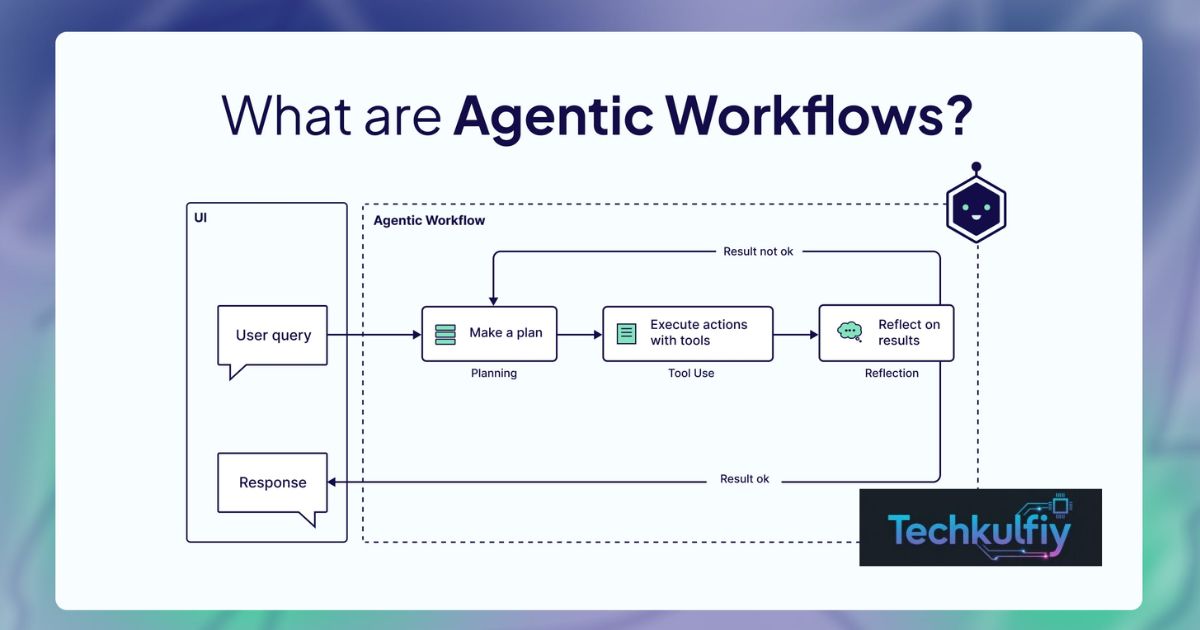
An agentic AI workflow is an AI system that works toward a goal with minimal human help.
It can understand information, make decisions, plan tasks, and take actions.
Unlike fixed automation, it can adapt its steps based on changing situations.
Imagine AI that doesn’t just follow instructions but chooses what to do next.
That’s the power of an agentic AI workflow in modern business and technology.
It can handle complex tasks while responding to new data and unexpected changes.
An agentic AI workflow connects AI agents, data, tools, and business systems.
It uses reasoning and feedback to improve how tasks are completed.
This makes AI workflow automation faster, smarter, and more flexible.
What Is an Agentic AI Workflow?
An agentic AI workflow is a system in which one or more AI agents work toward a defined goal by observing information, reasoning about the situation, choosing actions, using tools, and responding to feedback. Unlike a conventional software workflow, the system doesn’t necessarily follow the exact same sequence every time. It can select different steps depending on the information it receives. That flexibility is one of the defining features of autonomous AI.
Think of a traditional workflow as a railway track. Every train follows the same route because the track determines where it can go. An agentic workflow behaves more like a GPS. It has a destination, but it can choose another route when traffic, road closures, or new information changes the situation. In business terms, this means an agent can pursue a goal while adapting its path along the way.
The word “agentic” refers to agency, or the ability to act toward an objective. An agent doesn’t simply generate text. It can perform AI decision-making, interact with applications, retrieve information, and initiate actions. Depending on its permissions, it might create a support ticket, update a database, schedule a meeting, analyze a document, or trigger another automated process.
This doesn’t mean every AI-powered application is agentic. A chatbot that answers questions using generative AI may provide useful responses without taking meaningful action. An agentic system goes further by combining reasoning with execution. It may use an LLM to understand a request, call an API to retrieve information, apply business rules, decide what to do, and then use another tool to complete the task.
The distinction becomes clearer when comparing the three approaches below.
| Workflow type | Main behavior | Adaptability | Typical example |
|---|---|---|---|
| Traditional automation | Follows predefined rules | Low | Automatically sending an invoice |
| Generative AI workflow | Generates or transforms information | Moderate | Drafting a customer response |
| Agentic AI workflow | Reasons, plans, uses tools, and acts | High | Resolving a customer issue across multiple systems |
A well-designed agentic workflow can therefore support autonomous operations without removing people from every decision. In high-risk situations, organizations can introduce human in the loop approval before an agent performs an irreversible action. This creates a practical balance between autonomy and control.
How Does an Agentic AI Workflow Work?
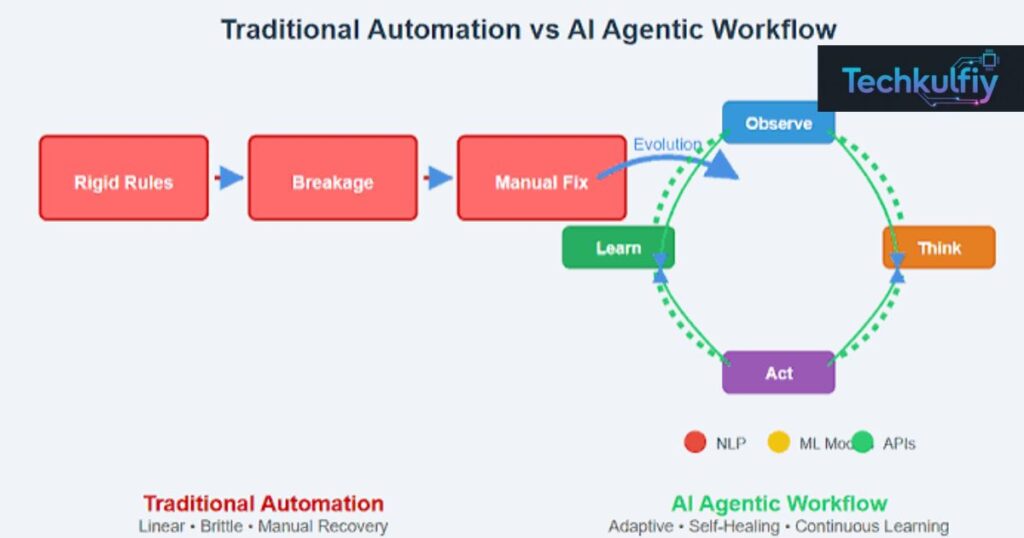
An agentic workflow typically begins with a goal, event, or incoming piece of information. The system then interprets the situation through AI environment perception, gathers relevant context, reasons about possible responses, chooses a plan, and performs actions. Afterward, it evaluates the outcome and can continue the process if the goal remains incomplete. This creates a feedback-driven cycle rather than a rigid sequence of commands.
A useful way to understand the process is through the classic MAPE control loop: monitoring, analysis, planning, and execution. Modern agentic systems expand this idea with sophisticated language models, tools, memory, retrieval systems, and feedback mechanisms. The agent first monitors its environment. It might receive a customer message, detect an unusual transaction, or notice that inventory has fallen below a threshold. It then analyzes available information and determines what matters.
Next comes planning. The agent may break a complicated objective into smaller tasks. For instance, “prepare a market report” could require finding recent industry data, checking company information, comparing competitors, analyzing trends, and preparing a final document. Instead of requiring a person to manually coordinate every step, the agent can create a plan and decide which tools it needs.
The workflow then moves into AI action execution. The agent may call APIs, query databases, search approved information sources, operate business software, or communicate with another agent. Once an action produces a result, the system can evaluate that result and determine whether it should continue, change direction, request approval, or stop.
This loop enables autonomous decision-making and, in time-sensitive environments, machine-speed decision-making. However, autonomy should match the risk of the task. An agent might safely reorder office supplies without approval, while a financial transaction or medical recommendation may require human review.
A simplified agentic workflow looks like this:
| Stage | What happens |
|---|---|
| Goal | The system receives an objective or detects an event |
| Perception | It gathers relevant information and context |
| Reasoning | It interprets the situation and considers options |
| Planning | It determines the steps needed to achieve the goal |
| Tool use | It selects APIs, databases, applications, or other tools |
| Execution | It performs the required actions |
| Evaluation | It checks whether the result meets the objective |
| Feedback | It adjusts the next step based on the outcome |
The important point is that an agentic workflow doesn’t merely “think.” It connects reasoning to action. That bridge between information and execution is what makes these systems useful for complex business processes.
Key Components of an Agentic AI Workflow
A reliable agentic workflow combines several technologies rather than relying on a single AI model. The central component is usually an AI agent powered by one or more AI models, such as large language models. The model provides capabilities for understanding language, reasoning through problems, interpreting instructions, and generating responses. However, the model alone cannot necessarily access business systems or perform real-world operations.
That is where tools become important. An agent might connect to a CRM, ERP platform, database, search system, calendar, email service, analytics platform, or custom API. These connections allow dynamic data consumption and give the agent access to information that changes over time. Retrieval systems can also provide relevant documents or company knowledge when the model needs additional context.
Memory is another important component. An agent may need to remember information from earlier steps, previous interactions, or the current task. Without suitable context management, the system can lose track of what it has already done. Good memory design helps maintain continuity while controlling what information the agent can access.
The underlying agent architecture also matters. A simple workflow may use one agent that handles everything. More sophisticated systems may divide responsibilities between several specialized agents. One agent might research information, another might analyze it, and a third might review the final result. This creates intelligent agents that cooperate within a larger system.
A strong workflow also needs orchestration, permissions, monitoring, and guardrails. Orchestration determines which agent or tool should act next. Permissions define what each agent can access. Guardrails restrict dangerous or inappropriate actions. Monitoring helps organizations understand what agents did, why they did it, and whether the workflow performed as expected.
The result is an AI pipeline that connects data, reasoning, tools, actions, and feedback. Machine learning can strengthen parts of this pipeline by improving predictions, classification, recommendations, or anomaly detection. Meanwhile, LLMs can provide flexible reasoning and language capabilities.
Agentic AI Workflow vs Traditional AI Workflows
Traditional workflows work best when the process is predictable. A company might define a sequence such as receiving a form, checking a field, updating a database, and sending an email. The system follows those rules consistently. That predictability makes conventional automation reliable and relatively easy to test.
Agentic workflows become useful when the path isn’t obvious. Instead of telling the system exactly which action to take at every stage, you provide a goal, constraints, available tools, and permissions. The agent determines how to proceed. This flexibility can help with customer support, research, IT troubleshooting, and other tasks where every case differs slightly.
Generative AI sits somewhere between these approaches. It can understand natural language and create useful content, but it doesn’t automatically become an autonomous agent simply because it uses an LLM. Agentic systems combine generative capabilities with planning, tools, memory, feedback, and execution.
| Feature | Traditional workflow | Generative AI workflow | Agentic AI workflow |
|---|---|---|---|
| Rules | Mostly fixed | Partly flexible | Dynamic within constraints |
| Decision-making | Predefined | Model-generated | Goal-driven |
| Tool use | Usually predefined | Limited or connected | Dynamic tool selection |
| Autonomy | Low | Moderate | High |
| Adaptation | Limited | Good | Strong |
| Multi-step tasks | Structured | Possible | Core capability |
| Feedback loop | Basic | Variable | Central feature |
| Human involvement | Often predefined | Usually interactive | Optional based on risk |
This doesn’t mean agentic workflows should replace every traditional process. A simple, deterministic task doesn’t need sophisticated autonomy. Using an AI agent to perform a task that a five-line automation rule can handle would add complexity without much benefit.
The better approach is to match the technology to the problem. Use traditional automation for stable processes. Use generative AI when content creation or language understanding is the main requirement. Choose agentic workflows when a task involves changing conditions, multiple steps, tool use, and meaningful decision-making.
Benefits of Agentic AI Workflows
The strongest advantage of intelligent automation is that it can connect decisions with actions. Employees often spend hours moving information between applications, checking records, researching routine questions, and coordinating repetitive tasks. An agentic workflow can handle much of that coordination while allowing people to focus on judgment, creativity, and higher-value work.
Efficiency is only part of the story. Agentic systems can also support faster responses because they don’t need a person to initiate every intermediate step. In a support environment, for example, an agent can classify an issue, retrieve account information, search relevant documentation, and prepare a resolution within one connected workflow.
Another major benefit is scalability. A human team may struggle when task volume suddenly increases. A properly designed agentic system can handle many similar workflows simultaneously, provided the underlying infrastructure and controls can support that load. This creates scalable AI infrastructure that can expand alongside business demand.
Agentic systems can also improve decision quality when they combine multiple sources of information. An agent might compare real-time sales data with inventory levels, customer behavior, and external market signals before recommending an action. This produces AI-powered decision-making based on a broader context than a single data source.
| Benefit | Business impact |
|---|---|
| Efficiency | Reduces repetitive manual work |
| Speed | Enables faster responses and decisions |
| Scalability | Handles larger task volumes |
| Adaptability | Responds to changing conditions |
| Personalization | Creates more context-aware interactions |
| Integration | Connects multiple tools and systems |
| Monitoring | Supports continuous oversight |
| Productivity | Gives employees more time for complex work |
The real value appears when these capabilities combine. An agent that simply answers questions is useful. An agent that understands the question, gathers information, updates systems, checks its result, and escalates unusual cases can transform an entire process.
Agentic AI Workflow Examples and Use Cases
Agentic workflows have applications across almost every industry where people manage complex digital processes. In customer service, an AI agent can interpret a customer’s problem, identify the relevant account, retrieve order information, search internal documentation, propose a solution, and update the support record. If the case falls outside its permissions, it can escalate the conversation to a human employee.
In AI marketing, agents can monitor campaign performance, compare results across channels, identify underperforming segments, and recommend changes. With suitable permissions, AI-powered marketing optimization could even adjust campaign settings automatically. The workflow becomes more dynamic because the agent responds to performance rather than simply following a calendar.
Healthcare offers another compelling example. AI healthcare systems can support administrative work, information retrieval, patient communication, and monitoring. AI-powered healthcare monitoring can analyze incoming data and identify patterns that may require attention. High-stakes clinical decisions, however, demand strict safeguards, appropriate validation, and qualified human oversight.
In AI human resources, an agent can help answer employee questions, identify training needs, organize information, and recommend relevant resources. An organization could use automated employee training workflows to connect employees with suitable courses based on skills, role requirements, and development goals. Sensitive employment decisions still require careful governance and human review.
Supply chains are especially suitable for agentic automation because conditions change constantly. An agent can monitor inventory, supplier information, shipping data, and external events. When stock falls unexpectedly, it can evaluate alternatives and initiate approved procurement actions. This enables automated inventory management and can support supply chain disruption prediction when external signals indicate potential delays.
Cybersecurity is another major area. An agent can examine alerts, network activity, authentication events, emails, and system logs to identify suspicious behavior. Real-time cybersecurity monitoring can help security teams prioritize incidents faster. When the system detects a known threat pattern, automated threat detection can trigger predefined containment steps. Strong permissions and human escalation remain essential because a false positive can disrupt legitimate business activity.
Finance provides perhaps the clearest example of speed-sensitive agentic systems. In high-frequency trading, even tiny differences in processing and network latency can matter. Specialized systems can consume market information, analyze opportunities, and execute decisions at speeds humans cannot match. These environments require highly optimized infrastructure and strict risk controls.
How Do Multi-Agent AI Workflows Work?
A multi-agent workflow uses multiple specialized agents that cooperate to complete a broader objective. Instead of asking one AI system to research, analyze, write, review, and execute everything, the workflow can divide responsibilities among several agents. This architecture resembles a well-organized team where each member has a defined role.
For example, imagine an enterprise wants to create a competitor analysis. One research agent could gather approved information. Another agent could analyze pricing and product differences. A third could identify market trends. A fourth could review the findings and prepare the final report. A coordinator agent can assign tasks, collect outputs, resolve dependencies, and determine when the workflow is complete.
This approach creates powerful multi-agent systems because specialized agents can focus on narrower objectives. It also enables parallel processing when tasks don’t depend on one another. However, adding agents isn’t automatically better. More agents mean more communication, more potential failure points, and more complexity.
The heart of a successful multi-agent design is AI agent coordination. Agents need clear responsibilities, communication rules, permissions, and stopping conditions. A coordinator should know which agent handles which task and what information each agent needs. Without that structure, a multi-agent workflow can become an expensive digital meeting where everyone talks and nobody finishes the job.
A practical multi-agent architecture might look like this:
| Agent | Primary role | Example action |
|---|---|---|
| Coordinator agent | Manages the workflow | Assigns tasks |
| Research agent | Collects information | Searches approved sources |
| Analysis agent | Interprets data | Finds patterns |
| Specialist agent | Handles domain tasks | Checks technical details |
| Reviewer agent | Validates output | Detects errors |
| Execution agent | Performs actions | Updates business systems |
This model supports agent-based automation while keeping responsibilities more clearly separated. As agent technology matures, organizations will likely use both single-agent and multi-agent architectures depending on the complexity of each process.
Challenges and Limitations of Agentic AI Workflows
Agentic AI introduces significant opportunities, but autonomy also introduces risk. The biggest challenge is that an agent can make a wrong decision and then act on it. A traditional chatbot might produce an inaccurate answer. An autonomous system could produce an inaccurate answer, update a record, send a message, or trigger another process.
Security therefore becomes a central concern. Agents need access to tools and data to perform useful work, yet excessive permissions can create serious vulnerabilities. Organizations should apply least-privilege access, strong authentication, approval controls, and continuous monitoring. AI cybersecurity must cover not only the models but also the tools, APIs, data, credentials, and workflows surrounding them.
Privacy creates another challenge. Agentic systems may access customer records, employee information, financial data, or proprietary documents. Strong AI privacy practices should define what information an agent can retrieve, where that information can be processed, and how long it can remain available. Organizations operating across jurisdictions must also consider data residency requirements.
Infrastructure can become expensive as workflows grow. Agents may make repeated model calls, access external systems, process large datasets, and communicate with other agents. This can increase compute, network, storage, and API costs. Poorly designed loops can make the problem worse because an agent may continue reasoning or retrying actions without reaching a useful result.
Reliability is another concern. AI models can misunderstand instructions, misinterpret data, or produce inconsistent reasoning. Businesses need testing, evaluation, logging, monitoring, and clear escalation paths. Human review remains especially important when an action could affect money, health, employment, legal rights, or customer safety.
Latency can also matter. A workflow that calls several models and APIs may take longer than expected. For applications requiring rapid responses, low-latency AI and carefully designed infrastructure become important. Organizations may need edge computing or other distributed architectures when data must be processed close to where it originates.
| Challenge | Why it matters | Practical response |
|---|---|---|
| Hallucinations | Agents may act on incorrect information | Evaluation and verification |
| Security | Tools can expand the attack surface | Least-privilege permissions |
| Privacy | Agents may access sensitive data | Strong access controls |
| Cost | Multiple model and tool calls can become expensive | Usage monitoring and optimization |
| Reliability | Complex workflows can fail unexpectedly | Testing and observability |
| Latency | Multiple steps can slow execution | Efficient architecture |
| Compliance | Regulations may restrict data use | Governance and auditing |
| Oversight | Autonomous actions can create business risk | Human approval checkpoints |
The goal isn’t unrestricted autonomy. The goal is controlled autonomy. A strong agentic system knows what it can do, what it cannot do, and when it should ask a human.
How to Build an Agentic AI Workflow
Building an agentic workflow starts with the business problem rather than the technology. Before choosing a model or framework, identify the process you want to improve. Ask what outcome matters, which steps consume the most time, where decisions occur, and which actions require human judgment.
Next, define the agent’s boundaries. A good workflow gives an agent a clear objective, relevant context, approved tools, and explicit constraints. You should decide which actions it can perform independently and which ones require approval. This creates a safer foundation for AI-powered automation.
Data architecture also deserves careful attention. An agent can only make useful decisions when it can access reliable information. Strong AI data architecture connects the right databases, documents, APIs, knowledge bases, and operational systems without giving the agent unnecessary access. The quality and freshness of those sources directly influence the quality of the workflow.
Infrastructure becomes increasingly important as deployment expands. Organizations may use hybrid cloud, private infrastructure, or distributed systems depending on their security, latency, cost, and compliance requirements. Some workloads benefit from private AI, particularly when organizations need tighter control over sensitive data and models.
For applications that need rapid responses, edge AI can move processing closer to the user, device, or data source. This approach can support low-latency AI operations and reduce unnecessary movement of information. Larger enterprises may instead combine centralized AI services with regional infrastructure to balance performance and governance.
A practical implementation process can be summarized in this table:
| Step | Key question |
|---|---|
| Define the goal | What business outcome should the agent achieve? |
| Map the process | Which tasks and decisions are involved? |
| Choose the model | Which AI model fits the task and risk level? |
| Connect tools | Which APIs, databases, and applications are required? |
| Set permissions | What can the agent access or change? |
| Add guardrails | Which actions require limits or approval? |
| Test | How does the system behave under normal and unusual conditions? |
| Deploy | Where should the workflow run? |
| Monitor | How will performance, cost, and failures be tracked? |
| Improve | What evidence will guide future changes? |
Testing should include ordinary cases and difficult edge cases. An agent may perform perfectly in a controlled demonstration and struggle when real-world data becomes messy. Continuous evaluation helps identify those gaps before they become costly operational problems.
For enterprise environments, secure AI deployment should remain part of the design from the beginning. Security shouldn’t be added after the workflow goes live. The same principle applies to observability, compliance, cost management, and human oversight.
The Future of Agentic AI Workflows
The next phase of enterprise AI will likely focus less on isolated AI features and more on connected systems that can complete meaningful work. Instead of opening a chatbot whenever they need assistance, employees may increasingly interact with software that quietly handles research, coordination, analysis, and routine execution in the background.
This evolution could create autonomous business operations in selected areas. A supply-chain system might monitor external conditions, detect potential shortages, compare approved suppliers, and recommend or initiate procurement. A cybersecurity system might continuously analyze events, investigate suspicious activity, and contain known threats under predefined policies. A sales system could research prospects, update CRM records, and coordinate follow-ups.
At the same time, the underlying infrastructure will become more sophisticated. Distributed AI infrastructure can place models, agents, and data closer to users and operational systems. This can improve latency while supporting regulatory requirements. Organizations may combine public cloud services with private environments and edge locations to create flexible AI deployment strategies.
Vendor flexibility will also become important. Businesses may use different models and specialized agents for different tasks rather than relying on one provider for everything. A strong architecture should make it possible to replace a model, tool, or agent without rebuilding the entire workflow.
The most valuable systems won’t necessarily be the ones with the highest degree of autonomy. They will be the ones that produce reliable business outcomes. Successful AI-driven enterprise operations will depend on clear objectives, quality data, robust controls, measurable performance, and thoughtful human oversight.
Ultimately, agentic AI workflows represent a shift from AI that answers to AI that acts. That shift could reshape how businesses organize software, employees, data, and automation. The winners won’t simply give AI more freedom. They’ll design smarter boundaries that let agents move quickly while keeping people firmly in control of important decisions.
Frequently Asked Questions About Agentic AI Workflows
What is an agentic AI workflow?
An agentic AI workflow is an AI-powered process that can pursue a goal by gathering information, reasoning about available options, using tools, taking actions, and responding to feedback. Unlike fixed automation, it can adapt its next step based on changing conditions.
How does an agentic AI workflow work?
An agentic workflow generally follows a cycle of perception, analysis, planning, tool use, execution, and evaluation. The agent gathers context, decides what needs to happen, performs an action, and checks the result. It can then continue, change direction, or request human approval.
What is the difference between an AI agent and an agentic workflow?
An AI agent is an individual system capable of reasoning and acting toward a goal. An agentic workflow is the broader process that connects one or more agents with data sources, tools, applications, rules, and feedback mechanisms.
What are the main components of an agentic AI workflow?
The main components typically include AI models, agents, data sources, tools, APIs, memory, planning capabilities, orchestration, feedback mechanisms, permissions, guardrails, and monitoring. Together, these components allow the workflow to move from reasoning to execution.
What are some agentic AI workflow examples?
Common examples include customer support automation, software development, sales operations, marketing optimization, IT service management, cybersecurity, supply-chain monitoring, financial analysis, and healthcare support. The strongest use cases usually involve multi-step processes with changing information.
Are agentic AI workflows fully autonomous?
Not necessarily. Organizations can design workflows with different levels of autonomy. Low-risk tasks may run automatically, while sensitive actions can require human in the loop approval. This risk-based approach provides greater control without eliminating the benefits of automation.
What are the risks of agentic AI workflows?
Key risks include inaccurate decisions, hallucinations, security vulnerabilities, excessive permissions, privacy problems, compliance issues, unexpected costs, and unreliable tool interactions. Strong testing, monitoring, access controls, guardrails, and human escalation can reduce these risks.
How do you build an agentic AI workflow?
Start with a clear business objective and identify the process you want to improve. Then choose suitable models, connect trusted data and tools, define permissions, design the agent’s decision process, add guardrails, test realistic scenarios, and continuously monitor the workflow after deployment.
What is the difference between single-agent and multi-agent workflows?
A single-agent workflow uses one primary agent to manage the task. A multi-agent workflow divides responsibilities among specialized agents that communicate or coordinate with one another. Multi-agent systems can handle complex processes more effectively, but they also introduce additional coordination and monitoring challenges.
FAQs
How can I build agentic AI workflows?
You can build them by defining a clear goal, connecting AI agents with data and tools, and adding rules for safe execution.
How is agentic AI implemented?
Agentic AI is implemented by combining AI models, agents, tools, memory, data, and feedback systems to complete tasks autonomously.
How can we make agentic AI?
You can create agentic AI by using an AI model with reasoning, planning, tool access, memory, and the ability to take actions.
How can we use agentic AI?
You can use agentic AI to automate complex tasks, make decisions, analyze data, manage workflows, and improve business operations.
What are the 7 types of AI agents?
The seven common types are simple reflex, model-based, goal-based, utility-based, learning, hierarchical, and multi-agent systems.
Meta Description :
Learn how agentic AI workflows work, their benefits, key components, and real-world use cases for smarter AI automation and growth
