

Physical AI is becoming an important technology trend in the United States as companies explore intelligent machines that can understand their surroundings, make decisions, and perform physical tasks. Unlike traditional software that works mainly with digital information, Physical AI connects artificial intelligence with robots, sensors, cameras, and mechanical systems. From American factories and warehouses to healthcare facilities and research laboratories, this technology could change how people work and how businesses operate.
The growing interest in humanoid robots is making this development even more exciting. Companies such as Tesla and Boston Dynamics are developing robots designed to move through environments built for humans and perform selected tasks. Meanwhile, advances in robotics automation, machine learning, and computer vision are helping machines recognize objects, navigate spaces, and respond to changing conditions. However, real-world robots still face challenges involving safety, cost, reliability, and practical performance.
For American businesses, workers, students, and technology enthusiasts, understanding Physical AI can provide a clearer picture of the future of automation. These systems could support manufacturing, logistics, agriculture, and other industries, but they will also require careful testing and human supervision. In 2026, the key question is not simply whether robots can perform impressive demonstrations, but whether they can complete useful tasks safely, consistently, and affordably in everyday environments.
1. Why Physical AI Is Becoming a Major US Technology Trend
The United States has a large industrial economy, advanced technology companies, research institutions, and businesses that depend on manufacturing, transportation, healthcare, and logistics. These sectors are exploring ways to improve productivity while managing labor costs, workplace safety, and operational complexity.
Physical AI is attracting interest because it could help machines perform tasks that previously required continuous human control. Instead of following only a fixed sequence of movements, an intelligent robot may be able to respond to visual information or adjust its actions when an object is in a different position.
One reason for this progress is the development of stronger AI models. Modern models can support object recognition, planning, and interpretation of information. When combined with robotics software, these capabilities may help machines operate in more flexible environments.
Another factor is the growth of robotics research and development. Companies are improving motors, batteries, cameras, processors, and mechanical designs. These improvements can make robots more useful for specific jobs.
American manufacturers are also interested in industrial automation because some facilities need to operate for long hours, manage repetitive workloads, or handle dangerous materials. Robots can support such operations when their capabilities match the task and appropriate safeguards are in place.
Nevertheless, adoption will depend on measurable results. Businesses need to know whether a robot can complete a task more safely or efficiently than existing methods. The initial purchase price is only one part of the calculation; maintenance, software, integration, training, and downtime also matter.
For this reason, Physical AI is likely to expand through carefully selected applications before becoming a universal solution for physical work.
2. Humanoid Robots: Why Human-Shaped Machines Are Getting Attention
Humanoid robots are machines designed with a body structure that resembles the human form. They may have a head, torso, arms, hands, and legs, although designs vary considerably.
Their shape could make them useful in environments built around human movement. Factories, warehouses, offices, and homes often contain stairs, shelves, handles, workbenches, and tools designed for people. A robot with suitable mobility and manipulation skills might eventually use some of these existing spaces without requiring every environment to be completely redesigned.
However, looking human is not the same as working like a human. Walking steadily, maintaining balance, picking up delicate objects, and reacting safely to unexpected movement are difficult engineering problems.
Humanoid robotics combines mechanical design, balance control, object manipulation, perception, and planning. Each capability requires extensive testing, especially when the robot operates near people.
Some robots are designed mainly for demonstrations and research. Others are being developed for particular industrial tasks. Their abilities, commercial readiness, operating costs, and levels of autonomy can differ significantly.
The main opportunity is flexibility. A specialized machine may be excellent at one repetitive task, while a capable humanoid robot could potentially perform several tasks in the same workspace. Whether this advantage justifies the additional complexity remains an important business question.
As Physical AI improves, developers hope to create robots that can adapt to unfamiliar objects and changing surroundings. Yet general-purpose performance is difficult to achieve, and real-world reliability remains more important than a successful demonstration.
3. Tesla Optimus and Boston Dynamics: The Robotics Race
Tesla and Boston Dynamics are among the best-known companies associated with advanced robotics, although their approaches and products are different.
Tesla has presented Optimus as a humanoid robot intended for tasks that could include repetitive work in industrial environments. The broader ambition is to develop machines capable of performing useful physical activities, but practical capabilities, production plans, and deployment timelines should be evaluated using confirmed information rather than promotional expectations.
Boston Dynamics is known for its work on dynamic robot movement, balance, and mobility. Its Atlas humanoid robot has demonstrated advanced physical movements in research and development settings. Those demonstrations illustrate engineering progress, but they do not by themselves establish how economically or reliably a robot can perform everyday commercial tasks.
These projects highlight different parts of the robotics challenge. A robot needs to move safely, recognize objects, manipulate tools, follow instructions, and recover from unexpected situations. It must also be maintainable and affordable enough for a business to justify using it.
The development of Physical AI requires close coordination between the AI model and the physical machine. A model may suggest an action, but the robot’s control system must ensure that the action is physically possible and safe.
Companies also need to test robots under varied conditions. A machine that works well in one factory may struggle in another environment with different lighting, floor surfaces, objects, or human activity.
The long-term competition will therefore involve more than who builds the most impressive robot. Reliability, energy efficiency, maintenance requirements, software updates, and practical task performance will all influence commercial success.
4. How Physical AI Works
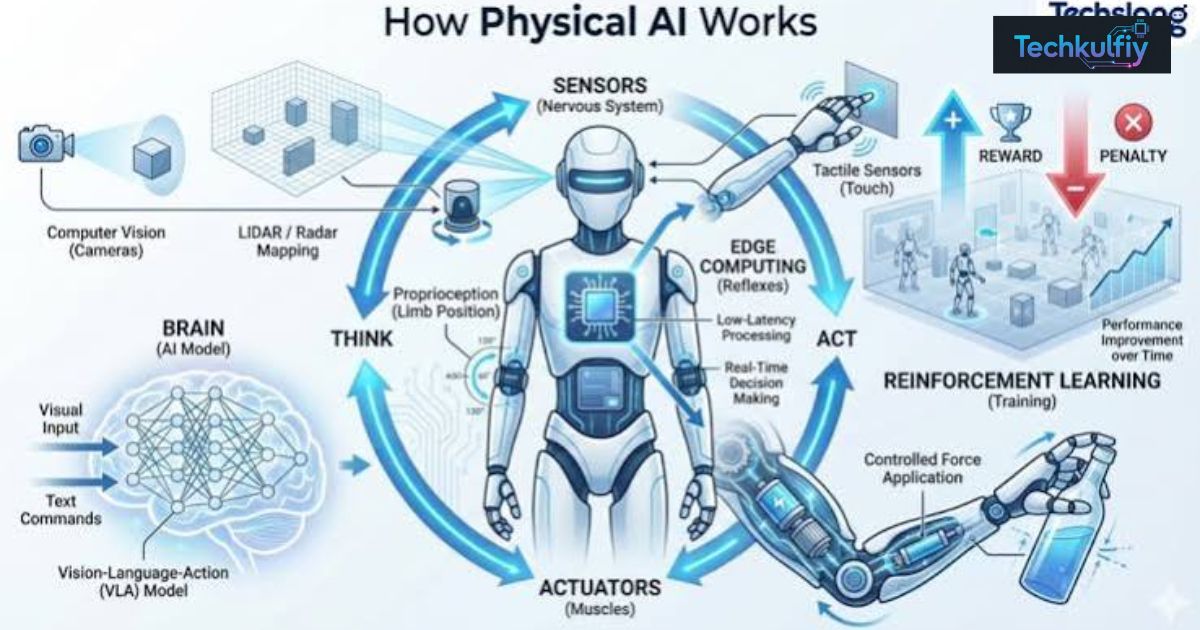
A machine that interacts with the physical world needs to gather information, interpret it, select an action, and carry out that action. It may then examine the result and adjust its next move.
Physical AI commonly depends on several connected technologies.
Computer vision allows a robot to process images from cameras. It can help identify objects, estimate distances, recognize obstacles, and locate items that need handling.
Sensor fusion combines information from cameras, depth sensors, motion sensors, and other hardware. Using multiple sources can help a robot develop a more useful understanding of its surroundings.
Machine learning allows systems to learn patterns from data. Depending on the application, a robot may use trained models to recognize objects, classify situations, or select appropriate responses.
Motion planning helps a robot determine how to move from one position to another while avoiding obstacles. A humanoid robot also needs balance and coordination to avoid falling or colliding with nearby objects.
Feedback control compares the intended action with the machine’s actual state. If a robot’s arm moves differently from the expected path, its controller may adjust the movement.
| Technology | Main role | Example application |
|---|---|---|
| Computer vision | Interprets images and visual scenes | Identifying packages on a conveyor |
| Sensor fusion | Combines information from multiple sensors | Estimating a robot’s position |
| Machine learning | Recognizes patterns and supports decisions | Classifying objects |
| Motion planning | Calculates movement paths | Navigating a warehouse |
| Feedback control | Adjusts actions using measured results | Moving a robotic arm accurately |
| Natural language processing | Interprets human instructions | Understanding a spoken task request |
When these technologies work together, Physical AI can help machines respond to their environment instead of relying entirely on fixed instructions.
Still, the system must recognize uncertainty. When a robot cannot identify an object confidently or encounters a dangerous situation, a safe response may be to stop and ask a human for help.
5. The Biggest Industries That Could Benefit
The potential applications of Physical AI extend well beyond humanoid robots. Many industries already use conventional automation, and AI may help certain machines handle more variable or complex tasks.
Manufacturing and factories
Factories can use robots for material handling, inspection, assembly, and other repetitive processes. AI-enabled systems may help identify defective products or adapt to changes in the position of objects.
The best applications are those with clearly defined tasks, measurable outcomes, and suitable safety controls. Some factories may benefit more from specialized robotic arms than from humanoid machines.
Warehousing and logistics
American warehouses process large quantities of products and packages. Robots can help transport materials, sort items, and move goods between designated locations.
Warehouse automation can improve consistency and reduce some physically demanding activities. However, systems must account for people, forklifts, changing inventory, and objects that do not always appear as expected.
Healthcare and medical facilities
Robots may assist with moving supplies, transporting equipment, cleaning, and other support activities. Certain specialized robotic systems already assist healthcare professionals with specific procedures.
Healthcare environments demand particularly strong safeguards because patients may be vulnerable and mistakes can have serious consequences. Robots should perform only tasks for which they have been appropriately designed and evaluated.
Agriculture
Agricultural robots can support selected activities such as crop monitoring, targeted spraying, harvesting assistance, and inspection. Cameras and sensors may help machines identify plants, estimate crop conditions, or navigate fields.
Outdoor conditions are unpredictable, however. Weather, mud, uneven ground, and changing light can affect performance.
Construction and infrastructure
Robotic systems may assist with surveying, inspection, material movement, and work in hazardous locations. Such applications could help reduce human exposure to certain risks, although construction sites are complex environments that require careful coordination.
Across these sectors, Physical AI offers the greatest potential when the machine’s capabilities fit a genuine operational need.
6. Benefits for American Businesses and Workers
One potential advantage is improved productivity. Robots can repeat suitable tasks consistently and may operate for extended periods when supported by appropriate maintenance and safety procedures.
Workplace safety is another important benefit. A robot may help handle hazardous materials, inspect dangerous equipment, or carry heavy objects in environments where those activities could put workers at risk.
Operational efficiency can improve when automation reduces delays or helps businesses manage repetitive workloads. For example, an intelligent inspection system might flag a possible defect for review rather than requiring an employee to examine every item manually.
Robots may also help businesses manage labor shortages in specific roles. They are not a universal replacement for workers, but they may provide support for tasks that are difficult to staff or physically demanding.
New technologies can create demand for different skills, including robotics maintenance, software integration, equipment testing, and safety evaluation. Workers may benefit from training that helps them operate, supervise, and maintain automated systems.
At the same time, some tasks may be reduced or redesigned. Businesses should consider how automation affects employees, what retraining is available, and how workers can move into new responsibilities.
Physical AI should therefore be evaluated not only by the number of tasks a robot can complete, but also by its impact on employees, safety, service quality, and the broader operation.
7. Challenges: Cost, Safety, Reliability, and Privacy
Despite its potential, Physical AI faces several important challenges.
High implementation costs
A robot’s price may include only part of the total expense. Businesses may also need installation, software integration, workspace modifications, employee training, replacement parts, and ongoing maintenance.
A company should calculate the full operating cost and compare it with the value produced. If a robot frequently stops working or requires constant human intervention, its expected savings may disappear.
Safety in shared environments
Robots operating near people must detect obstacles, manage movement, and respond appropriately to unexpected events. A machine that works safely in a controlled test area may face additional challenges in a busy workplace.
Reliability in unfamiliar situations
Physical environments contain endless variations. Packages may be damaged, objects may move, floors may become slippery, and lighting can change. Robots must be tested against these conditions before being trusted with important tasks.
Cybersecurity
Connected robots may receive software updates, communicate with business systems, or collect operational information. Weak security could expose equipment to unauthorized access or disruption.
Privacy and workplace monitoring
Cameras and other sensors may collect information about workers, customers, or visitors. Businesses should consider what data is necessary, how it is stored, who can access it, and how long it is retained.
Physical AI will become more practical when developers and businesses address these concerns alongside improvements in intelligence and movement.
8. Will Humanoid Robots Replace Human Jobs?
The effect of robots on employment is one of the most debated questions in American technology.
The answer is unlikely to be the same for every occupation. Some jobs include repetitive physical tasks that may be suitable for automation. Others require empathy, complex judgment, communication, adaptability, or responsibility in unpredictable situations.
A warehouse employee, for example, may spend part of the workday moving materials and another part resolving inventory problems. A robot might eventually support the material-handling component without replacing every responsibility associated with the role.
Similarly, a manufacturing worker may move from repetitive manual activities toward equipment supervision, quality control, maintenance, or troubleshooting. These transitions require training and thoughtful workforce planning.
Workforce reskilling can help employees learn new technical and operational skills. Employers can also involve workers in selecting and testing automation tools because they often understand practical problems that may be overlooked during product demonstrations.
There are real risks, too. Certain positions may decline, and new jobs may not appear in the same locations or require the same skills. Policymakers, employers, educational institutions, and workers will need to respond to these changes.
The most useful question is not whether robots will replace every human worker. It is which tasks can be automated, which responsibilities still need people, and how the benefits and costs of automation will be distributed.
9. Physical AI Versus Traditional Industrial Robots
Traditional industrial robots are often programmed for repetitive tasks in structured environments. They can be highly accurate and efficient when the work remains predictable.
Physical AI may allow certain robots to interpret visual information, respond to changing conditions, and handle a wider range of tasks. However, this flexibility can increase complexity and does not automatically make an AI-enabled robot more reliable or economical.
| Feature | Traditional industrial robots | AI-enabled physical robots |
|---|---|---|
| Typical operation | Repeated, programmed movements | May adapt to changing input |
| Environment | Often structured and controlled | May support more variable settings |
| Task flexibility | Usually specialized | Potentially broader, depending on capability |
| Main strengths | Speed, precision, repeatability | Perception, adaptability, task interpretation |
| Main limitations | May need reprogramming for changes | Can make errors and require extensive testing |
| Best use case | Stable, high-volume tasks | Tasks requiring perception or adaptation |
The two approaches can complement each other in Physical AI. A factory may use traditional robotic arms for high-speed assembly and AI-enabled systems for inspection or handling items that vary in shape.
The right choice depends on the task, required accuracy, safety standards, operating costs, and available technical support.
10. How Businesses Can Prepare for Physical AI
Businesses do not need to replace their existing operations all at once. A measured approach can help them identify useful applications without taking unnecessary risks.
First, identify a clear problem. The goal might be to reduce injuries, improve inspection, transport materials more efficiently, or handle a repetitive task.
Second, examine the environment. Robots need sufficient space, reliable connectivity where required, suitable lighting, and safe movement areas. Existing equipment and human workflows may also need adjustments.
Third, test the system on a limited scale. A pilot project can reveal how the robot performs under actual operating conditions and how often human intervention is necessary.
Fourth, measure results. Useful metrics may include task completion time, error rates, downtime, maintenance expenses, safety incidents, and the amount of human supervision required.
Fifth, establish responsibilities. Employees should know who can stop the system, who investigates errors, and who approves changes to its operating permissions.
Finally, prepare workers for the transition. Training should cover equipment operation, safety procedures, reporting problems, and working effectively alongside automated systems.
For companies considering Physical AI, successful adoption depends on combining technical performance with practical planning. A well-chosen system that solves one problem reliably may deliver more value than a costly robot purchased mainly for publicity.
11. What the Future Could Look Like in the United States
The next stage of robotics development may bring closer connections between AI models, sensors, mechanical systems, and enterprise software.
Robots could become better at recognizing unfamiliar objects, following natural-language instructions, and completing several connected tasks. More efficient processors and improved battery technology may also expand the range of practical applications.
AI-powered robotics could help manufacturers inspect products, warehouses move goods, farms monitor crops, and infrastructure teams examine difficult-to-reach locations. Progress will likely vary across industries because every environment has different technical and safety requirements.
Humanoid robots may attract the most public attention, but many valuable applications may involve less human-like machines. Robotic arms, mobile platforms, inspection devices, and specialized equipment can solve practical problems without reproducing the human body.
Physical AI could also become more closely integrated with edge computing, allowing some decisions to happen directly on a machine instead of relying entirely on remote servers. This may improve responsiveness in certain situations, although hardware limitations and cybersecurity remain important.
The technology’s progress should be measured through real-world performance. Important questions include how often machines complete tasks successfully, how much supervision they need, whether they can operate safely around people, and whether their benefits justify their costs.
In the United States, the most meaningful advances will come when robotics companies and their customers turn promising demonstrations into dependable products that meet genuine needs.
Frequently Asked Questions
What is Physical AI in simple words?
Physical AI is artificial intelligence connected to machines that interact with the real world. It helps robots use sensors and software to understand their surroundings, make decisions, and perform physical actions.
What is the difference between Physical AI and generative AI?
Generative AI typically creates or transforms content such as text, images, audio, or code. Physical AI focuses on systems that perceive and act in physical environments. The two can overlap when a generative or reasoning model helps a robot interpret instructions or plan tasks.
Are humanoid robots being used in the United States?
Humanoid robots are being researched, demonstrated, and developed in Physical AI for potential commercial applications. Their actual capabilities and deployment levels vary. A demonstration does not necessarily mean a robot is ready for widespread everyday use.
What are Tesla Optimus and Boston Dynamics Atlas?
Tesla Optimus is Tesla’s humanoid robot project. Atlas is Boston Dynamics’ humanoid robot platform, known for advanced mobility demonstrations. Their capabilities, intended uses, and commercial readiness should be assessed using confirmed product information.
Which industries could benefit most from Physical AI?
In Physical AI Potential applications include manufacturing, logistics, agriculture, infrastructure inspection, and selected healthcare support tasks. The best opportunities depend on whether a robot can perform a clearly defined task safely and cost-effectively.
Will Physical AI eliminate jobs?
Physical AI may automate some tasks and change the responsibilities associated with certain jobs. It can also create demand for maintenance, supervision, programming, and safety-related skills. The overall employment impact will vary by occupation and industry.
Is Physical AI safe?
Safety of Physical AI depends on the machine’s design, testing, operating environment, and safeguards. Businesses should use appropriate risk assessments, emergency stops, access controls, and human supervision for tasks where errors could cause harm.
Why are humanoid robots difficult to develop?
Humanoid robots must balance their bodies, coordinate complex movements, recognize objects, manipulate tools, and respond to unexpected situations. Achieving all these capabilities reliably while keeping costs manageable is a major engineering challenge.
How can a small business use robotics?
A small business could begin by evaluating a specific task such as repetitive material movement, inspection, or packaging. It should compare the full cost of automation with the expected benefits and test the system before making a large investment.
Conclusion
Physical AI represents an important development in the relationship between artificial intelligence and the real world. By connecting intelligent software with sensors, mechanical systems, and robots, developers are working toward machines that can do more than process information. They aim to build systems that can recognize their surroundings, adapt to certain changes, and perform useful physical tasks.
As per Physical AI For American businesses, the opportunities may include improved workplace safety, more consistent operations, and support for repetitive or physically demanding work. Humanoid robots from companies such as Tesla and Boston Dynamics illustrate the direction of research, while specialized robots may provide practical benefits in factories, warehouses, agriculture, and inspection.
However, progress will depend on more than impressive demonstrations. Reliability, safety, cybersecurity, maintenance, implementation costs, and workforce preparation will all influence whether a robot succeeds in a commercial setting. Businesses should begin with clear objectives, conduct limited trials, and measure results before expanding deployment.
The future of Physical AI will not necessarily involve a humanoid robot in every home or workplace. It may instead involve many types of intelligent machines designed for specific tasks. Companies that focus on real problems, responsible implementation, and measurable value will be best positioned to benefit as robotics technology develops in 2026 and beyond.

About the Author
The author at TechKulfiy writes informative articles about technology, software, digital platforms, and IT solutions. The goal is to make complex topics easier to understand by providing clear explanations, practical insights, and helpful information. Each article aims to help readers explore technology topics and make informed decisions.