

SERPInsight Link Insertion is a topic worth exploring for American website owners, SEO professionals, bloggers, and digital marketing agencies looking for ways to manage backlink campaigns. Instead of publishing a completely new guest post, link insertion involves adding a relevant reference to an article that already exists on another website.
For businesses competing in the United States, the right backlink strategy can support brand visibility, referral traffic, and broader search engine optimization efforts. However, buying a link simply because a website has a high authority score can be an expensive mistake.
This guide explains how SERPInsight Link Insertion works, what buyers should examine before ordering a placement, how it differs from guest posting, and which factors matter when evaluating backlinks for American audiences.
What Is SERPInsight Link Insertion?
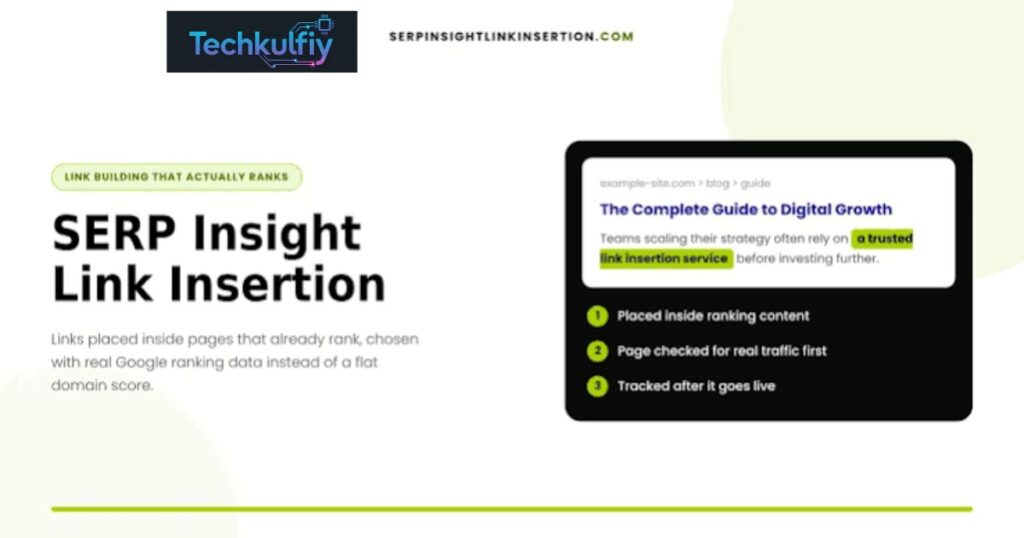
SERPInsight Link Insertion refers to exploring link insertion opportunities through SERPInsight, a marketplace associated with backlink placement services. Link insertion is also commonly called a niche edit, a term used in SEO to describe adding a relevant link to an article that has already been published.
The concept is straightforward. A publisher has an existing article, and another website has a resource that may help readers understand a topic more completely. If the reference is appropriate and the publisher accepts the request, the existing article can be updated to include the link.
For example, imagine a US-based company publishes a detailed guide about small business accounting. A software provider might have a helpful resource explaining how independent contractors organize their expenses. If that resource genuinely supports the article, a contextual link could be useful to readers.
SERPInsight provides a marketplace-style way to discover placement opportunities instead of requiring every buyer to contact publishers individually.
However, there is an important distinction between finding a placement and proving its SEO value. A marketplace listing can provide information about a website, but the buyer must still evaluate its content, relevance, organic visibility, and editorial standards.
SERPInsight Link Insertion is a link-building option, not a guaranteed Google ranking solution. Understanding that difference helps businesses make more informed purchasing decisions.
How Does SERPInsight Link Insertion Work?
The typical process starts with identifying a page that could provide a suitable home for a link. Buyers then review the available placement information, select an appropriate opportunity, and submit the required details.
Finding Relevant Websites
The first step is identifying publishers whose content matches your business or target audience. For an American campaign, this might mean looking for US-focused technology blogs, business publications, marketing websites, or industry-specific resources.
SERPInsight advertises publisher discovery and filtering features that help users compare available opportunities. Depending on the listing, useful information may include niche, country, estimated traffic, authority metrics, and price.
These details can narrow the search, but they should not replace manual research. A website that covers business topics in general may not be the best choice for a specialist cybersecurity company.
Reviewing Existing Articles
Once you find a suitable publisher, examine the individual page where the link could appear.
Look at the article’s subject, writing quality, freshness, and relevance to your target page. A page about email deliverability may be suitable for a resource about email authentication, while an unrelated entertainment article would usually provide a weaker contextual match.
Also examine whether the article appears useful to real readers. Pages created mainly to sell links, filled with unrelated outbound links, or written with little editorial care deserve extra scrutiny.
Selecting the Placement
After researching the publisher and its content, compare the listing’s terms. Review the cost, delivery estimate, placement requirements, and any protection policy that applies.
Provide the correct destination URL and explain the context in which your resource would help readers. If anchor text is requested, choose wording that accurately describes the linked page rather than forcing an unnatural exact-match keyword into the article.
Checking the Published Link
Once the order is completed, open the live article and verify the result.
Make sure the link points to the intended destination, works correctly, and appears in the agreed location. Check that the surrounding text makes sense and that the page is accessible.
It is also worth reviewing whether the link uses a sponsored or other qualifying attribute. Paid placements should follow Google’s link spam policies rather than being treated as automatically eligible to pass ranking credit.
Why Are American Businesses Interested in Link Insertion?
The US digital market is highly competitive across industries such as software, finance, e-commerce, healthcare, education, and professional services. Businesses often need more than published content alone to build visibility and establish relationships with relevant audiences.
Contextual backlinks can connect readers with useful resources while helping websites build relationships with other publications.
For example, a US-based marketing agency might publish research about customer acquisition costs. A relevant article on another marketing website could reference that research when discussing advertising budgets.
Such a placement may help interested readers discover the agency’s work. If visitors follow the link, it can also generate referral traffic.
Another potential benefit is brand exposure. Being mentioned in a relevant publication can introduce a company to people who have not previously encountered its website.
However, these benefits depend on the actual publisher and audience. A link on a page that nobody visits may provide little referral traffic, even if the website displays impressive authority metrics.
For US businesses, the strongest selection criteria include topical relevance, genuine audience value, and a clear reason for readers to visit the linked resource.
SERPInsight Link Insertion vs. Guest Posting
Guest posting and link insertion are both used in link-building campaigns, but they involve different content processes.
With guest posting, a contributor creates a new article for an external publication. With link insertion, a publisher updates existing content to include a relevant reference.
| Comparison factor | Link insertion | Guest posting |
|---|---|---|
| Content format | Existing article | New article |
| Content creation | Usually no new full article is required | A new article is generally required |
| Main research task | Evaluate the existing page | Evaluate the publisher and article opportunity |
| Potential advantage | Uses an established, relevant page | Provides room for a fresh, useful contribution |
| Time requirements | Depends on review and publisher approval | Includes writing, review, and publication |
| Main risk | Irrelevant or manipulative placement | Low-quality or overly promotional content |
| Best starting point | A relevant existing article | A valuable new topic for the publication |
Neither method is automatically better.
A link insertion may be convenient when a suitable article already exists. Guest posting may be more appropriate when you have original research, specialist knowledge, or a useful explanation that deserves a new article.
The deciding factor should be the quality and relevance of the opportunity, not simply the name of the service.
How to Evaluate a SERPInsight Link Insertion Opportunity
Before buying a placement, evaluate the website and the individual page separately. A domain-level score alone does not tell you whether a particular backlink is worthwhile.
Check Topical Relevance
Topical relevance should be one of your first considerations.
If your website publishes cybersecurity advice, a link from an established technology or security publication may make more sense than a link from an unrelated general-interest website.
The same principle applies to American businesses serving specific industries. A local accounting firm, for example, may benefit more from being mentioned in relevant business resources than in a publication that attracts an unrelated audience.
Ask yourself whether the link would make sense if search engines did not exist. If the answer is yes because the resource genuinely helps readers, the placement has a clearer editorial purpose.
Review Organic Search Visibility
Third-party SEO tools can estimate how much traffic a website receives from search engines and which keywords it ranks for.
These estimates can help you investigate a publisher, but they are not verified visitor counts. Compare trends, ranking keywords, and the apparent relevance of its traffic instead of relying on one headline number.
A website with a high authority score but almost no relevant search visibility may be less useful for your campaign than a smaller specialist publication with a clearly engaged audience.
Understand Domain Rating and Domain Authority
Domain Rating (DR) is an Ahrefs metric, while Domain Authority (DA) is a Moz metric. They are not Google ranking scores.
Some link marketplaces display these metrics because they make it easier to compare websites. Nevertheless, a high score does not guarantee that a page will generate referral visits or improve your search performance.
Look at the whole picture: relevance, organic visibility, content quality, outbound linking patterns, and the page where the link will appear.
Inspect the Existing Article
An individual article can reveal more than a website’s homepage.
Check whether it covers the subject properly, contains useful information, and has a logical place for your resource. Look at its publication date and whether the information remains accurate.
If the page is filled with promotional links to unrelated businesses, reconsider the opportunity. A link should support the article’s purpose rather than appear as an obvious commercial insertion.
Check the Publisher’s Audience
For campaigns targeting the United States, investigate whether the publisher attracts readers who match your intended market.
A website’s domain extension does not prove that its audience is American. Likewise, a website hosted in another country can still have a substantial US readership.
Use available audience estimates and content signals to assess geographic fit. If verified analytics are unavailable, treat audience claims as estimates rather than confirmed facts.
How Much Does SERPInsight Link Insertion Cost?
The cost of SERPInsight Link Insertion depends on the selected publisher and the terms of the specific listing. There is no universal price that applies to every website.
Factors that may influence a placement’s price include the publisher’s niche, audience, perceived authority, traffic estimates, content requirements, and editorial workload.
A specialist publication with an established readership may charge more than a small general-interest website. However, a higher price does not necessarily mean a better placement.
For American businesses, the sensible approach is to compare the cost with the likely value of the opportunity.
Consider the relevance of the article, the potential for referral traffic, the publisher’s editorial standards, and whether the linked resource genuinely benefits readers.
It is also important to calculate the full cost of a campaign. Purchasing several placements can become expensive, especially if the business continues ordering links without evaluating their results.
Before paying, review the current listing and the marketplace’s applicable policies. Confirm what the price includes, whether the publisher must approve the link, and which conditions apply if the placement is not delivered as expected.
Avoid choosing an opportunity solely because it is cheap. The purpose of research is to identify a suitable placement, not simply the lowest available price.
Does SERPInsight Link Insertion Help Google Rankings?
Link insertion may be part of a broader backlink strategy, but buying a placement does not guarantee higher Google rankings.
Search engines use numerous signals to understand web pages and their relationships. Links can provide useful context, but their value depends on factors such as relevance, quality, and how they were obtained.
Google’s spam policies specifically address link schemes designed to manipulate search rankings. Buying or selling links for ranking purposes can create policy risks when those links are intended to pass ranking credit in violation of the guidelines.
Paid placements should be appropriately qualified, such as with the rel="sponsored" attribute where applicable. A marketplace order should not be assumed to provide an unrestricted SEO benefit.
This is particularly important for US businesses that depend on organic search for leads, sales, or customer acquisition. A short-term focus on acquiring more backlinks should not come at the expense of long-term website quality.
A sustainable SEO strategy includes useful content, technical improvements, clear site architecture, a good user experience, and legitimate ways of earning relevant references.
SERPInsight can help organize placement purchases, but it cannot replace these fundamentals or promise a particular ranking outcome.
Common SERPInsight Link Insertion Mistakes to Avoid
One common mistake is choosing websites based only on DR or DA. These metrics can help with initial screening, but they do not prove that a publisher is relevant or trustworthy.
Another mistake is using the same exact-match anchor text repeatedly. Natural language and descriptive links are generally more appropriate than forcing commercial keywords into unrelated sentences.
A third mistake is ignoring the quality of the destination page. If your website contains outdated information, confusing navigation, or an unhelpful article, sending visitors to that page may not support your business goals.
Buyers should also avoid assuming that every published link will remain available permanently. Publishers can change their content, update their websites, or remove pages. Review the applicable protection policy without treating it as a lifetime guarantee.
Finally, do not judge success by the number of purchased links alone. Track meaningful indicators such as referral visits, relevant engagement, brand mentions, and the performance of the pages you are trying to promote.
SERPInsight Link Insertion for SEO Agencies and Freelancers
SEO agencies often manage multiple clients, each with different target audiences, budgets, and content requirements. A centralized marketplace can make publisher research and order management easier to organize.
Freelancers may also find a structured purchasing workflow useful when they need to compare placement options without conducting every negotiation manually.
For agencies serving American companies, however, each campaign should begin with a clear objective.
A B2B software company may need exposure in specialist technology publications. An online retailer may prioritize relevant product guides, while a professional service provider may benefit from resources that reach a specific business audience.
The publisher should fit the client’s market rather than merely satisfy a numerical authority target.
Agencies should also document the selected publisher, destination URL, anchor text, placement date, cost, and verification status. This makes campaign reporting more transparent and helps clients understand what was purchased.
Most importantly, explain the difference between acquiring a placement and achieving an SEO result. No marketplace can guarantee that a purchased link will increase rankings or generate a particular amount of traffic.
SERPInsight Link Insertion Alternatives
SERPInsight is one possible route for discovering placements, but it is not the only way to approach link building.
Manual blogger outreach involves researching relevant websites and contacting editors or website owners directly. It can take more time, but it allows you to build relationships and propose genuinely useful content.
Digital public relations focuses on creating stories, original research, expert commentary, and resources that publishers may want to reference. This approach can support brand awareness as well as editorial links.
Guest posting allows you to contribute a new article to an appropriate publication. It works best when the content offers meaningful information instead of serving only as a vehicle for a backlink.
Linkable content includes original statistics, detailed guides, useful tools, and research that other writers may naturally reference.
For small businesses in the United States, these options can be combined according to budget and available resources. The best choice is the one that supports the business’s actual audience and long-term objectives.
Frequently Asked Questions
What is SERPInsight Link Insertion?
SERPInsight Link Insertion refers to finding link insertion opportunities through the SERPInsight marketplace. Link insertion involves adding a relevant link to an existing article on another website.
Is SERPInsight Link Insertion the same as a guest post?
No. A guest post involves publishing a new article, while link insertion adds a reference to an article that already exists.
Is SERPInsight Link Insertion worth it for US businesses?
It depends on the publisher, audience relevance, cost, and campaign objective. Businesses should evaluate individual placements carefully instead of assuming every listing offers the same value.
Can link insertion increase website traffic?
A relevant placement may send referral visitors to your website. The amount of traffic depends on the article’s audience, visibility, and the usefulness of the linked resource.
Does SERPInsight guarantee better Google rankings?
No. A placement does not guarantee a ranking improvement. Search performance depends on multiple factors, and paid links intended to manipulate rankings may violate Google’s spam policies.
How do I check a publisher before ordering?
Review its topical relevance, organic visibility, content quality, outbound links, audience, listing terms, and the specific article where your link may appear.
Is a high Domain Rating enough to choose a website?
No. Domain Rating is an Ahrefs metric, not a Google ranking score. It should be considered alongside relevance, page quality, and other available evidence.
Is link insertion better than guest posting?
Neither is always better. Link insertion can suit an existing relevant article, while guest posting provides an opportunity to contribute fresh content.
Should paid backlinks use a sponsored attribute?
Paid links should be qualified in accordance with Google’s link spam policies. The rel="sponsored" attribute is the recommended option for identifying paid links.
Can beginners use SERPInsight?
Beginners can research the marketplace, but they should understand backlink quality, search engine policies, and publisher evaluation before spending money.
Conclusion
SERPInsight Link Insertion offers a marketplace-based approach to discovering existing articles where a relevant link might be placed. For website owners, SEO freelancers, and digital marketing agencies, this can make publisher research and order management more organized.
Its usefulness depends on the quality of the individual opportunity. A relevant article with genuine readers may offer more practical value than a website selected only for a high authority score. Buyers should examine organic visibility, editorial standards, audience fit, placement terms, and the usefulness of the destination page before ordering.
For businesses targeting the United States, geographic and topical relevance deserve particular attention. A publisher should connect with the intended audience and provide a natural reason for readers to explore the linked resource.
It is equally important to understand the limitations. SERPInsight cannot guarantee rankings, permanent links, or a particular level of referral traffic. Paid links must also be handled in accordance with Google’s spam policies.
Ultimately, the strongest approach is to use careful research, relevant content, and realistic expectations when evaluating SERPInsight Link Insertion. A marketplace can simplify the process of finding opportunities, but long-term SEO success still depends on building a useful website that deserves attention from readers and publishers alike.

Noor ul Ain is a tech enthusiast and the founder of Techkulfiy. She loves exploring Artificial Intelligence (AI) and future tech, breaking down complex trends into simple, engaging updates for her readers.