


Multimodal AI is becoming an important part of the technology industry in the United States in 2026. Unlike systems that work mainly with text, this technology can process different types of information, including images, audio, video, and written instructions. It is creating new opportunities for American businesses, students, content creators, developers, and professionals who want to use artificial intelligence for more complex tasks.
The growing development of AI reasoning models, advanced AI chips, and on-device AI is helping expand what modern AI systems can do. People can use AI to analyze pictures, summarize recordings, understand documents, and interact through voice. Technology companies are also working to make these systems faster, more efficient, and easier to integrate into everyday applications. However, accuracy, privacy, computing costs, and hardware limitations remain important challenges.
For American users, understanding Multimodal AI can help them identify useful applications and make better technology decisions. From AI-powered productivity tools and computer vision to edge computing and natural language processing, these developments may influence education, healthcare, entertainment, and business operations. The future will depend not only on more powerful models but also on how safely, efficiently, and responsibly companies make them available.
1. Why Multimodal AI Is Becoming a Major US Technology Trend
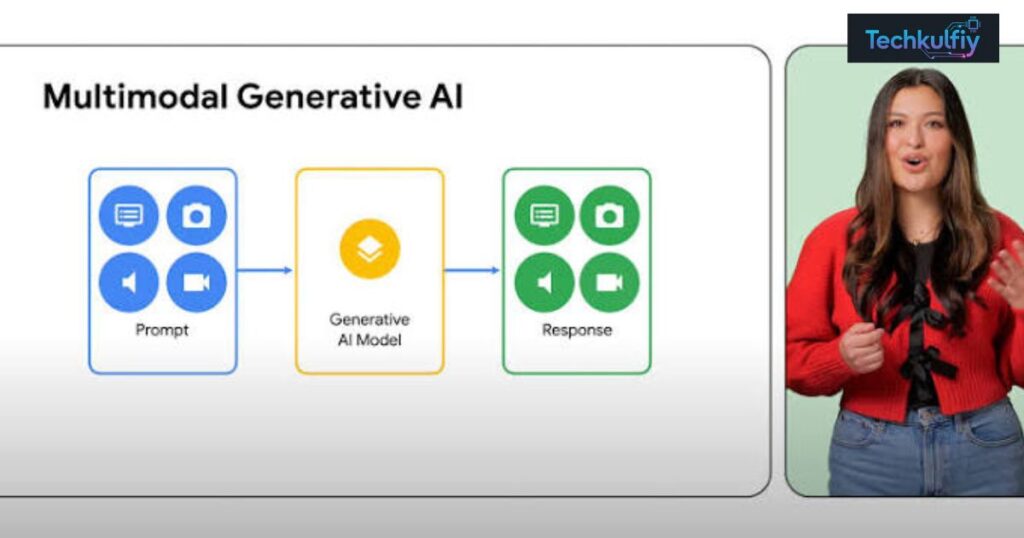
American technology companies are investing in AI systems that can handle a broader range of everyday tasks. Businesses increasingly want tools that can understand information in the form employees already use rather than requiring everything to be converted into text first.
Multimodal AI supports this shift by allowing applications to work with different kinds of input. A marketing team, for example, may need to analyze product photographs, customer feedback, recorded interviews, and written reports. A suitable AI system could help organize these materials and produce a useful summary.
Another important factor is the growing availability of generative AI tools. These applications can create or transform content, including text, images, audio, and, in some cases, video. When multiple capabilities are combined, users can complete more parts of a creative workflow within a single application.
The rise of AI-powered productivity tools is also changing expectations in the workplace. Employees want technology that can help them understand documents, search information, communicate with colleagues, and manage repetitive tasks.
Education is another area of interest. Students may use AI to discuss difficult concepts, analyze diagrams, practice languages, or receive explanations in different formats. Teachers may explore tools for preparing learning materials, although accuracy and academic integrity remain important.
The benefits are not automatic. AI systems may misunderstand images, misinterpret speech, or invent details that are not present in the source material. Organizations must therefore evaluate their tools before using them for important decisions.
For many US businesses, the value of Multimodal AI comes from connecting information that previously required separate tools and manual effort. The strongest applications are likely to be those that save time while maintaining dependable results.
2. How Multimodal AI Understands Text, Images, Audio, and Video
Different forms of information require different processing techniques. Written language contains words and sentence structures, images contain visual patterns, audio includes sound and speech, and video combines visual frames with changes over time.
Computer vision helps AI systems identify objects, interpret scenes, and analyze visual information. It can support tasks such as reading a chart, identifying a product, or describing the contents of an image.
Natural language processing helps systems interpret written language, recognize relationships between words, and generate responses. It is useful when a person asks a question about a document or requests an explanation of visual content.
Speech recognition converts spoken language into information a computer can process. Related audio technologies may identify speakers, interpret spoken instructions, or generate synthetic speech.
Video analysis adds another layer of complexity. A system may need to understand what appears in a scene, how objects move, what people say, and how events relate to one another.
Many systems use multimodal models to connect these information types. Depending on their design, they may convert different inputs into internal representations that can be processed together. This helps the model relate a spoken question to a photograph or connect a video scene with a written instruction.
Consider an American retailer reviewing a short product demonstration. An AI system might summarize the spoken explanation, describe visible features, and help draft a product description. A human employee would still need to check important specifications and ensure that the final description is accurate.
The ability to combine inputs is useful, but it does not guarantee perfect understanding. Poor lighting, background noise, unclear images, unfamiliar accents, and missing context can all affect results.
3. Advanced AI Chips: The Hardware Behind Modern AI
Powerful AI applications depend on hardware capable of performing large numbers of mathematical operations efficiently. As models become more capable, computing performance, memory capacity, power consumption, and heat management become increasingly important.
AI chips are processors designed or optimized for workloads associated with artificial intelligence. These may include graphics processing units (GPUs), specialized accelerators, and processors that combine several computing functions.
GPUs are widely used for AI development and deployment because they can perform many operations in parallel. Other specialized processors may be designed to improve performance or efficiency for particular tasks.
Companies such as NVIDIA, AMD, Apple, and other semiconductor developers compete across different parts of the computing market. Their products serve different purposes, so comparing processors requires looking at actual workloads, software compatibility, memory, energy consumption, and cost.
AI hardware acceleration can make certain applications faster by assigning demanding calculations to processors designed for them. This can be important for image analysis, speech processing, model training, and real-time AI interactions.
Memory also matters. A processor may be powerful, but a system with insufficient memory could struggle to run a large model or handle high-resolution visual input. Efficient software and model design can help reduce these limitations.
Another priority is energy-efficient computing. Businesses want hardware that delivers useful performance without excessive electricity consumption or cooling requirements. Efficiency is especially important for large data centers and devices that run on batteries.
As Multimodal AI applications process larger images, longer recordings, and more complex combinations of information, hardware design will influence how quickly and affordably those tasks can be completed.
4. On-Device AI and Edge Computing
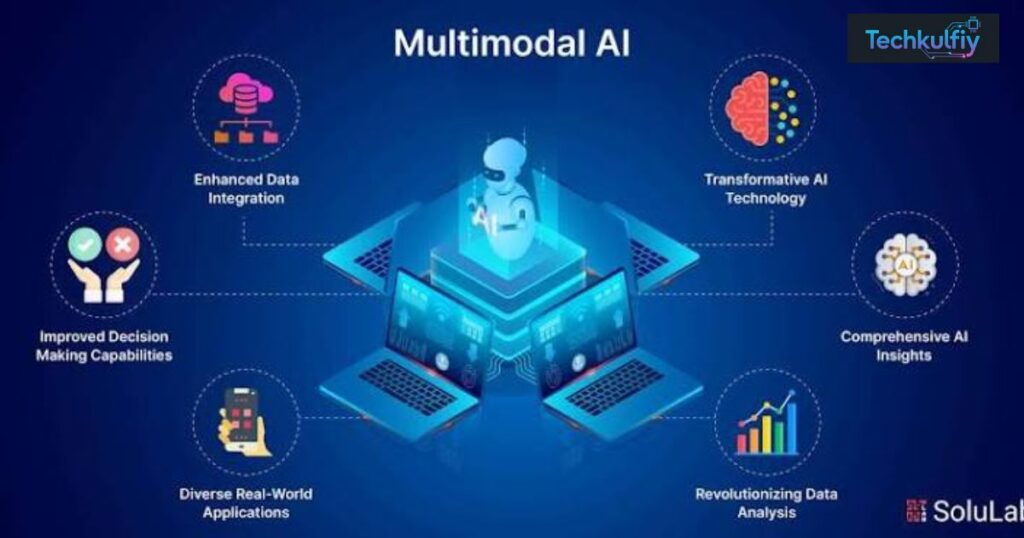
Not all AI processing needs to happen in a remote data center. Some tasks can run directly on a smartphone, laptop, camera, or other connected device.
On-device AI refers to AI processing that takes place locally on a device. Depending on the model and hardware, this may allow applications to respond quickly and reduce the need to send certain information to external servers.
For example, a smartphone may use local AI features to improve photographs, recognize voice commands, or summarize supported content. A laptop may run a smaller language model for selected tasks without relying entirely on a cloud service.
Edge computing is a broader approach that processes data closer to where it is generated. This can be useful in factories, retail stores, vehicles, and other settings where low latency or reliable local operation is important.
There are several potential advantages. Local processing can reduce network delays, support certain privacy-sensitive workflows, and allow some features to work when internet connectivity is limited.
However, devices have physical limits. A phone cannot necessarily run the same large model as a powerful server. Battery life, memory, heat, and storage all affect what is practical.
Some applications use a hybrid AI architecture, dividing work between a local device and cloud services. A smaller task may run locally, while a more demanding request is sent to a remote model when connectivity and privacy rules permit.
Users should understand which information stays on their device and which information may be sent to a provider. Privacy depends on the actual application and its settings, not simply on the presence of an AI feature.
5. How US Businesses Can Use Multimodal AI
Businesses often manage information in many formats. They receive emails, documents, photographs, recordings, videos, spreadsheets, and customer inquiries. Reviewing all these materials manually can consume substantial time.
Multimodal AI can help organize and interpret supported information, allowing employees to focus on tasks that require judgment, communication, and decision-making.
Retail and e-commerce
Retailers may use AI to describe product photographs, categorize inventory, summarize customer feedback, or help shoppers find products using images and written questions.
These applications can improve product discovery, but companies must verify descriptions, prices, compatibility details, and other facts before publishing them.
Marketing and advertising
Marketing teams can use generative AI tools to brainstorm campaign ideas, create draft copy, review images, and summarize audience research. A team may combine written campaign goals with product photographs to generate content concepts.
Human review remains important because AI-generated marketing can include inaccurate claims, inconsistent branding, or misleading visual details.
Customer service
Customer support teams may use AI to interpret written messages, summarize voice conversations, and help employees find relevant information. Some systems can connect several input types, such as a customer’s screenshot and a written complaint.
Organizations must protect customer information and ensure that automated responses do not promise refunds, warranties, or services that the business cannot provide.
Manufacturing
Factories can use computer vision systems to inspect products and identify visible defects. Audio or sensor information may also help monitor equipment conditions.
The performance of these systems depends on the quality of the data, the production environment, and the consequences of missing a defect.
Education and training
Companies can use AI to develop training materials, summarize instructional videos, and explain diagrams. Employees may benefit from receiving information in formats that suit different learning needs.
Across these industries, successful adoption requires clear goals, accurate inputs, privacy safeguards, and a reliable process for reviewing results.
6. Multimodal AI in Healthcare and Education
Healthcare and education are two areas where different forms of information play an important role. Both sectors could benefit from AI systems that help organize complex material, but both require careful oversight.
In healthcare, professionals work with clinical notes, medical images, laboratory results, and patient conversations. Certain AI applications may help organize documentation or support the review of information within an approved workflow.
Medical image analysis is one established area of AI research and application. Depending on the system, AI may help identify patterns in selected images or highlight areas for a qualified professional to examine. Performance varies, and a tool should only be used for an appropriate, validated purpose.
AI may also assist with medical education by explaining terminology, summarizing approved learning materials, or helping students understand diagrams. It should not be treated as a substitute for professional medical judgment or emergency care.
In education, students may use visual explanations, audio conversations, and text summaries to explore a topic from different angles. Teachers may use AI to draft quizzes, organize course materials, or develop examples suited to different skill levels.
However, AI can produce incorrect explanations or make mistakes when interpreting a diagram. Students should compare important information with reliable learning resources, while teachers should check generated materials before using them in class.
Accessible technology is another opportunity. Voice interaction, image descriptions, captions, and speech-to-text features can make some digital tasks easier for people with different needs.
Both healthcare and education must consider data privacy, consent, fairness, and accuracy. Sensitive records should not be uploaded to unapproved services, and organizations should clearly explain how AI is used.
7. The Role of AI Reasoning Models
AI systems are increasingly designed to handle complex instructions rather than simply generate short answers. These systems may break problems into steps, compare possible approaches, use tools, or check intermediate results.
AI reasoning models are intended to improve performance on tasks that benefit from structured analysis. Their usefulness varies by model and task, and their output still requires verification.
For example, a business analyst might provide a spreadsheet, a chart, and a written question. A capable system could help interpret the chart, summarize the data, and draft a report. However, the analyst should verify calculations and check whether the available data actually supports the conclusions.
Combining reasoning with visual and audio inputs creates additional opportunities. A system may interpret a diagram, relate it to written instructions, and explain the result in natural language.
Yet more complex input can also introduce more ways for an AI system to make mistakes. A model might overlook a detail in an image, misunderstand a sentence, or produce a conclusion that is not supported by the evidence.
Organizations should test AI model performance using realistic examples from their own work. They should also establish clear rules for when an AI system may take action and when a human must review its output.
The most useful AI assistant is not necessarily the one that produces the longest or most confident answer. It is the one that handles the required task accurately, explains uncertainty when appropriate, and fits the user’s workflow.
8. Challenges: Accuracy, Privacy, Cost, and Security
Despite its benefits, Multimodal AI comes with practical risks that businesses and consumers should understand.
Accuracy and hallucinations
An AI system may describe an image incorrectly, misinterpret a recording, or invent details that do not appear in the source. Users should verify important information, especially when it affects money, health, legal decisions, or safety.
Privacy and sensitive data
Images, recordings, and videos may contain faces, addresses, personal conversations, confidential documents, or customer details. Uploading this material without authorization can create privacy and compliance problems.
Cybersecurity
AI applications that connect to files, databases, or business systems may introduce additional security risks. Companies should use appropriate access controls, review integrations, and avoid granting unnecessary permissions.
Computing costs
Processing high-resolution images, long videos, and large audio files may require substantial computing resources. Businesses should evaluate usage limits, subscription costs, latency, and the expense of integrating AI into existing systems.
Bias and unequal performance
AI systems may perform differently across languages, accents, lighting conditions, image quality, or user populations. Testing should reflect the people and environments where the system will actually be used.
Copyright and ownership
AI-generated images, audio, and other material may raise questions about ownership, licensing, and the use of existing creative works. Businesses should check the relevant terms and legal requirements before using generated content commercially.
These challenges do not eliminate the value of AI. They demonstrate why careful evaluation and responsible deployment matter.
9. Multimodal AI Compared With Text-Only AI
Text-only AI can be highly effective for writing, summarization, and language-based tasks. Systems that support multiple modalities may be more useful when the question involves visual, audio, or video information.
| Feature | Text-only AI | Multimodal AI |
|---|---|---|
| Main input | Written text | Text and other supported data types |
| Image understanding | Usually unavailable unless connected to a visual tool | Available in systems that support images |
| Audio interaction | May require a separate tool | Can be integrated in supported systems |
| Video analysis | Usually requires additional processing | Available in some systems |
| Common applications | Writing, summaries, text analysis | Visual analysis, voice interaction, media workflows |
| Computing requirements | Depend on model and task | May increase with complex or high-resolution inputs |
| Main limitation | Limited access to non-text information | Accuracy and capability vary by modality |
The choice depends on the task. If a user only needs help polishing a paragraph, a text-focused model may be sufficient. If the task involves understanding a video, a diagram, and written instructions together, a system with appropriate multimodal capabilities may be more useful.
10. How to Choose the Right Multimodal AI Tool
American consumers and businesses have access to a growing range of AI applications. Choosing the right one requires more than looking at popularity or promotional demonstrations.
First, define the task. Decide whether you need image analysis, voice interaction, video summarization, document processing, or a combination of capabilities.
Second, check the supported inputs and outputs. A tool that accepts images may not support long videos or real-time audio. Confirm the current product capabilities before paying for a subscription.
Third, evaluate accuracy. Test the tool using realistic examples and compare its results with information you can independently verify.
Fourth, review privacy and security settings. Understand how uploaded content is processed, whether data may be retained, and what controls are available for business information.
Fifth, compare cost and performance. Consider subscription fees, usage limits, response speed, hardware requirements, and the time required to correct mistakes.
Finally, consider accessibility and ease of use. A powerful model may not be the best choice if it is difficult for your team to use or does not fit your existing workflow.
For many users, the best approach is to test a small number of suitable tools before making a long-term commitment.
11. What Is Next for Multimodal AI in the USA?
The next phase of AI development may bring more natural voice interactions, improved image understanding, better video analysis, and stronger connections between models and everyday applications.
Developers are also working on smaller AI models that can run efficiently on local devices. These models may support faster responses and selected offline capabilities, although they will not necessarily match the performance of the largest cloud-based systems.
Progress in AI hardware acceleration could improve the speed and efficiency of certain workloads. Better memory systems, more efficient processors, and improved software may help developers support increasingly demanding applications.
Businesses may also combine multimodal systems with AI agents that use approved tools to complete connected tasks. For example, an assistant might interpret a document, analyze a related image, prepare a summary, and draft an email for human approval.
These capabilities will require careful testing because a system that combines multiple tools and information types can make mistakes at several stages.
Responsible AI development will remain important. Companies need to explain limitations, protect sensitive information, test for bias, and give users appropriate control over automated actions.
The future is unlikely to be determined by model size alone. Performance, affordability, privacy, accessibility, and usefulness will influence which applications become part of everyday life.
Frequently Asked Questions
What is Multimodal AI in simple words?
Multimodal AI is artificial intelligence that can work with different kinds of information, such as text, images, audio, and video. It can help users analyze or combine these inputs when the selected model supports them.
How is multimodal AI different from generative AI?
Generative AI creates or transforms content. Multimodal AI describes the ability to process multiple kinds of information. A system can be both generative and multimodal when it understands and produces different content types.
Which companies are developing multimodal AI?
Several technology companies, including OpenAI, Google, Meta, and other AI developers, work on models and products with multimodal capabilities. Available features differ by product, model, region, and subscription.
Do advanced AI chips make AI faster?
They can improve performance for supported workloads. Actual speed depends on the processor, memory, model size, software optimization, and task complexity.
Can multimodal AI run without the internet?
Some AI features can run locally on compatible devices, but others require cloud processing. Offline capability depends on the specific application, model, and hardware.
Is multimodal AI safe for personal information?
Safety depends on the service and its data practices. Users should review privacy settings and avoid uploading sensitive personal or business information to unapproved tools.
How can businesses use multimodal AI?
Businesses may use it to analyze product images, summarize recordings, review supported documents, assist customers, and create content drafts. Important results should be checked before they are used.
Will multimodal AI replace human workers?
It may automate certain tasks and change existing workflows, but its effects will vary across industries. Human judgment, communication, accountability, and oversight remain important.
Why does multimodal AI need powerful hardware?
Images, audio, and video can contain large amounts of information. Processing them may require additional memory and computation, particularly when inputs are high-resolution or lengthy.
Conclusion
Multimodal AI is expanding the ways people and businesses interact with artificial intelligence. By connecting text, images, audio, and video, these systems can support tasks that once required several separate tools. American businesses may use them to improve customer service, analyze visual information, develop content, and organize complex workflows.
Advanced processors, on-device AI, and edge computing are also influencing where AI tasks can run and how efficiently they can be completed. Meanwhile, AI reasoning models may help users manage more complicated requests, although their results still require appropriate verification.
The technology also introduces important responsibilities. Accuracy, privacy, cybersecurity, cost, and fairness should be considered before AI becomes part of an essential business process. Users should check outputs, protect sensitive information, and select tools that fit their actual needs.
For the United States, the most important development will not simply be the arrival of more powerful models. It will be the ability to apply AI in practical, accessible, and responsible ways. Businesses and individuals who understand both the opportunities and the limitations will be better prepared to benefit from this technology in 2026 and beyond.

About the Author
The author at TechKulfiy writes informative articles about technology, software, digital platforms, and IT solutions. The goal is to make complex topics easier to understand by providing clear explanations, practical insights, and helpful information. Each article aims to help readers explore technology topics and make informed decisions.