

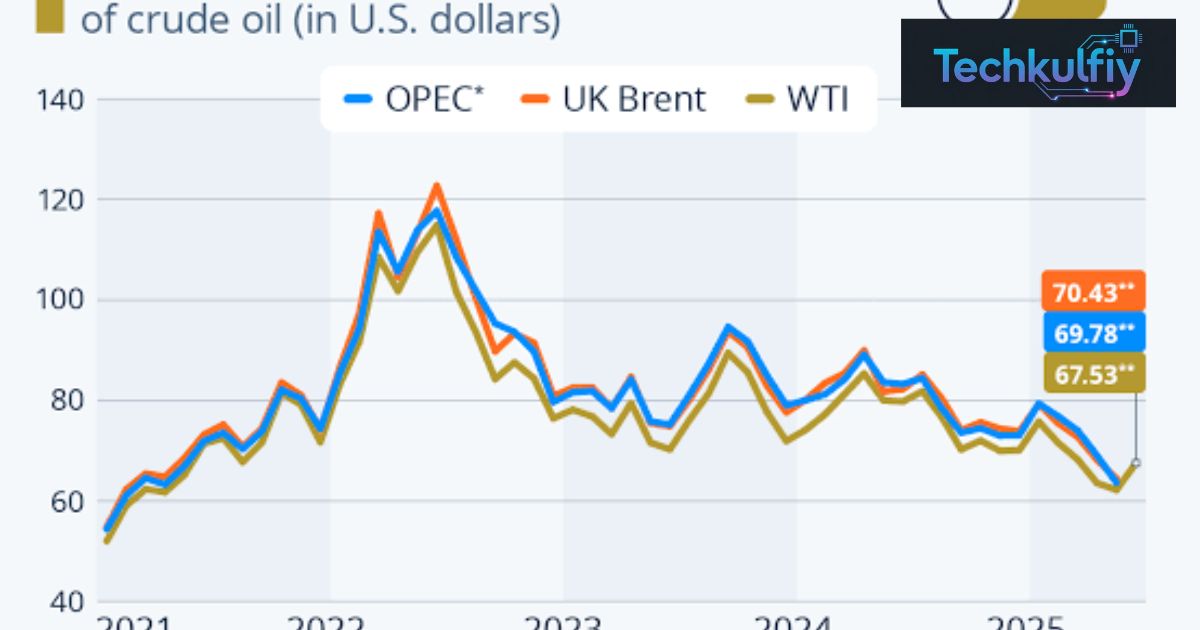
Oil prices refer to the amount paid for crude oil in global markets. They can change based on supply, demand, and market conditions. WTI and Brent are two major oil price benchmarks.
Oil prices can move quickly and affect many parts of daily life. A sudden change can impact fuel costs, transportation, and businesses. That’s why tracking oil prices can be important for many people.
Oil prices also influence the global energy market and economy. Factors like production, inventories, and world events can cause prices to rise or fall. Understanding these changes helps explain today’s oil market.
What Are Oil Prices and How Are They Determined?

Oil prices are the market prices buyers pay for crude petroleum, usually quoted as the oil price per barrel in U.S. dollars. One standard oil barrel contains 42 U.S. gallons. However, there isn’t one single price for every barrel of crude. Different grades have different qualities, locations, transportation costs, and sulfur levels. As a result, benchmarks such as West Texas Intermediate, commonly known as WTI, and Brent crude provide reference prices for large parts of the market.
The crude oil market works like a huge global auction. Producers want to sell their barrels at attractive prices while refiners and other buyers want reliable supplies at reasonable costs. When available supply is tight, buyers may compete more aggressively for crude. When production and inventories are plentiful, sellers may need to accept lower prices. The U.S. Energy Information Administration describes crude markets as a global auction where price changes help balance available supply with demand. ([EIA][2])
A major part of this process happens through both physical transactions and financial markets. A spot transaction involves crude delivered for near-term use, while oil futures represent contracts for delivery at a future date. Producers can use futures to manage price risk. Commercial buyers can use them to plan future costs. Other market participants trade futures based on their expectations about future oil price changes. This makes the futures market an important source of price signals.
The relationship between supply and demand sounds simple, but the oil market has one unusual feature: both sides can be slow to react. A producer can’t instantly build a new oil field because prices suddenly rise. Likewise, a driver can’t immediately replace a gasoline-powered vehicle when fuel prices increase. The EIA notes that this limited short-term responsiveness can require substantial price changes to bring the market back into balance. ([EIA][2])
| Term | Meaning | Why It Matters |
|---|---|---|
| WTI | West Texas Intermediate crude benchmark | Important for U.S. oil pricing |
| Brent | International crude benchmark | Widely used for global pricing |
| Spot price | Price for near-term physical delivery | Shows current market conditions |
| Futures price | Price agreed for future delivery | Reflects expectations and risk |
| Barrel | Standard unit of crude oil | Used to quote crude prices |
| Inventory | Stored crude and petroleum products | Helps balance supply and demand |
Current Oil Prices: WTI and Brent Crude
The oil price today can move throughout the trading session, which means a price displayed in the morning may not be the same price shown later. For that reason, readers checking the crude oil price today should always look at the timestamp, contract month, benchmark, and whether the displayed number represents a spot or futures price.
As of September 30, 2026, Reuters reported Brent crude at roughly $103 per barrel and WTI near $90 per barrel during early trading. The market was responding to stalled U.S.-Iran negotiations, continuing concerns about supply, and tight fuel conditions. ([Reuters][1]) The previous day provided a useful contrast. On September 29, Brent settled at $102.59 while WTI settled at $89.38 after signs of recovering Middle Eastern exports eased some supply concerns. ([Reuters][3])
This daily movement is important because daily oil prices don’t always tell the same story as the wider trend. A market can fall on Tuesday and still post a strong monthly gain. That’s exactly why analysts examine daily, weekly, monthly, and yearly changes together.
WTI crude oil is particularly important for the United States. It is a light, relatively low-sulfur crude that has historically served as a key U.S. benchmark. Brent crude oil, meanwhile, has a broader international role and is used to price many crude streams around the world.
The difference between the two benchmarks is known as the Brent-WTI spread. That spread can change because of regional production, pipeline capacity, exports, shipping costs, refinery demand, inventories, and geopolitical developments. On September 30, Reuters reported that the gap between Brent and WTI had widened to a four-month high amid speculation about possible U.S. diesel-export restrictions and different regional supply conditions. ([Reuters][1])
A useful way to read the market is to ask three questions: What is the current oil price? What has it done recently? And what fundamental event caused the movement? The third question often matters more than the first.
Why Are Oil Prices Rising or Falling?
An oil price rise usually means traders see tighter supply, stronger demand, greater geopolitical risk, or some combination of those factors. An oil price decline can signal improving supply, weaker demand, growing inventories, lower geopolitical risk, or expectations that future production will be stronger.
The September 2026 market provides a clear example. On September 29, oil prices fell about 2.5% as signs of recovering Middle Eastern exports reduced some fears about supply shortages. Brent dropped to $102.59 while WTI fell to $89.38. ([Reuters][3]) One day later, prices moved higher again after uncertainty around U.S.-Iran talks returned to the spotlight. ([Reuters][1])
That quick reversal illustrates an important point: the oil market is forward-looking. Traders don’t wait until every barrel disappears before adjusting prices. If they believe an important supply route could be disrupted tomorrow, they may change prices today.
Inventories are another major clue. If companies add large amounts of crude to storage, the market may interpret that as a sign that supply is exceeding immediate demand. If inventories fall sharply, traders may see evidence that available supply is becoming tighter. The EIA describes petroleum inventories as a physical buffer between supply and demand and an important signal for oil prices. ([EIA][4])
Economic expectations matter too. Stronger economic activity can increase fuel consumption because factories produce more, trucks transport more products, airlines carry more passengers, and consumers travel more. A major economic slowdown can reverse that process.
| Market condition | Typical price pressure |
|---|---|
| Stronger global demand | Upward |
| Major supply disruption | Upward |
| Falling inventories | Upward |
| Higher OPEC+ production | Potentially downward |
| Weak economic growth | Downward |
| Rising inventories | Downward |
| Recovering exports | Potentially downward |
| Lower geopolitical risk | Potentially downward |
These relationships aren’t mechanical rules. Oil prices can respond differently depending on what traders have already priced into the market.
Key Factors That Affect Crude Oil Prices
The biggest forces behind crude oil prices are production, consumption, inventories, refinery activity, transportation, weather, geopolitics, financial conditions, and expectations. None operates in isolation.
Supply is the first piece. More available crude generally reduces scarcity. Less available crude can increase competition among buyers. However, the market also cares about where that crude is located. Ten million barrels sitting in the wrong place won’t necessarily solve a shortage somewhere else.
Demand is equally important. Gasoline, diesel, jet fuel, petrochemicals, and other petroleum products all depend on crude oil. The U.S. transportation system remains heavily dependent on petroleum products, which means changes in economic activity can quickly affect energy consumption. ([EIA][2])
Inventories provide the bridge between the two. Companies can store crude and refined products when supply exceeds current consumption. They can draw those stocks when consumption exceeds current production. ([EIA][4])
Refineries also matter. Crude isn’t usually the final product consumers buy. Refineries transform crude into products such as gasoline, diesel, jet fuel, and heating oil. A refinery outage can therefore create a strange situation in which crude demand weakens while fuel prices increase because product supply becomes tighter.
Transportation is another overlooked factor. Pipelines, ports, storage terminals, rail networks, and tankers connect producers with consumers. When one link fails, crude may be available but difficult or expensive to move.
Weather can cause similar problems. Hurricanes can disrupt U.S. Gulf Coast oil production and refinery operations. Severe winter weather can increase demand for heating oil and place additional pressure on fuel supplies. The EIA identifies hurricanes, severe cold, refinery outages, and pipeline problems among events that can disrupt petroleum markets. ([EIA][2])
Financial conditions add another layer. The U.S. dollar matters because crude is generally priced in dollars. Changes in interest rates, currency values, economic expectations, and investor positioning can influence commodity prices and energy commodities.
Oil Supply, Demand and Global Production
Oil supply and demand form the foundation of the entire market. When production exceeds consumption for a sustained period, inventories can build. When consumption exceeds production, inventories can fall. Prices help push the system toward a new balance.
The United States has become especially important to global supply. American production, particularly from shale regions, gives the country a large role in international energy markets. Higher prices can make additional drilling more attractive, although new production doesn’t appear instantly.
Global demand is spread across transportation, manufacturing, petrochemicals, aviation, agriculture, shipping, and other sectors. A growing economy generally needs more energy. The EIA notes that economic growth is one of the biggest factors affecting petroleum demand. ([EIA][2])
A useful case study is the difference between immediate and delayed responses. Imagine crude prices jump because global supply suddenly falls. Consumers still need to drive to work tomorrow. Trucks still need diesel. Airlines still need jet fuel. Factories still need energy. Demand therefore doesn’t immediately collapse. Producers also can’t instantly create new fields. The market may need a large price movement before enough changes occur.
Case Study: Why Inventories Matter
Suppose U.S. refineries suddenly need more crude while production stays unchanged. Buyers can initially obtain additional barrels by drawing crude from storage. That prevents the physical shortage from becoming severe immediately. If inventories continue falling, however, traders may become increasingly concerned about future availability.
The EIA explains that inventory levels influence both current and future prices. When futures prices rise relative to current prices, companies may have greater incentive to store oil. When current supply becomes unexpectedly tight, spot prices can rise relative to future contracts. ([EIA][4])
This is why an inventory report can sometimes move oil prices even when there has been no new oil field discovery or production shutdown.
OPEC+ and Its Impact on Oil Prices
OPEC and OPEC+ remain central to discussions about global oil production. OPEC consists of major oil-producing countries, while OPEC+ includes additional non-OPEC producers that cooperate on market management.
The group can influence expectations by adjusting production targets. If the market expects lower production, traders may anticipate tighter supply. If the group signals higher output, the market may expect additional barrels.
However, OPEC+ doesn’t simply control one global oil price. Actual market influence depends on compliance with production targets, spare capacity, demand, and the response of producers outside the group. The EIA specifically identifies compliance, consumer responsiveness, non-OPEC competition, and production efficiency as factors that affect OPEC’s ability to influence prices. ([EIA][2])
Current developments make this especially relevant. Reuters reported on September 30 that seven OPEC+ countries were expected to keep November production targets steady at their upcoming meeting. Reuters also reported that August production was around 25 million barrels per day, still significantly below pre-war February levels. ([Reuters][5])
That doesn’t automatically tell us where prices will go. Instead, it gives the market another important piece of information about future supply.
| OPEC+ action | What traders may consider |
|---|---|
| Production cut | Tighter future supply |
| Production increase | More available crude |
| Target maintained | Existing supply outlook continues |
| Weak compliance | Actual supply may differ from target |
| Strong spare capacity | Greater ability to respond to disruption |
The key is to watch actual production as well as official announcements. A headline about a production target is only part of the story.
Geopolitical Events and Their Effect on Oil Prices
Geopolitics can move global oil prices because much of the world’s petroleum trade depends on a limited number of major producing regions and shipping routes. A conflict doesn’t need to destroy an oil field to affect prices. If traders fear that tankers, pipelines, ports, or export routes could be disrupted, they may immediately price in additional risk.
The Strait of Hormuz is one of the clearest examples. It is a crucial energy shipping route connecting Persian Gulf producers with international buyers. Disruptions can force traders to reconsider how quickly crude and petroleum products can reach the global market.
September 2026 demonstrated this sensitivity. Oil prices moved sharply as traders assessed attacks, shipping disruptions, Middle Eastern exports, and U.S.-Iran diplomatic developments. Reuters reported on September 28 that Brent futures moved above $105 amid renewed concerns about disruption through the Strait of Hormuz. ([Reuters][6])
Yet the market didn’t move in one direction every day. On September 29, signs of recovering Middle Eastern exports helped push prices lower. ([Reuters][3]) On September 30, renewed uncertainty over U.S.-Iran talks helped push them higher again. ([Reuters][1])
“Oil markets are essentially a global auction.” — U.S. Energy Information Administration ([EIA][2])
The idea is simple. If buyers fear fewer barrels will reach the market, they may be willing to pay more for the barrels that remain available.
Case Study: Middle East Supply Risk in 2026
The 2026 disruption also shows why international oil prices can remain volatile even after some exports recover. Reuters reported that Gulf oil exports had rebounded toward 2025 average levels by September 30, while product shortages and high freight costs were still keeping parts of the market tight. ([Reuters][1])
This creates a useful lesson for anyone following the petroleum market: restoring production isn’t necessarily enough. Transportation, refining, inventories, insurance, shipping costs, and regional fuel availability can continue affecting prices after crude begins flowing again.
Oil Prices and the Global Economy
Changes in energy prices can spread through the economy because petroleum is connected to transportation and production. For Americans, the most visible effect is usually at the gas station. But the economic impact reaches much further.
Higher crude prices can increase the cost of producing gasoline and diesel. Trucking companies may spend more on fuel. Airlines can face higher jet-fuel costs. Farmers can face higher expenses for diesel-powered machinery. Manufacturers and retailers may pay more to transport goods.
This creates a chain reaction. A truck carrying food doesn’t care whether crude oil is $70 or $100. It still needs diesel. The difference appears in the company’s operating costs.
Higher fuel costs can also contribute to inflation. If businesses pass higher transportation and energy costs to customers, prices for goods and services may rise. At the same time, oil-producing companies and regions can benefit from higher revenues.
The U.S. Strategic Petroleum Reserve can also become relevant during major disruptions. On September 29, 2026, Reuters reported that the U.S. announced a loan of up to 40 million barrels from the SPR as part of a broader international reserve release following the Iran conflict. ([Reuters][7])
The economic effects can therefore move in different directions depending on who you are.
| Area | Higher oil prices can mean |
|---|---|
| U.S. drivers | Higher gasoline costs |
| Trucking | Higher diesel expenses |
| Airlines | Higher fuel costs |
| Manufacturers | Higher energy and transport costs |
| Oil producers | Potentially higher revenue |
| Oil-importing economies | Higher import bills |
| Inflation | Additional upward pressure |
| Energy companies | Potentially stronger cash flows |
Oil prices can also influence currencies and financial markets. Reuters reported on September 30 that high crude prices and rising bond yields were creating pressure for some emerging-market currencies while increasing inflation concerns. ([Reuters][8])
For the U.S., the relationship with the Federal Reserve can become important when energy costs contribute to inflation. Higher inflation can affect expectations for interest rates, while interest-rate expectations can influence economic growth and financial markets.
Oil Price Forecast and Future Outlook
An oil prices forecast isn’t a promise about tomorrow’s price. It is an estimate based on assumptions about supply, demand, production, inventories, geopolitics, economic growth, and other variables. Change one major assumption and the forecast can change.
The oil price prediction for the next few months can therefore look very different from a long-term outlook. Short-term forecasts focus heavily on inventories, disruptions, refinery conditions, shipping, and current production. Long-term forecasts place greater weight on investment, global economic growth, technological change, efficiency, electric vehicles, and energy-transition trends.
The September 2026 EIA outlook provides a useful example of why forecasts must be updated. The agency said global inventories had fallen sharply because of continued disruptions and expected oil prices to remain elevated until global flows normalized and inventories could rebuild. Its September outlook projected Brent crude averaging around $90 per barrel in the second half of 2026 under its stated assumptions. ([EIA][9])
Actual market prices at the end of September were above that forecast level, showing how quickly conditions can change. Reuters reported Brent above $103 on September 30. ([Reuters][1]) That difference doesn’t necessarily mean one source was simply “wrong.” Forecasts depend on assumptions, while market prices continuously incorporate new information.
For anyone tracking oil price trends, the most useful approach is to watch the assumptions behind a forecast. If global production rises faster than expected, prices may face downward pressure. If inventories fall faster than expected, prices may move higher. If geopolitical tensions ease, a risk premium can disappear. If a major shipping route remains disrupted, the opposite can happen.
The long-term outlook also depends on changes in transportation and energy use. Electric vehicles can reduce gasoline demand over time. Better fuel efficiency can lower consumption. Renewable electricity can reduce petroleum use in some sectors, although oil remains deeply connected to transportation, petrochemicals, aviation, and other parts of the global economy.
A forecast is therefore better viewed as a map of possible conditions rather than a guaranteed destination.
Frequently Asked Questions About Oil Prices
What is the oil price today?
The oil price today depends on the benchmark, contract, and exact time of the quote. On September 30, 2026, Reuters reported Brent around $103 per barrel and WTI around $90 during early trading. ([Reuters][1]) Prices can change throughout the session.
What is the current WTI crude oil price?
The WTI crude oil price is the market value of West Texas Intermediate crude. WTI is one of the most important U.S. benchmarks. Its price can change because of U.S. production, inventories, exports, refinery demand, global conditions, and futures-market expectations.
What is the current Brent crude oil price?
The Brent crude oil price is a major international benchmark. It reflects conditions in the global oil market and is widely used as a reference for internationally traded crude.
Why are oil prices rising?
An oil price rise can occur when supply becomes tighter, demand strengthens, inventories fall, geopolitical risks increase, or traders expect future shortages. Several of these factors can occur at the same time.
Why are oil prices falling?
An oil price decline can happen when production increases, exports recover, demand weakens, inventories rise, or geopolitical risks decrease. Expectations often matter as much as current physical supply.
What is the difference between WTI and Brent?
WTI is a major U.S. benchmark associated with West Texas Intermediate crude. Brent is a widely used international benchmark. Their prices can differ because of regional supply, transportation, quality, inventories, and market conditions.
How does OPEC+ affect oil prices?
OPEC+ can influence the market through production targets and supply decisions. Its impact depends on actual production, compliance, global demand, spare capacity, and output from non-OPEC producers.
How do oil prices affect U.S. gasoline prices?
Crude oil is a major input for gasoline. When crude prices rise, fuel prices often face upward pressure. However, refining costs, taxes, transportation, seasonal demand, and local market conditions also affect the final price drivers see at gas stations.
What is the oil price forecast for 2026?
There isn’t one universally accepted forecast. The EIA’s September 2026 outlook projected Brent at around $90 per barrel on average during the second half of 2026 under its assumptions, while actual late-September market prices were above $100. ([EIA][9]) This difference highlights the uncertainty surrounding an oil price forecast.
What factors should you watch when following oil prices?
Watch production, demand, inventories, OPEC+, refinery activity, shipping routes, geopolitical developments, economic growth, the U.S. dollar, and oil futures. Together, these indicators provide a much clearer picture than any single headline.
Conclusion: Understanding Oil Prices and Future Trends
Oil prices are much more than a number displayed beside WTI or Brent on a financial website. They reflect a constantly changing balance between supply, demand, production, inventories, transportation, financial expectations, and geopolitical risk.
For U.S. readers, WTI crude oil deserves close attention because it provides an important domestic benchmark, while Brent crude oil offers a broader view of international oil prices. Watching both can help explain why the U.S. market and the wider global market sometimes move differently.
The September 2026 market is a strong example of that complexity. Recovering Middle Eastern exports pushed prices lower on September 29, while renewed uncertainty over U.S.-Iran talks helped lift prices again on September 30. ([Reuters][3]) Meanwhile, OPEC+ production decisions, U.S. strategic reserves, inventories, and global demand continue to shape the outlook.
The smartest way to follow oil market trends is to look beyond today’s headline. Check the crude oil prices, understand the supply-demand balance, watch inventories, follow OPEC+, and examine the assumptions behind every oil price forecast. Oil markets can change direction quickly, but the underlying forces leave clues.
META DESCRIPTION
Explore oil prices, crude oil trends, WTI and Brent rates, key market factors, supply, demand, and global energy updates.

About the Author
The author at TechKulfiy writes informative articles about technology, software, digital platforms, and IT solutions. The goal is to make complex topics easier to understand by providing clear explanations, practical insights, and helpful information. Each article aims to help readers explore technology topics and make informed decisions.